Is Hume Band the Best Wearable Device? Everything to Know
Is Hume Band the Best Wearable Device? – (🔥Smart Health Tracking!). Explore Hume Band features, health insights, benefits, and how it compares to other wearables.
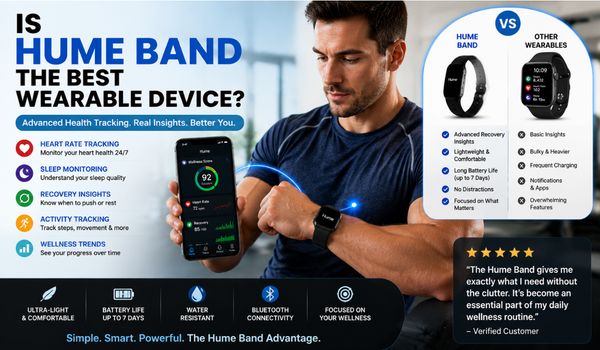
Wearable health technology has changed the way people think about fitness, sleep, recovery, and everyday wellness.
Instead of relying only on occasional checkups or how they feel day-to-day, people can now use wearable devices to collect data on their activity and physiological patterns over time.
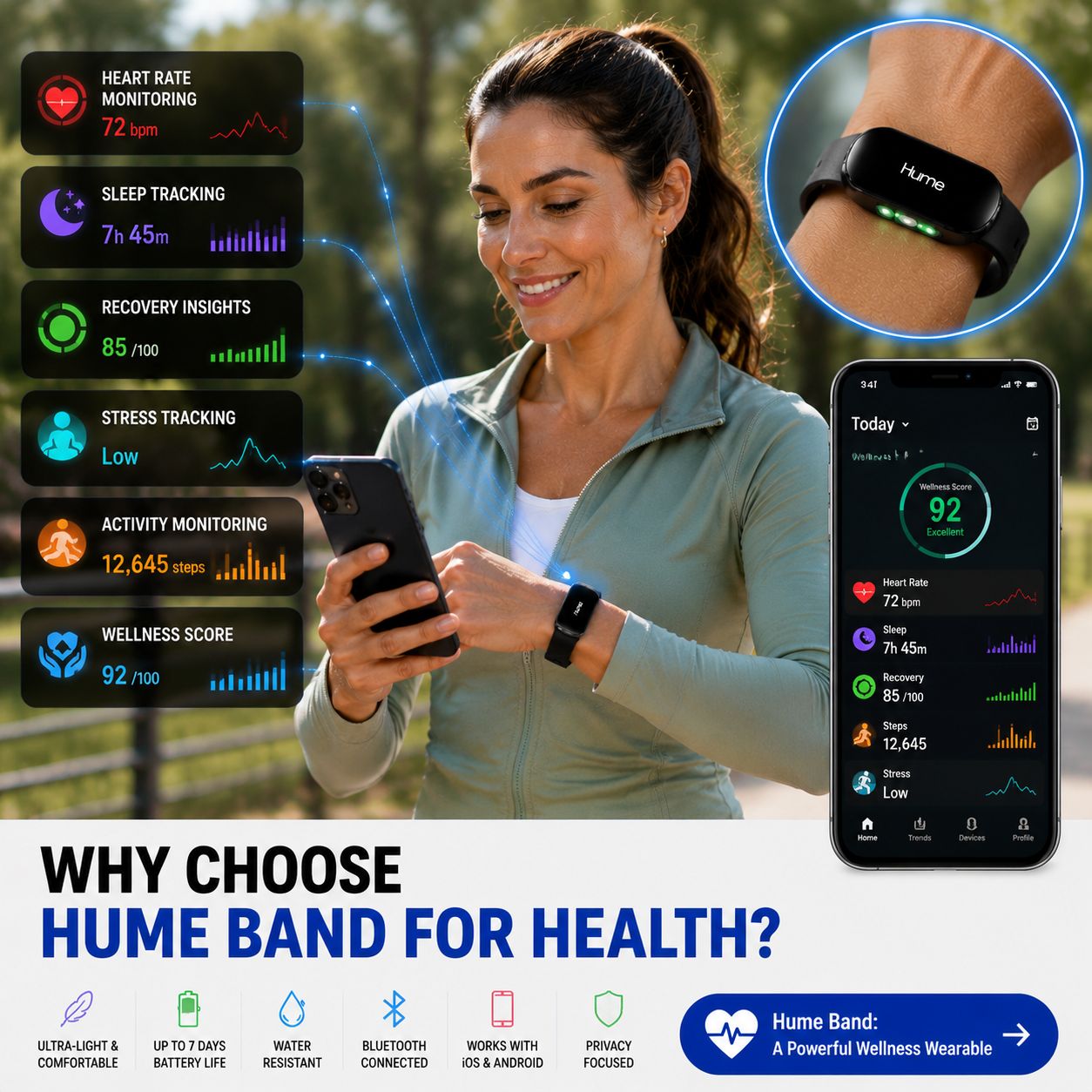
The current Hume Band 2.0 is designed for continuous wear and includes features such as heart rate, heart rate variability (HRV), blood oxygen, skin temperature, sleep stages, activity, strain, recovery, and wellness insights. Hume also highlights metrics such as Metabolic Momentum and Pace of Aging.
This guide takes a closer look at what the Hume Band offers, how it compares to other wearable categories, who may benefit from it, and whether it deserves to be considered one of the best wearable devices available.
What Is the Hume Band?
The Hume Band is a screenless wearable health tracker developed by Hume Health. Instead of displaying notifications, messages, apps, or fitness statistics directly on your wrist, the Band collects data that is then interpreted through the Hume Health smartphone app.
The company’s current Band 2.0 uses optical sensors to collect physiological signals and is designed to operate continuously, day and night. Hume says the device uses five LEDs and four photodiodes for its optical sensing system.
A smartwatch encourages you to interact with your wrist. You can look at the screen, read a notification, answer a call, check the weather, control music, or start a workout.
You wear it and largely forget about it. Then, when you want to understand your health patterns, you open the app.
That can be particularly attractive to people who want health information without another screen demanding their attention throughout the day.
What Does the Hume Band Track?
One of the biggest reasons people consider the Hume Band is its range of health-related measurements.
According to Hume, Band 2.0 tracks or provides insights related to:
- Heart rate
- Heart rate variability (HRV)
- Resting heart rate
- Blood oxygen (SpO2)
- Skin temperature
- Sleep stages
- Sleep quality
- Activity and movement
- Steps and distance
- Calories
- Strain
- Recovery
- Blood-pressure trends
- Pace of Aging
- Metabolic Momentum
- Metabolic Capacity
Hume emphasizes that several of these measurements are intended to help users understand patterns rather than provide medical diagnoses. For example, its blood-pressure feature is presented as a trend insight rather than a replacement for a traditional blood-pressure cuff.
A consumer wearable can be useful for understanding personal trends, but it should not automatically be treated as a medical diagnostic device.
Is Hume Band the Best Wearable Device?
Hume Band is a promising wearable for people who want to focus on health, recovery, sleep, stress, and everyday wellness.
Traditional smartwatches are designed with a more health-focused approach and a lightweight, minimalist form.
- Tracks key health and wellness metrics throughout the day.
- Monitors sleep patterns and supports better recovery insights.
- Provides personalized wellness data through the Hume Health app.
- Lightweight design makes it comfortable for everyday wear.
- Offers health-focused features beyond basic activity tracking.
The Hume Health app helps users review their health data, track trends, and better understand changes in their daily habits.
Overall, Hume Band is a strong choice for health-conscious users, but it’s important to compare its features, accuracy, subscription requirements, and overall value with other wearables before buying.
Hume Band and Sleep Tracking
Sleep is one of the areas where a wearable can provide useful long-term information.
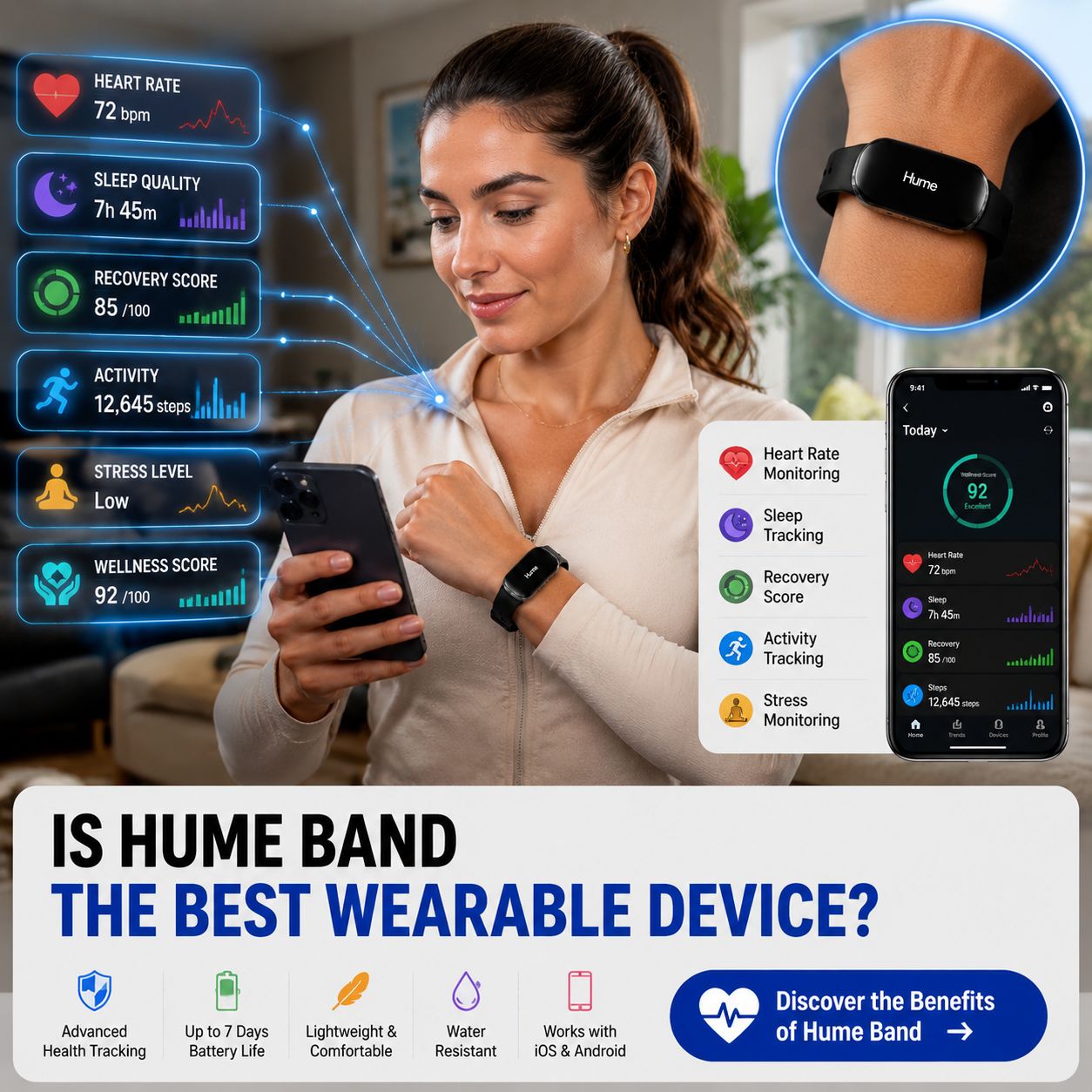
The Hume Band is designed to be worn overnight and to track sleep data such as duration and sleep stages.
Hume says Band 2.0 tracks light, deep, REM, and awake stages and combines overnight information with metrics such as HRV and resting heart rate.
Independent testing has also found the Hume Band’s sleep-duration results reasonably comparable to Apple Watch, although the reviewer noted differences in sleep-stage measurements and weaker detection of nighttime awakenings.
The value isn’t necessarily that the device’s ability to identify every second of every sleep stage. Instead, repeated measurements can help users recognize patterns.
For example, you may notice that:
- You sleep less after late-night work.
- Your recovery score changes after poor sleep.
- Your HRV tends to be different after workouts.
- Your sleep quality changes when your daily routine changes.
- Consistent sleep habits correspond with wellness trends.
Looking at outcomes over weeks can be more useful than obsessing over one night’s score.
Recovery Tracking: One of Hume Band’s Main Strengths
Recovery is another major focus of the Hume Band.
Traditional fitness tracking often emphasizes what you did: steps taken, distance traveled, calories burned, or minutes exercised. Recovery tracking asks a different question:
How well is your body responding to what you are doing?
The Hume Band uses information such as HRV, resting heart rate, and sleep to provide recovery-related insights.
Hume describes its recovery score as a directional measure intended to help users decide whether to push harder or take it easier. This can be useful for people who exercise regularly.
Imagine two mornings:
- On Monday, you sleep well and wake up feeling refreshed.
- On Tuesday, you sleep poorly after a stressful day and complete a hard workout late at night.
- Your training plan might look identical on paper, but your body’s response may not be identical.
- A recovery-focused wearable can help make that difference more visible.
However, recovery scores should not replace common sense. If you feel exhausted, sick, dizzy, or unusually weak, you shouldn’t ignore those symptoms simply because a wearable gives you a favorable score.
Hume Band vs. Other Health Trackers
The Hume Band also competes with screenless health and recovery trackers, including products from brands such as WHOOP and Oura.
Recent independent comparisons have described Hume Band 2.0, WHOOP 5.0, and Oura Ring 5 as devices with different approaches to health and recovery tracking rather than identical products.
The Hume Band’s major selling point is its focus on long-term wellness combined with a screenless design.
Hume also emphasizes a no-subscription approach for core Band functionality, although its current product pages distinguish between the free core app experience and optional premium features such as AI-powered coaching.
The initial purchase price is only one part of the cost. Subscription requirements, replacement accessories, charging equipment, and premium app features can affect the long-term value of a wearable.
Battery Life and Everyday Convenience
Battery life is often overlooked when people compare wearable devices. A health tracker is most useful when you actually wear it. If you frequently remove a wearable to charge it, you can create gaps in your sleep and recovery data.
Hume says the Band 2.0 can provide up to 14 days of battery life on a single charge, although real-world battery performance can vary based on use and conditions.
An independent wearable review of an earlier Hume Band reported substantially shorter real-world battery life, with the reviewer charging it approximately every 2.5 to 3 days, despite the model’s longer advertised battery life.
This is a useful reminder to distinguish between advertised specifications and independent testing.
The current Band 2.0 is a different product generation, so older battery tests should not automatically be applied to the newer model.
Still, anyone buying a wearable should look at both manufacturer specifications and independent reviews.
Comfort and Screenless Design
Comfort is especially important for a device designed to be worn while sleeping.
The Hume Band’s screenless design means there is no display constantly lighting up on your wrist. Hume describes the current Band 2.0 as lightweight, breathable, and designed for 24/7 wear.
For some people, this can be a significant advantage. A smartwatch can be useful during the day but feels bulky at night. A screenless band may be easier to forget about.
The trade-off is that you cannot simply look at your wrist to see your health data. You have to use the app.
That is either a disadvantage or an advantage depending on how you like to use technology. If you want fewer interruptions, the lack of a screen may be refreshing. If you want instant information while exercising, a smartwatch may be more convenient.
Water Resistance and Daily Wear
Hume states that the Band 2.0 is IP68 dustproof and water-resistant to depths of approximately 1 meter for up to two hours under its specified conditions.
This supports everyday use, but users should always follow the manufacturer’s care and water-resistance guidance. Water resistance is not necessarily the same thing as being suitable for every aquatic activity.
Before wearing any electronic wearable in a pool, shower, sauna, or open water, check the current manufacturer’s instructions for your specific model.
Is the Hume Band Accurate?
Accuracy is one of the most important questions to ask before buying any health wearable.
Hume says its sensor system uses five LEDs and four photodiodes, and that its measurements have been validated through laboratory studies and third-party testing.
However, consumers should be cautious about interpreting wearable measurements as exact medical readings.
Optical wearable sensors estimate physiological information from signals detected at the skin. Different devices can produce different readings, and results can vary based on fit, movement, skin contact, activity, and other conditions.
Even sleep tracking should be understood as an estimate rather than a clinical sleep study.
Recent discussion around consumer wearables has highlighted a broader issue: many wearable devices infer sleep stages and other physiological states using indirect signals, such as movement and heart rate, rather than directly measuring brain activity.
Therefore, the most sensible way to use the Hume Band is to focus on consistent trends rather than treating every number as a definitive measurement.
Hume Band Health Insights
The Hume Health app is an important part of the overall experience. The Band collects data, but the app is where users can view and interpret that information.
Hume says its app provides core metrics, including Metabolic Capacity, Metabolic Momentum, Health Score, and other wellness information. Premium membership can add personalized AI-powered coaching and feedback.
This approach is different from simply giving users a list of numbers. For many people, a long list of heart rate, sleep, activity, and HRV measurements can become overwhelming.
A good wellness platform should help users understand what the information may mean in context. Still, users should maintain a healthy degree of skepticism about automated recommendations.
AI-generated wellness advice can be useful for general guidance, but it should not replace a qualified healthcare professional when you have symptoms, concerns, or a medical condition.
What Makes Hume Band Different?
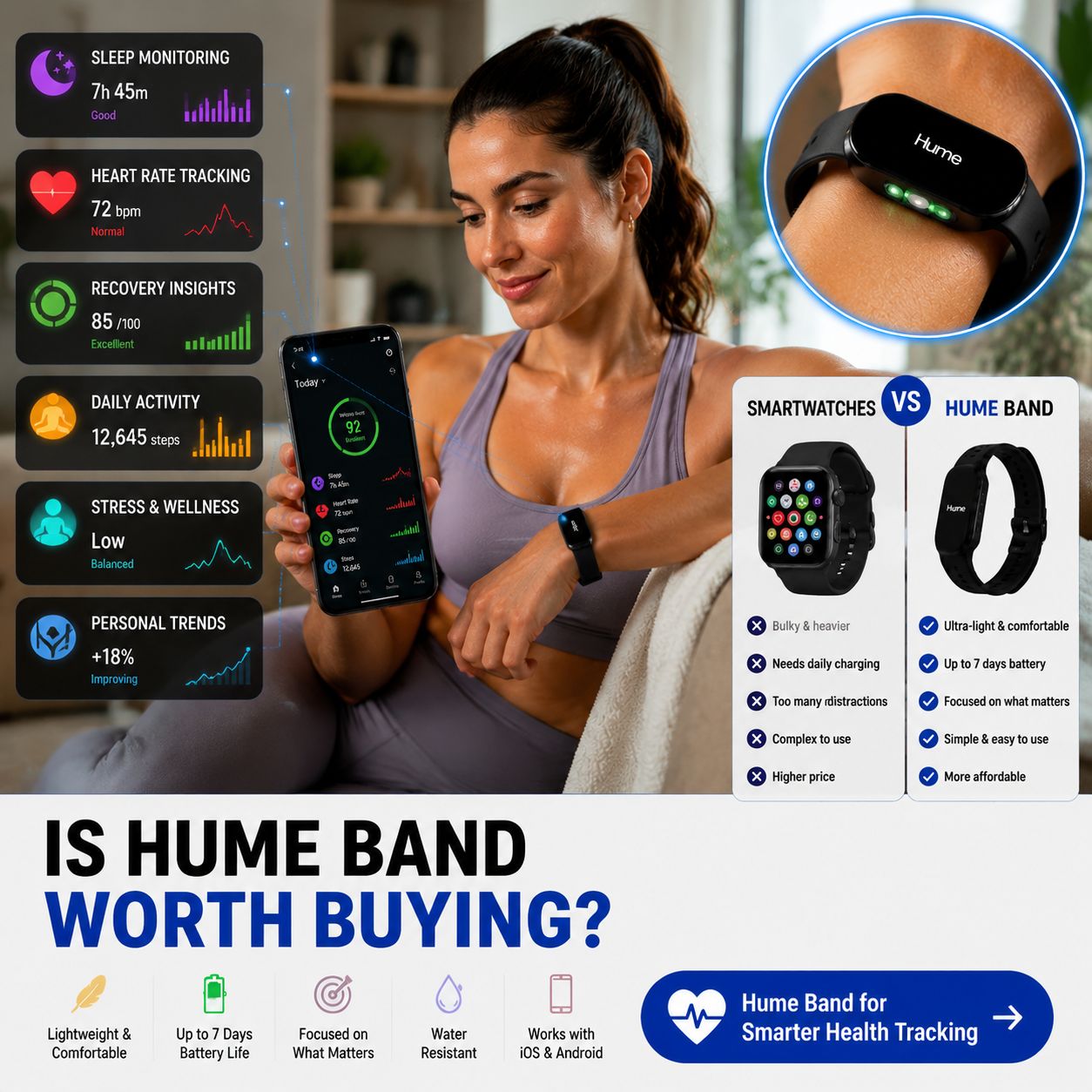
The Hume Band’s biggest distinction is its focus. Many wearable devices try to do everything. The Hume Band instead emphasizes health and wellness tracking.
Its screenless design, recovery focus, long-term health metrics, and passive tracking make it particularly interesting for people who don’t need another smartwatch.
Hume also promotes concepts such as Metabolic Momentum and Pace of Aging. These are intended to help users think about longer-term trends rather than only daily activity.
That philosophy may appeal to someone who is more interested in sustainable lifestyle changes than competing for a higher step count every day.
Potential Advantages of the Hume Band
- There are several reasons someone might choose the Hume Band. Screen-free experience – The absence of a screen reduces distractions and encourages passive tracking.
- Recovery-focused insights – Recovery, HRV, sleep, and related information are central to the product’s health-tracking approach.
- Sleep tracking – Wearing the device overnight allows users to observe sleep patterns over time.
- Long-term wellness perspective – Hume emphasizes trends such as Metabolic Momentum and Pace of Aging rather than focusing exclusively on daily activity.
- Continuous tracking – The Band is designed to stay on the wrist throughout the day and night.
- Minimalist design – People who don’t want a large smartwatch on their wrist may prefer the simpler form factor.
- No traditional smartwatch distractions – No wrist notifications, social media alerts, or apps competing for your attention.
Potential Limitations
No wearable is perfect, and the Hume Band has limitations worth considering.
- No smartwatch functionality – If you want calls, notifications, apps, maps, music controls, or a large display, the Hume Band isn’t designed to replace a smartwatch.
- Data should not be treated as a medical diagnosis – Hume itself states that its wellness insights are not medical diagnoses, and its blood-pressure feature is intended as a trend insight rather than a replacement for a cuff.
- App dependence – Because the Band is screenless, you rely on the smartphone app to review most of your information.
- Wearable measurements have limitations, no consumer wearable should be assumed to provide perfect measurements under all conditions.
- Premium features may vary – The current Hume ecosystem includes a free app experience and optional premium features, so buyers should check exactly which features are included with their chosen purchase.
Who Should Consider the Hume Band?
The Hume Band may be worth considering if you are someone who:
- Wants to track sleep consistently.
- Is interested in recovery and HRV.
- Exercises regularly.
- Wants a screenless wearable.
- Doesn’t need smartwatch features.
- Wants long-term wellness trends.
- Prefers passive health tracking.
- Wants to reduce wrist notifications.
- Likes reviewing health information through a smartphone app.
It may be especially attractive to people who already own a smartphone and don’t need another device for communication.
Is Hume Band the Best Wearable Device?
There is no universal “best” wearable device. The best wearable depends on the user’s goals.
If your definition of the best wearable is the device with the most smartwatch features, the Hume Band is not the obvious winner.
If your definition is a screenless wearable focused on health, recovery, sleep, and long-term wellness, the Hume Band becomes much more compelling.
The current Hume Band 2.0 focuses on continuous tracking of recovery, sleep, HRV, activity, wellness trends, and longer-term health insights.
Its biggest advantage may not be the number of features it has. It may be the fact that it encourages a different relationship with health data.
Instead of constantly checking a screen, you wear the device, collect data, and review your trends on your own schedule.
How to Get the Most From a Hume Band?
Buying a wearable is only the beginning. To make the information useful, consistency matters.
Wear it regularly
Try to wear the Band consistently during normal daily activities and while sleeping. More consistent data can make long-term trends easier to interpret.
Focus on trends
Don’t panic over one unusual score. Instead, look for changes over several days or weeks.
Combine data with how you feel
Your wearable is one source of information. Consider your energy, mood, sleep quality, workout performance, stress, and other real-life factors too.
Avoid chasing scores
A health score is not a competition. The goal is to understand your habits and make sustainable improvements.
Use professional medical care when appropriate
If you have persistent symptoms, abnormal readings, or health concerns, speak with a qualified healthcare professional rather than relying exclusively on wearable data.
Final Verdict
For everyone, no. For the right user, however, it can be a very compelling option.
The Hume Band is best understood as a health and wellness tracker rather than a traditional smartwatch.
Its current Band 2.0 focuses on continuous physiological tracking, sleep, recovery, HRV, activity, wellness trends, and longer-term health insights.
Its screenless design can be appealing for people who want fewer distractions, while its health-focused app provides a deeper look at patterns that may be difficult to notice from day-to-day feelings alone.
At the same time, a smartwatch remains a better choice for people who need GPS, notifications, apps, calls, music, navigation, and on-device workout information.
If your priority is passive, continuous health and recovery tracking without the distractions of a smartwatch, the Hume Band deserves a place on your shortlist.
If you need a multifunctional wrist computer with advanced sports and smart features, a smartwatch may be the more practical choice.
.
.
.