Is Hume Band Reliable Compared to Competitors? – Fitness Guide
Is Hume Band Reliable Compared to Competitors? – (🔥Smart Health Tracking!). Compare Hume Band accuracy, features, benefits.
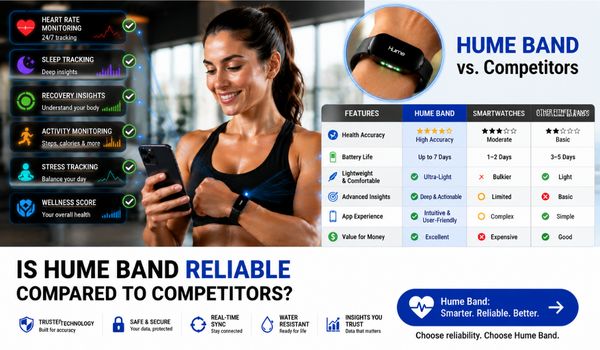
Wearable health technology has changed the way people monitor their daily activity, sleep, recovery, heart rate, and overall wellness.
One question many people ask before purchasing a health wearable is: Is the Hume Band reliable compared to competitors?
The Hume Band has attracted attention because it takes a different approach from traditional smartwatches.
Instead of focusing on notifications, calls, apps, and a bright display, it emphasizes continuous wellness tracking and long-term health insights.
Hume Band 2.0 is designed to monitor metrics such as heart rate, heart rate variability (HRV), sleep, blood oxygen, skin temperature, activity, and strain.
Hume says its newer band uses five LEDs and four photodiodes and is designed for continuous tracking.
What is Hume Band?
Hume Band is a screen-free wearable designed to help users monitor health and wellness trends throughout the day and night.
Worn on the wrist, it tracks metrics such as heart rate, heart rate variability (HRV), blood oxygen, skin temperature, sleep, activity, strain, and recovery.
The data is synced with the Hume Health app, where users can review trends and gain insights into their overall wellness. Hume Band is intended as a consumer wellness product, not a medical device.
How Does Hume Band Work?
Hume Band 2.0 is designed as a screen-free wearable that can be worn continuously. Rather than placing a display on the wrist, the device collects data, which is then presented in the Hume Health app.
According to Hume, the Band 2.0 uses five LEDs and four photodiodes to collect biometric information. The company says the sensor system captures data frequently and has been evaluated through laboratory studies and third-party testing.
The device is designed to track several areas of wellness, including:
- Heart rate
- Heart rate variability
- Sleep stages
- Blood oxygen
- Skin temperature
- Activity
- Strain
- Recovery-related information
The Hume app then turns those measurements into trends and scores intended to help users understand how lifestyle habits may influence their overall wellness.
This approach is different from a smartwatch. A smartwatch is designed to be a general-purpose technology device, while the Hume Band is much more focused on passive health monitoring.
Is Hume Band Accurate?
Accuracy is probably the most important factor in determining whether Hume Band is reliable.
The short answer is: Hume Band can be useful for monitoring health and fitness trends, but it should not be treated as a laboratory-grade diagnostic instrument.
That distinction applies to most consumer wearables.
Hume states that its Band 2.0 uses an upgraded sensor system and says its accuracy has been validated through laboratory and third-party testing. Independent testing also provides a more practical perspective.
A recent review from Wareable found that the Hume Band could provide useful, continuous wellness information and that its sleep and activity measurements were broadly comparable to those of other consumer wearables.
Therefore, the best way to use Hume Band is to look at long-term patterns and focus on becoming overly concerned about becoming isolated in reading.
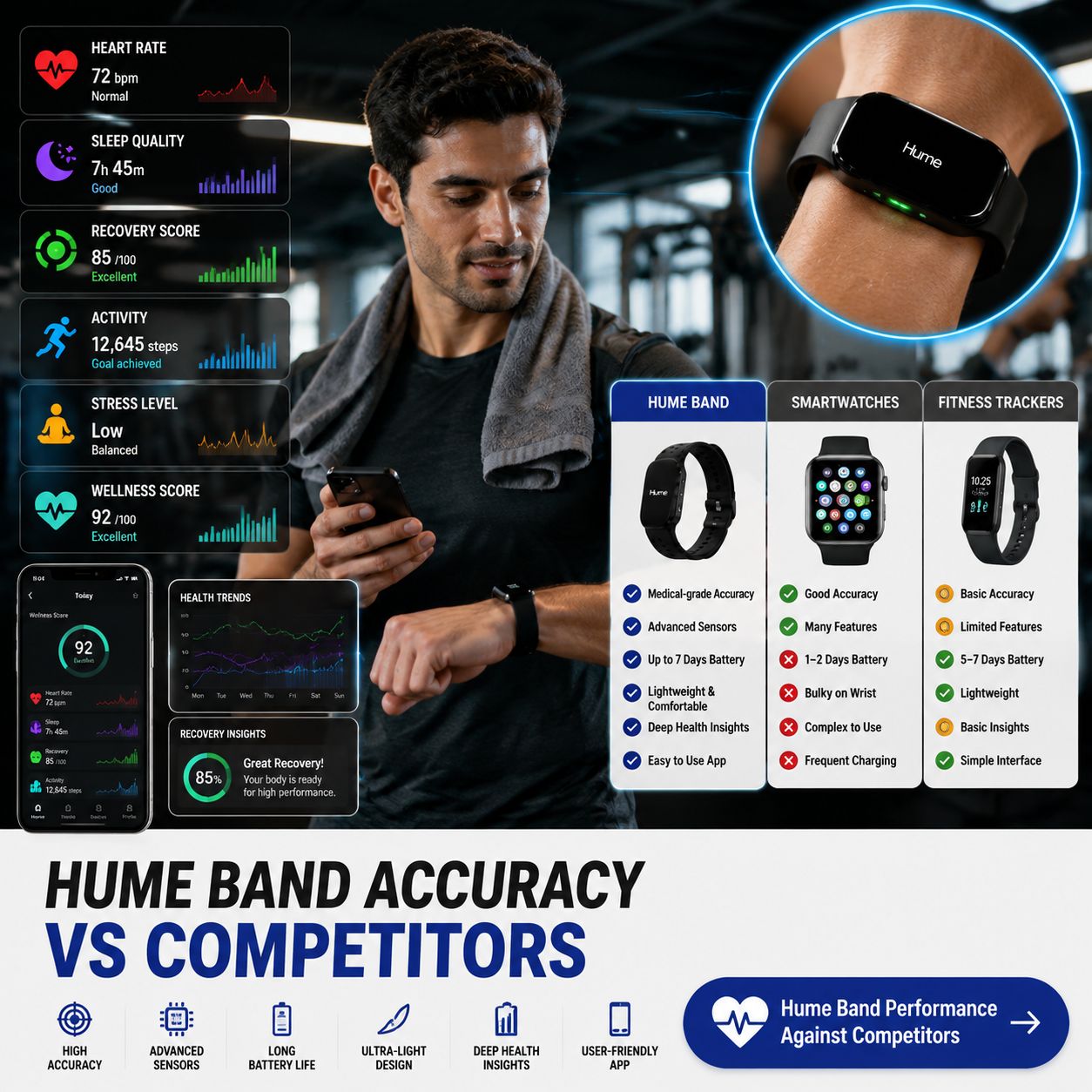
Hume Band Compared with WHOOP
WHOOP is one of the most obvious competitors because both Hume Band and WHOOP are screen-free wearables focused heavily on health, recovery, and continuous monitoring.
WHOOP has historically been especially popular among athletes and fitness-focused users. Its platform emphasizes metrics such as strain, recovery, sleep, and training-related insights.
Hume Band takes a somewhat broader wellness and longevity-oriented approach.
Hume Band advantages over WHOOP
Hume Band can be purchased as a standalone device, while WHOOP is built around a membership model. Recent comparisons put Hume Band 2.0 at around $249, with an optional Hume membership, while WHOOP requires a membership for access to its service.
For someone who does not want another long-term subscription, this difference can be significant. Hume Band also emphasizes wellness and metabolic health concepts rather than focusing primarily on athletic performance.
Where WHOOP may be stronger
WHOOP has a mature recovery and training ecosystem and is particularly attractive to serious athletes.
Recent comparisons indicate that WHOOP supports a much broader range of activity tracking and offers more detailed training-oriented analytics.
Therefore:
Hume Band may be the better fit for general wellness and longevity-focused users, while WHOOP may be better suited to athletes who want deeper training and recovery analytics.
Hume Band Compared With Oura Ring
Oura is another major competitor in the health-wearable market. The most obvious difference is the form factor.
Hume Band is worn on the wrist, while Oura is a smart ring. Oura has become particularly popular among people who want discreet sleep and wellness tracking without wearing a traditional smartwatch.
Recent comparisons of Hume Band 2.0 and Oura Ring 5 show that both devices focus on sleep, activity, and recovery, although their designs and ecosystems differ significantly.
Where Hume Band has an advantage
Some users may prefer a wristband because it is familiar and easier to put on and remove.
Hume Band also offers a screen-free experience without the bulk of a smartwatch.
Its pricing can also make it more attractive than premium smart rings, particularly for users who do not want to pay for a high-priced ring plus an ongoing membership.
Hume Band Compared With Fitbit
Devices such as the Fitbit Charge 6 combine fitness tracking with a small display and additional smartwatch-like functionality. One advantage Fitbit has over the Hume Band is versatility.
A Fitbit can provide features such as:
- On-device information
- GPS-related functionality
- Workout tracking
- Notifications
- Heart-rate monitoring
- Fitness metrics
- Additional smart features
Hume Band deliberately removes many of these features. That may sound like a disadvantage, but it can actually be an advantage for people who want fewer distractions.
A screen-free wearable can collect information without constantly encouraging the user to check notifications or interact with the device.
In an independent comparison, Hume Band was described as particularly well-suited for users seeking long-term wellness monitoring without the distractions of a smartwatch.
Therefore, Fitbit may be the better choice if you want a traditional fitness tracker with a screen, while the Hume Band may appeal more to those who prefer passive monitoring.
Hume Band Compared With Apple Watch
Apple Watch is one of the most feature-rich competitors, but it serves a fundamentally different purpose.
An Apple Watch can function as:
- A fitness tracker
- A smartwatch
- A communication device
- A navigation tool
- A notification center
- A health-monitoring device
- An app platform
Hume Band does not attempt to compete with Apple Watch on those features.
The lack of a screen means there are no constant notifications, messages, calls, or apps competing for your attention.
This can be especially appealing to people who already have a smartphone and do not want another screen on their wrist.
On the other hand, the Apple Watch offers a much broader range of exercise and health features. If your priority is maximum functionality, the Apple Watch is difficult for a simple screen-free band to match.
If your priority is continuous wellness tracking with minimal distraction, Hume Band may be more appealing.
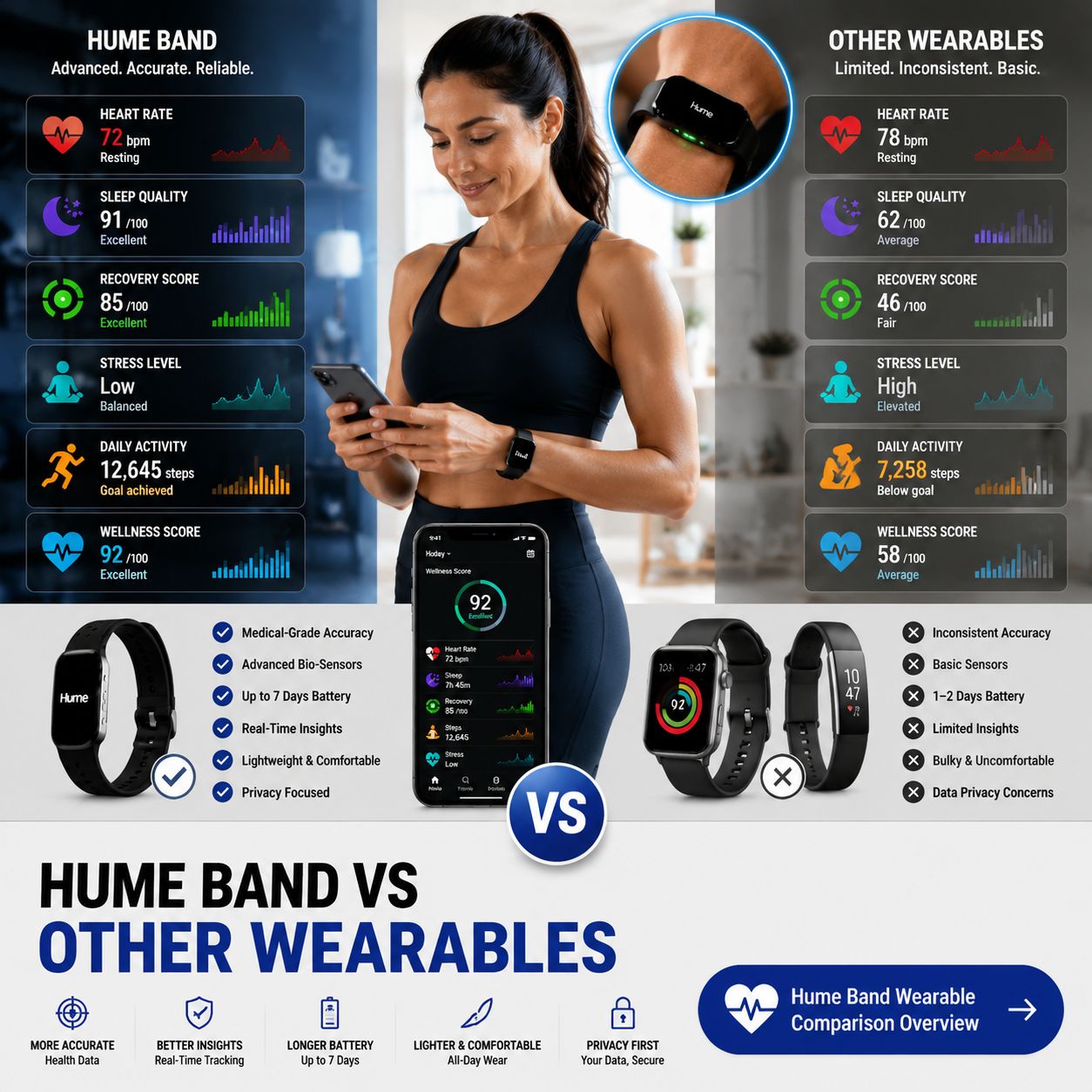
Hume Band vs. Garmin
Garmin devices are particularly popular among runners, cyclists, outdoor athletes, and serious fitness enthusiasts.
Garmin’s strengths include:
- GPS
- Advanced workout data
- Training metrics
- Sports profiles
- Navigation
- Performance analysis
- Long battery life on many models
Recent fitness-tracker comparisons continue to emphasize Garmin’s strength in training-oriented features and GPS performance.
Hume Band is not designed to replace a high-end Garmin sports watch.
If you are training for a marathon and need advanced running metrics, GPS, pace data, route tracking, and detailed training analysis, Garmin is likely a better choice.
But if you mainly want to monitor sleep, recovery, activity, and general wellness without a screen, Hume Band has a different value proposition.
Battery Life and Reliability
Battery life is an often-overlooked part of wearable reliability. A tracker can have excellent sensors, but if it needs frequent charging, users may remove it more often. That creates gaps in sleep and recovery data.
Hume’s current Band 2.0 documentation states that the device can provide up to 14 days of battery life, with typical charging taking approximately 20 to 80 minutes depending on the battery level.
Independent testing of the first-generation Hume Band found that its real-world battery performance could fall below the advertised figure, with one reviewer reporting approximately 2.5 to 3 days during testing.
That history is worth knowing because it shows why consumers should distinguish between manufacturer specifications and independent real-world testing.
For Hume Band 2.0, the advertised battery life is considerably longer. Still, actual battery performance can vary depending on:
- Continuous heart-rate monitoring
- Blood oxygen monitoring
- Sync frequency
- Firmware
- Usage patterns
- Battery condition
Longer battery life is not just a convenience. It can contribute to more consistent health tracking because users have fewer reasons to remove the device.
Does Wearing Hume Band Correctly Matter?
Yes. Sensor-based wearables depend heavily on good skin contact.
If a band is too loose, the sensors may not maintain consistent contact with the skin. If it is too tight, it can become uncomfortable and may discourage continuous wear.
Independent testing of the original Hume Band noted that positioning could influence sensor reliability.
For best results, users should:
- Wear the band securely.
- Avoid excessive looseness.
- Keep the sensors in consistent contact with the skin.
- Follow the manufacturer’s wearing instructions.
- Keep the device clean.
- Check synchronization regularly.
Consistency is particularly important when comparing your data over time.
If you wear the band differently every day, changes in measurements may reflect differences in sensor contact rather than genuine changes in your body.
Is Hume Band Reliable for Sleep Tracking?
Sleep is one of the areas where Hume Band can be particularly useful.
The Band is designed to monitor sleep duration and sleep stages, including awake, light, REM, and deep sleep. Independent testing has found that Hume’s sleep measurements broadly align with those of other consumer wearables, though differences can occur.
However, users should avoid interpreting sleep-stage numbers as medical diagnoses.
For example, if the Hume Band says you had a certain percentage of deep sleep, that does not mean the number is identical to what a clinical sleep laboratory would measure.
Instead, focus on questions such as:
- Am I sleeping longer?
- Is my sleep schedule becoming more consistent?
- Does my resting heart rate change when I sleep poorly?
- Do my recovery trends improve when I maintain a regular bedtime?
- Are lifestyle changes associated with better sleep patterns?
These questions make wearable data much more useful.
Is Hume Band Reliable for Heart Rate?
Optical heart-rate sensors are now common across consumer wearables. Hume Band uses optical sensors to continuously collect physiological data.
Heart-rate tracking is generally more useful when the user looks at trends rather than expecting every individual reading to be perfect.
During steady conditions, such as at rest or during ordinary daily activities, optical wearables can provide useful information.
During intense movement, however, readings may become less consistent. Motion, wrist movement, fit, sweat, and other factors can interfere with optical sensing.
This is not unique to Hume Band. Similar limitations exist across many wrist-based fitness trackers.
For serious athletic training where precise heart-rate measurements are essential, some users may prefer a dedicated chest strap paired with a compatible training platform.
What About HRV?
Heart rate variability, or HRV, is another metric increasingly used by wearable companies.
HRV refers to variations in the timing between heartbeats. It is commonly used as one component of recovery analysis.
Hume Band includes HRV among the metrics it tracks. However, HRV is highly individual.
A single HRV measurement should not automatically be interpreted as good or bad.
A better approach is to establish your personal baseline and observe how the trend changes over time.
Factors such as:
- Sleep
- Training
- Stress
- Alcohol
- Illness
- Travel
- Recovery
- Daily routine
can influence HRV.
Therefore, the reliability of an HRV wearable is best judged by whether it consistently captures meaningful changes in your own baseline.
Is Hume Band Reliable for Fitness Tracking?
Hume Band is capable of tracking activity, but it is not designed primarily as a dedicated sports watch. This distinction is important.
Independent testing found that Hume Band could provide useful step and activity information, but automatic workout detection was less consistent for certain exercises, particularly weightlifting. It also lacked built-in GPS in the original model.
That means an athlete who wants advanced running, cycling, or outdoor data may find Garmin, Apple Watch, or another dedicated fitness device more appropriate.
Hume Band’s Biggest Strength: Simplicity
One of the strongest arguments for Hume Band is simplicity. Modern smartwatches can provide an enormous amount of information.
That sounds beneficial, but more data does not always lead to better decisions.
Hume Band attempts to simplify the experience by collecting information in the background and presenting it through the Hume Health app. This screen-free design may also reduce distractions.
Recent reports on the wearable market show renewed interest in screen-free health trackers as consumers seek technology that monitors health without constantly demanding attention.
Hume Band’s Limitations
No wearable is perfect, and Hume Band has several limitations worth considering.
It is not a medical diagnostic device – Hume Band should not be used to diagnose or treat a medical condition.
Workout tracking is not its strongest category – Serious athletes may prefer Garmin or WHOOP for advanced training analysis.
No traditional display – The lack of a screen is an advantage for some users but a disadvantage for others. You cannot simply glance at your wrist to view information.
App dependence – Most of the meaningful information is viewed through the Hume Health app.
Measurements are estimates – Like other consumer wearables, Hume’s metrics depend on sensors, algorithms, and proper device placement.
Competitors have more mature ecosystems – Apple, Garmin, Fitbit, Oura, and WHOOP have established ecosystems with different strengths.
Is Hume Band a Better Value Than Competitors?
- Value depends on how you use the device.
- A user who wants a smartwatch may find Hume Band limiting.
- A runner who needs GPS may prefer Garmin.
- A performance-focused athlete may prefer WHOOP.
- A person who wants a smart ring may prefer Oura.
But someone who wants:
- Screen-free tracking
- Continuous wellness monitoring
- Sleep tracking
- Recovery insights
- Long battery life
- A minimalist design
- A lower ongoing cost than subscription-heavy alternatives
Recent comparisons place Hume Band 2.0 in a competitive position because it combines a one-time device purchase with an optional premium service rather than making an ongoing membership mandatory for basic functionality.
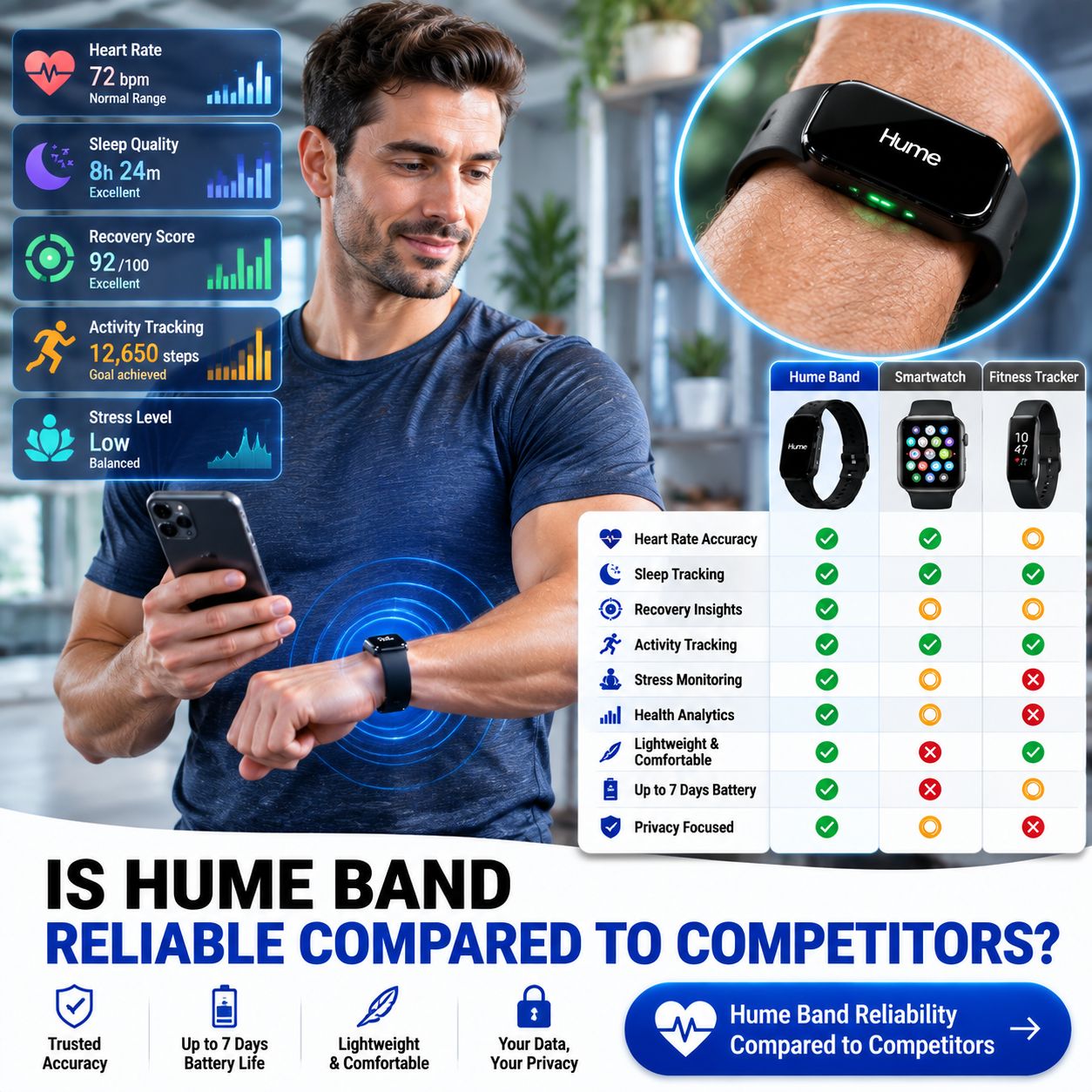
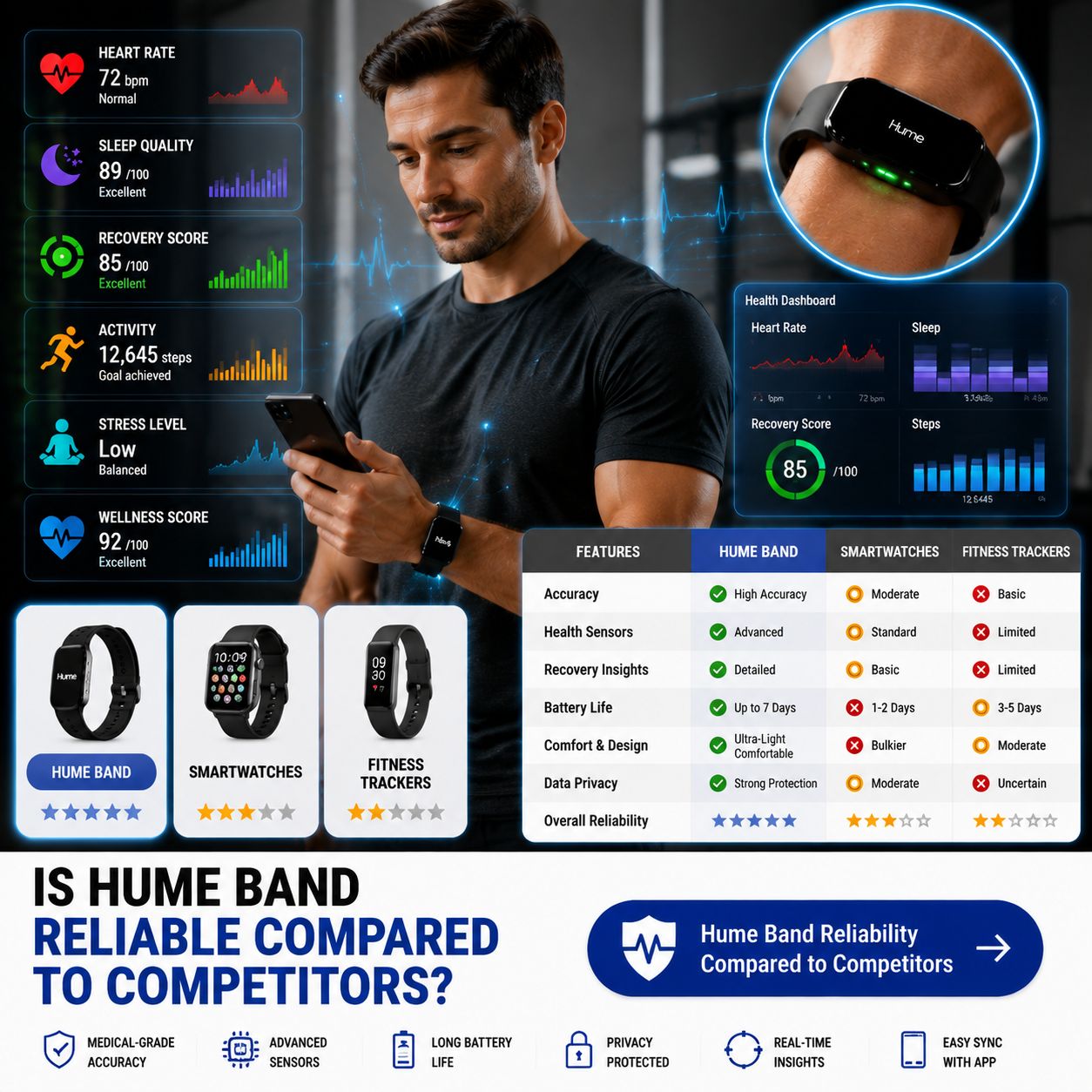
How Reliable Is Hume Band Compared to Competitors?
So, is Hume Band reliable compared to competitors?
Yes, Hume Band can be considered a reliable wellness-tracking option, particularly for monitoring long-term trends in sleep, activity, recovery, and physiological metrics.
Compared with WHOOP, Hume Band may be more attractive to users who dislike mandatory subscriptions and want a simpler wellness experience.
Compared with Oura, Hume Band offers a wrist-based alternative to a smart ring and emphasizes continuous wellness monitoring.
Compared with Fitbit, Hume Band is more minimalist and less focused on smartwatch-style functionality.
Compared with the Apple Watch, the Hume Band is dramatically simpler and less feature-heavy. Compared with Garmin, the Hume Band is less suitable for advanced sports and GPS-based training.
This makes Hume Band less of a universal replacement and more of a specialized wellness wearable.
Who Should Consider Hume Band?
Hume Band may be a good option for people who:
- Want a screen-free wearable
- Care about sleep and recovery
- Want to monitor wellness trends
- Prefer a lightweight device
- Do not want constant notifications
- Want long battery life
- Prefer a simple health app
- Want an alternative to subscription-heavy wearables
- Are interested in long-term wellness rather than only workout statistics
It may be less suitable for people who:
- Need built-in GPS
- Want smartwatch features
- Require advanced sports analytics
- Need detailed navigation
- Want an ECG-focused device
- Prefer seeing information directly on their wrist
- Need clinical-grade measurements
How to Get the Most Reliable Data From Hume Band?
Even a good wearable can produce inconsistent results if it is not used properly.
To improve consistency:
- Wear it regularly, continuous wear provides more data and makes trends easier to identify.
- Keep the fit secure – The band should maintain comfortable contact with your skin without being excessively tight.
- Keep the sensors clean – Sweat, dirt, and other buildup can potentially affect sensor contact.
- Sync the device regularly – Keeping your app and device synchronized helps maintain a consistent record.
- Pay attention to trends – Do not overreact to one unusual reading. Instead, look at changes across several days or weeks.
- Compare the data with how you feel – If your wearable reports poor recovery but you feel energetic, consider the broader context rather than treating the score as an absolute fact.
Final Verdict
Hume Band is a credible option for consumers seeking continuous wellness and health-trend monitoring, but it should not be viewed as universally more accurate than all competitors.
Its biggest strengths are its screen-free design, focus on wellness and recovery, broad health metrics, and long battery life on the newer Band 2.0.
Hume states that Band 2.0 can provide up to 14 days of battery life and uses a multi-sensor optical system designed for frequent data collection.
Independent reviews suggest that Hume Band can provide useful information about sleep, activity, and recovery, while also highlighting limitations in areas such as automatic workout detection.
Hume Band is not trying to be a Garmin sports watch, an Apple Watch, or a medical diagnostic instrument. It is designed to quietly collect health information and help users understand longer-term wellness patterns.
But for someone who wants simple, screen-free, continuous wellness tracking without relying entirely on a subscription-based model, Hume Band can be a compelling choice.
Hume Band fits that role well for many everyday wellness users as long as its measurements are treated as useful health trends rather than definitive medical results.
.
.
.