Is Hume Band Worth Buying Compared to Smartwatches? Read!
Hume Band vs Smartwatches – (🔥Complete Comparison Guide!) Compare health tracking, fitness features, recovery insights, and everyday use.
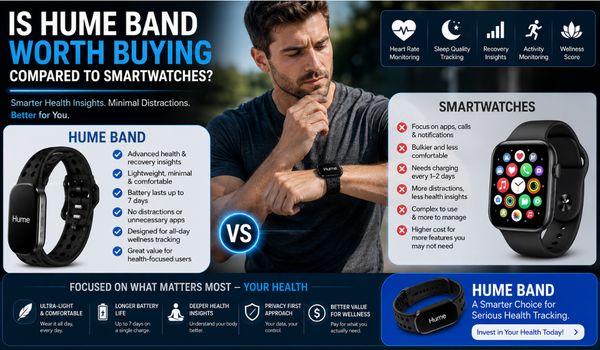
The Hume Band takes a very different approach from traditional smartwatches. It has no screen, notifications, calls, apps, or music controls.
Instead, it is designed to quietly collect physiological information and present health and wellness trends through the Hume Health app.
A modern smartwatch, on the other hand, is designed to be both a health tracker and a small computer for your wrist.
Devices such as the Apple Watch can provide heart-health features, sleep tracking, workouts, notifications, communication, apps, and other smart functions.
What Is the Hume Band?
The Hume Band is a screenless wearable designed around continuous health and wellness tracking.
Rather than trying to become a miniature smartphone, it focuses on collecting physiological signals while you go about your day. The information is then interpreted through the Hume Health app.
According to Hume, the current Hume Band 2.0 tracks signals including continuous heart rate, overnight heart-rate variability (HRV), resting heart rate, blood oxygen, skin temperature, sleep stages, activity, strain, recovery, steps, distance, and calories.
It also provides additional trend-oriented metrics, such as Health Score, Metabolic Capacity, Metabolic Momentum, Pace of Aging, and blood pressure trend insights.
The Band 2.0 uses five LEDs and four photodiodes and is designed to be worn continuously. Hume lists a battery life of up to 14 days, though actual battery life may vary depending on usage and syncing.
A smartwatch is built to interact with you. The Hume Band is designed to monitor you quietly.
Hume Band vs. Smartwatch: Health Tracking
| Health Tracking Feature | Hume Band | Smartwatch |
|---|---|---|
| Heart Rate | Provides continuous heart-rate tracking throughout the day. | Most modern smartwatches also provide continuous heart-rate monitoring. |
| HRV & Recovery | Focuses strongly on HRV, recovery, resting heart rate, and long-term wellness trends. | Many smartwatches track HRV and recovery-related data, but features vary by model. |
| Sleep Tracking | Tracks sleep stages, including light, deep, and REM sleep, along with overnight HRV and resting heart rate. | Modern smartwatches can also track sleep duration and stages, with some offering additional sleep-health features. |
| Blood Oxygen | Tracks overnight blood oxygen (SpO₂) trends as part of its health monitoring. | Some smartwatches offer SpO₂ tracking, depending on the model and market. |
| Health & Longevity Insights | Emphasizes Health Score, Metabolic Capacity, Metabolic Momentum, Pace of Aging, and other long-term health trends. | Typically focuses more broadly on fitness, activity, heart health, and general wellness. |
| Continuous Monitoring | Screenless design and up to 14-day battery life make it suitable for continuous day-and-night tracking. | Offers more interactive features, but battery life varies significantly by model and usage. |
Why Trends Matter?
Your heart rate can change due to exercise, stress, sleep, hydration, caffeine, illness, medications, temperature, or normal biological variation.
The same is true for sleep and HRV. Looking at one measurement in isolation can therefore be misleading. A wearable becomes more useful when it helps you identify patterns over time.
For example:
- You consistently sleep fewer than seven hours.
- Your resting heart rate gradually increases.
- Your HRV trends downward.
- Your recovery scores decline.
- Your activity level decreases.
The combination may encourage you to examine your sleep, stress, training schedule, or other lifestyle factors.
However, these wearable measurements should generally be treated as wellness information rather than a diagnosis.
Hume itself describes its blood-pressure insights as trends rather than cuff readings and states that its wellness metrics are not intended to diagnose or manage medical conditions.
How do smartwatches compare for Health Monitoring?
Smartwatches have also become increasingly sophisticated. Apple Watch, for example, can monitor heart rate and provide notifications for unusually high, low, or irregular rhythms.
Compatible models can also perform a single-lead ECG. Apple also offers sleep tracking and overnight metrics, including heart rate, respiratory rate, wrist temperature, and sleep duration.
Some modern smartwatches also provide:
- Blood oxygen measurements in supported markets/models
- Sleep scores
- Sleep-apnea notifications
- Temperature tracking
- Workout heart-rate zones
- GPS activity tracking
- Fitness estimates
- Cycle tracking
- Emergency features
This gives smartwatches an advantage if you want a broader health-and-fitness ecosystem. The downside is that more features can also mean more complexity.
A smartwatch may encourage you to check your wrist repeatedly throughout the day. For some people, that is useful. For others, it becomes another source of notifications and digital distraction.
Sleep Tracking: Which Is Better?
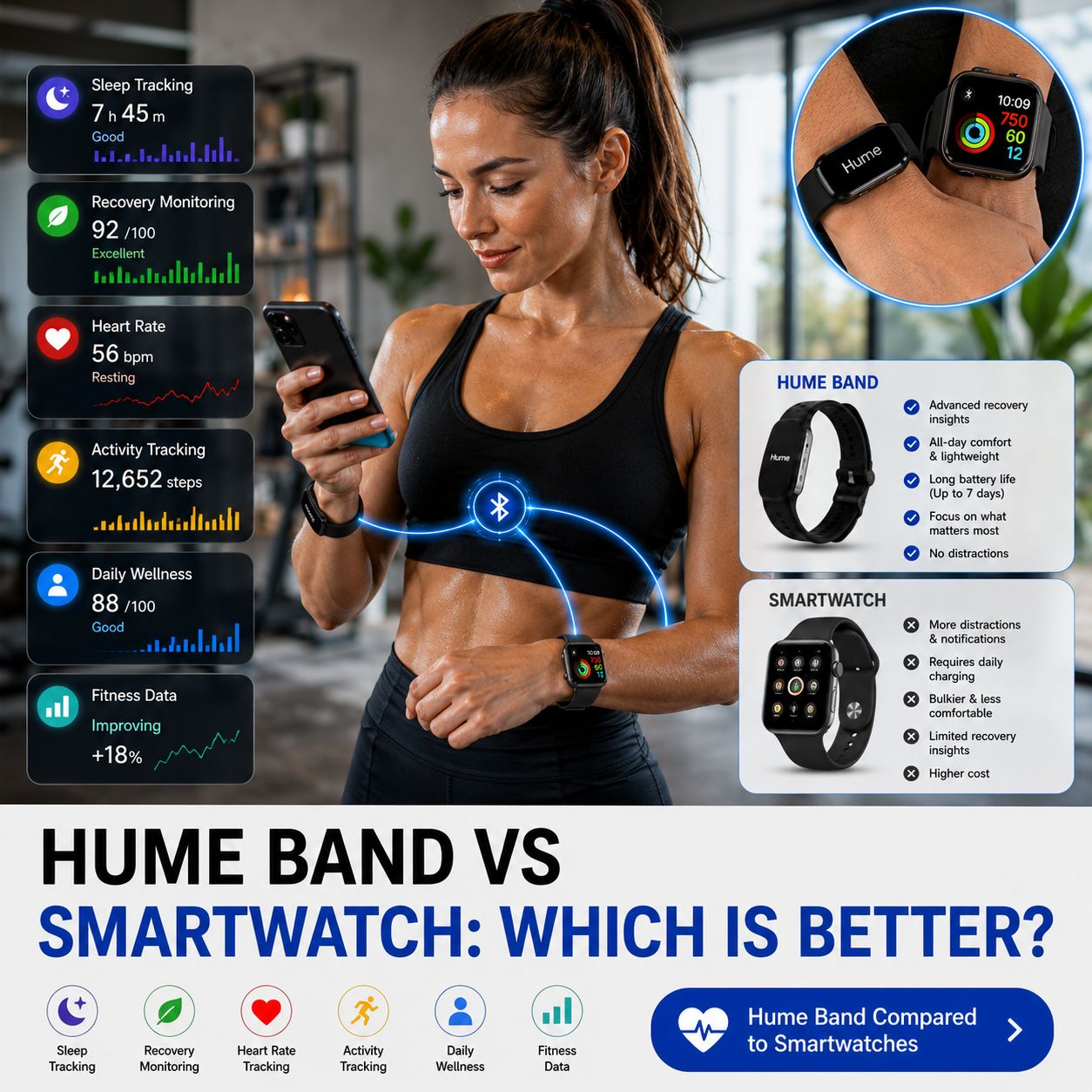
Hume Band is designed to be worn overnight and to track sleep stages, including light, deep, and REM, as well as HRV and resting heart rate. Hume then uses this information to provide insights into sleep and recovery.
Independent testing of the original Hume Band found that its sleep-duration results were broadly similar to Apple Watch measurements, although the reviewer noted differences in sleep-stage results and nighttime awakening detection.
Apple Watch, for example, tracks sleep duration and stages and provides additional overnight health information. Apple has also introduced sleep scoring and sleep-apnea-related features on supported models.
Battery Life: A Major Hume Band Advantage
Battery life is one of the clearest differences between the Hume Band and many smartwatches.
Hume currently advertises up to 14 days of battery life for Band 2.0. The company says that typical charging takes approximately 20–80 minutes, depending on the battery level.
- This can be particularly useful for sleep tracking.
- Imagine charging your wearable every evening.
- You may eventually stop wearing it overnight because it needs to be charged.
- Then you lose sleep data.
- Then your long-term trends become incomplete.
- A longer-lasting device reduces that problem.
By comparison, battery life varies considerably between smartwatches. Some models can last multiple days, while others require more frequent charging, depending on display use, GPS, workouts, cellular connectivity, and other features.
This doesn’t automatically make Hume Band better. It simply means the Band is optimized for a different purpose.
If you want a wearable that can go for many days without thinking about charging, Hume Band has a meaningful advantage.
The Screenless Design: Advantage or Disadvantage?
This may be the most personal part of the decision. You can’t glance at the Band to see:
- The time
- A text message
- Weather
- Incoming calls
- Workout statistics
- GPS directions
- Music controls
You need to open the Hume app on your phone to review your information.
But there is another way to look at it. A screenless wearable can reduce distractions.
Recent testing of Hume Band 2.0 described this as one of its biggest lifestyle advantages compared with a smartwatch: the device provides health tracking without becoming another screen demanding attention.
For people who already spend hours looking at phones and computers, that simplicity may be attractive. For others, the lack of a display will be frustrating.
So ask yourself: Do I want my wearable to give me information—or do I want it to quietly collect information?
If you choose the second option, Hume Band becomes much more interesting.
Smart Features: Smartwatch Wins Easily
A smartwatch can provide a wide range of functions that the Hume Band intentionally doesn’t provide.
Depending on the model, these may include:
- Phone notifications
- Calls
- Text messages
- Apps
- GPS
- Music controls
- Digital payments
- Maps
- Alarms
- Timers
- Workout displays
- Voice assistants
- Emergency communication
Hume Band doesn’t attempt to compete in these areas.
Its screenless design means there are no notifications, apps, calls, or music controls on your wrist. Independent testing of the original Band highlighted this simplicity as both a strength and a weakness depending on the user’s expectations.
Therefore, if you are buying a wearable primarily for smartwatch functionality, don’t buy Hume Band expecting it to replace your smartwatch.
Fitness and Workout Tracking
This is another category where smartwatches generally have an advantage. Runners, cyclists, hikers, and serious athletes often want real-time information while exercising.
For example:
- Current heart rate
- Pace
- Distance
- Speed
- GPS route
- Workout duration
- Heart-rate zones
- Elevation
- Intervals
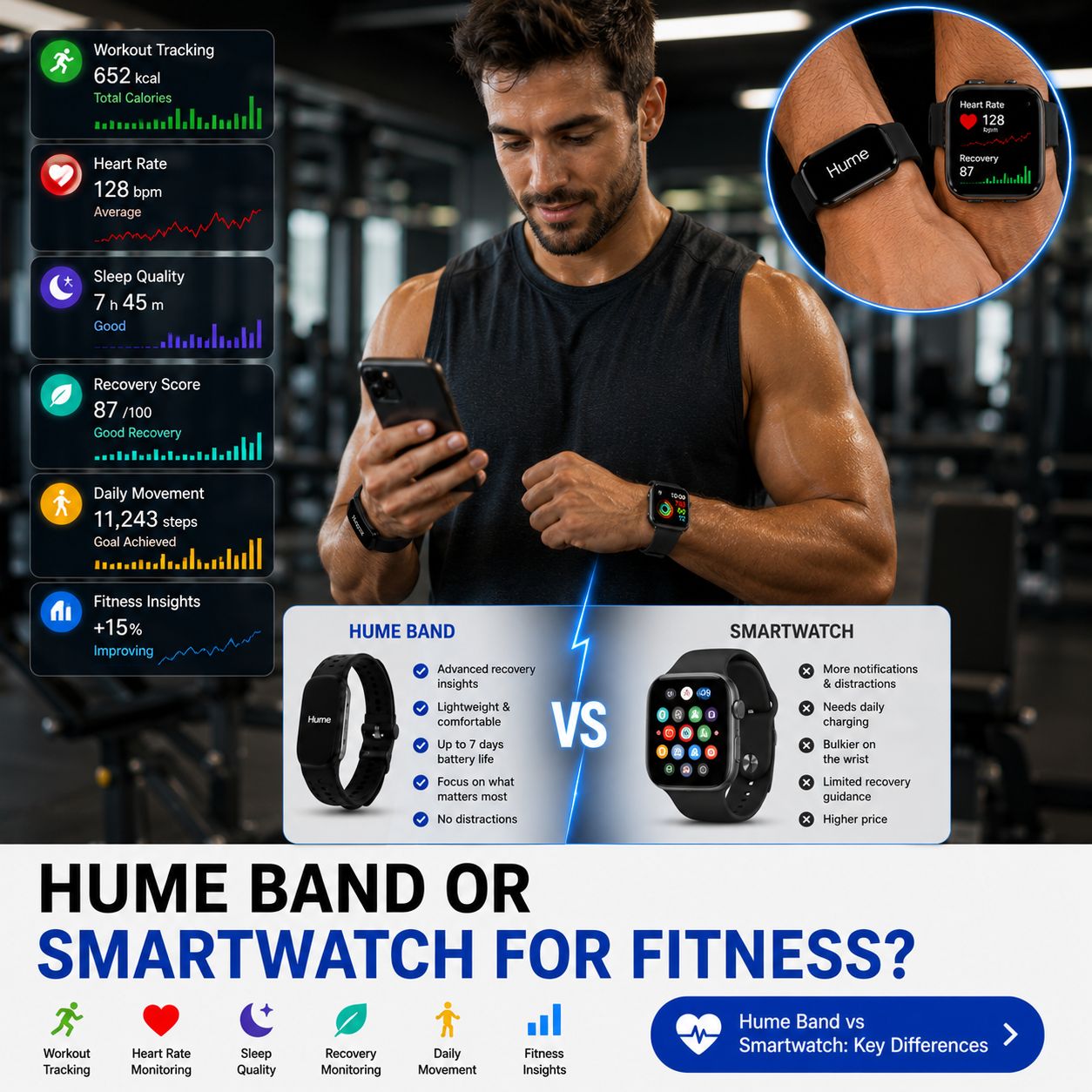
A smartwatch can put much of this information directly on your wrist. The Hume Band is more passive.
It can track activity, movement, heart rate, strain, steps, distance, calories, and recovery-related information, but its screenless design means it isn’t intended to provide a real-time workout dashboard.
For someone who exercises mainly for general health, that may be perfectly acceptable. For a competitive athlete, a dedicated fitness watch may be more appropriate.
Blood Pressure: An Important Distinction
Hume Band 2.0 has introduced blood-pressure trend insights, but this feature needs to be understood correctly. The Band is not a replacement for a validated blood-pressure cuff.
Hume describes the feature as a way to observe relative patterns over time rather than providing a conventional clinical blood-pressure measurement.
If someone needs an actual blood pressure measurement for medical decision-making, a validated blood pressure monitor should be used according to professional guidance.
A wearable trend may be interesting and potentially useful as an additional wellness signal, but it shouldn’t replace appropriate medical measurement. The same principle applies to many other wearable metrics.
Wearables can support health awareness. They do not replace clinical evaluation.
Hume Band and Longevity Tracking
One of Hume’s key differentiators is its focus on longevity.
Traditional fitness trackers often emphasize:
- Steps
- Calories
- Exercise
- Distance
- Heart rate
Hume puts more emphasis on what it calls longevity-oriented signals.
Its platform includes metrics such as:
- Metabolic Momentum
- Metabolic Capacity
- Pace of Aging
- Recovery
- Health Score
- Sleep
- HRV
Hume describes Metabolic Momentum as a way to assess whether health-related habits are trending in a favorable or unfavorable direction over time.
This approach may appeal to someone who is less interested in beating yesterday’s step count and more interested in building sustainable habits.
However, consumers should be cautious about interpreting terms such as “biological age,” “pace of aging,” or “longevity score” as direct measurements of how long they will live.
They can potentially help people think about trends and behavior, but they shouldn’t be interpreted as predictions of an individual’s lifespan or as medical diagnoses.
Cost and Subscription Considerations
Hume currently lists the Hume Band 2.0 for a one-time purchase price of $249 on its website and offers a 45-day money-back trial. Pricing and promotions can change, so buyers should check the current offer before purchasing.
The basic Hume app and core Band metrics do not require a subscription. However, Hume also offers an optional Premium membership for additional AI-powered coaching and deeper personalized insights.
This is important because “no subscription required” does not necessarily mean every possible feature is included without an optional subscription.
The initial purchase price is only part of the equation. Depending on the device, you may also consider:
- Cellular service
- Accessories
- Replacement bands
- Premium fitness services
- Cloud services
- Phone compatibility
- Future upgrades
Therefore, when comparing costs, consider your expected ownership period rather than just today’s purchase price.
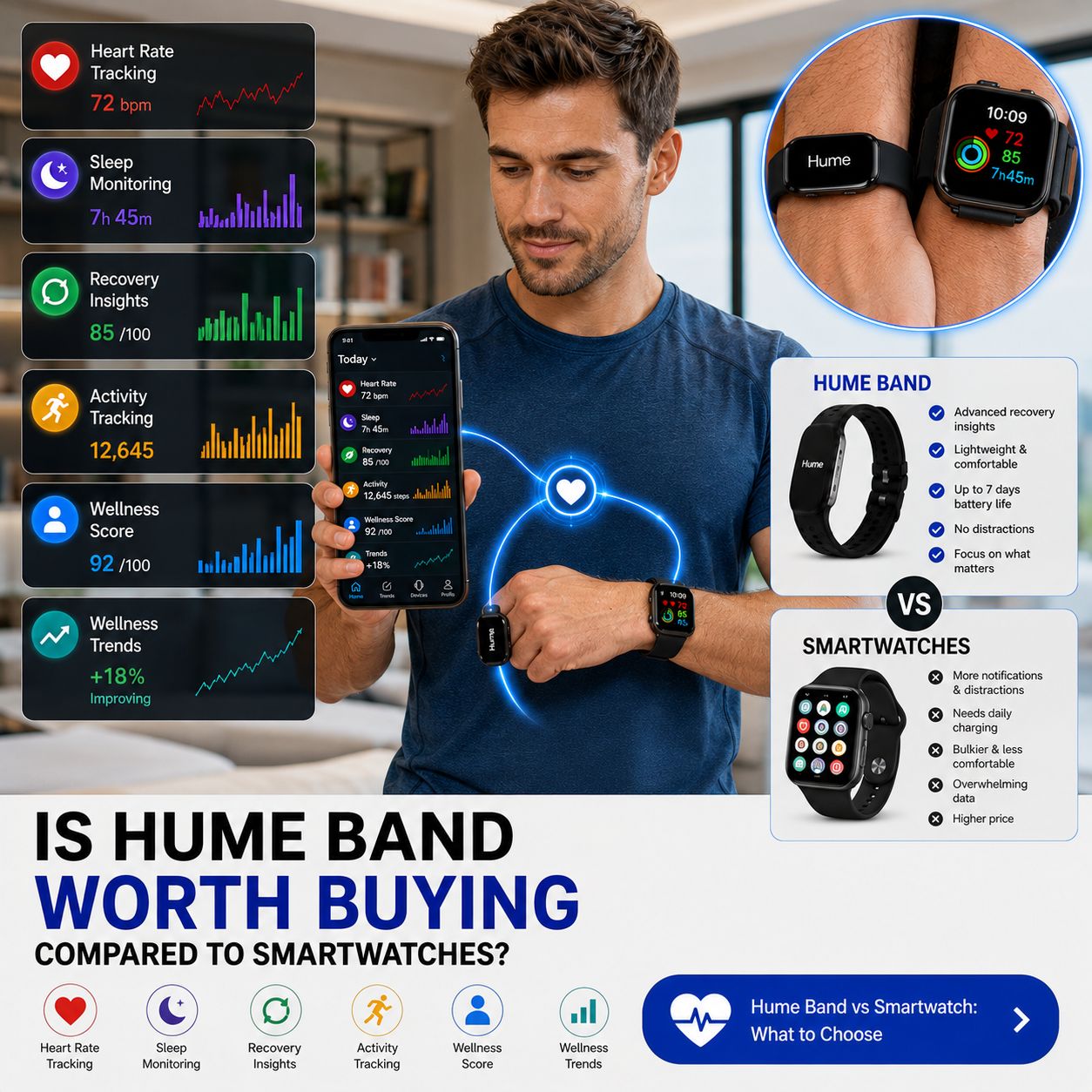
Hume Band vs. Apple Watch
Apple Watch is one of the clearest examples of what a modern smartwatch can offer.
Apple Watch combines health and fitness tracking with a large ecosystem of smart features.
Supported models can provide:
- Heart-rate monitoring
- ECG
- Irregular rhythm notifications
- Sleep tracking
- Sleep score
- Sleep-apnea notifications
- Workout tracking
- GPS
- Notifications
- Apps
- Calls and messaging
- Other safety features
Apple says its health features were developed with clinical experts and that several have undergone scientific validation.
So why would someone still choose Hume?
- Because Hume is intentionally simpler.
- There is no glowing screen.
- There are no notifications.
- There is no need to manage a smartwatch interface.
- The Band’s emphasis is on passive monitoring and app-based interpretation.
For someone who already owns a smartwatch but wants a quieter health tracker, Hume Band can potentially complement rather than replace the smartwatch.
Hume Band vs. Fitbit-Style Trackers
Fitness trackers sit somewhere between a traditional smartwatch and a screenless health band.
Many Fitbit devices focus strongly on:
- Steps
- Heart rate
- Exercise
- Sleep
- Activity
- Wellness trends
Some models include displays, notifications, and other smartwatch-like features.
This makes a Fitbit-style tracker potentially more appropriate for someone who wants a balance between simplicity and on-device information. Hume becomes more compelling if your priority shifts toward:
Long-term wellness trends, recovery, sleep, HRV, and longevity-oriented insights.
Is Hume Band More Accurate Than a Smartwatch?
This is a question that deserves caution. It would be misleading to say that one wearable is universally “more accurate.”
Accuracy can vary by:
- Sensor technology
- Device fit
- Skin contact
- Movement
- Activity type
- Individual physiology
- Algorithm
- Measurement method
- Environmental conditions
Hume says Band 2.0 uses five LEDs and four photodiodes and describes its sensor system as having improved accuracy compared with the previous model.
Independent testing of the original Hume Band found that some measurements were useful but also noted inaccuracies in areas such as heart rate, sleep, and recovery.
That is a useful reminder: No consumer wearable should be treated as perfectly accurate.
For important medical measurements, use clinically appropriate devices and consult a qualified healthcare professional.
Is Hume Band Worth Buying Compared to Smartwatches?
The answer is yes for the right person but not as a universal smartwatch replacement.
If you want a screenless wearable that emphasizes sleep, recovery, HRV, long-term trends, and wellness with minimal distraction, Hume Band 2.0 is a compelling option.
Its long battery life and no-mandatory-subscription approach make it particularly attractive to people who want continuous tracking without charging every day or paying a recurring membership simply to access their core data.
Hume currently lists up to 14 days of battery life and a one-time purchase price of $249, although prices and promotions may change.
However, if you want a device that can replace your phone for certain everyday tasks, a smartwatch is clearly more capable.
A smartwatch is the better option for:
- GPS
- Calls
- Messages
- Apps
- Music
- On-wrist information
- Advanced workouts
- ECG on supported devices
- Broader smart features
In other words:
Hume Band is a health-first wearable. A smartwatch is a technology-first wearable with increasingly sophisticated health capabilities.
Neither category automatically wins. The better choice depends on what you want your wearable to do.
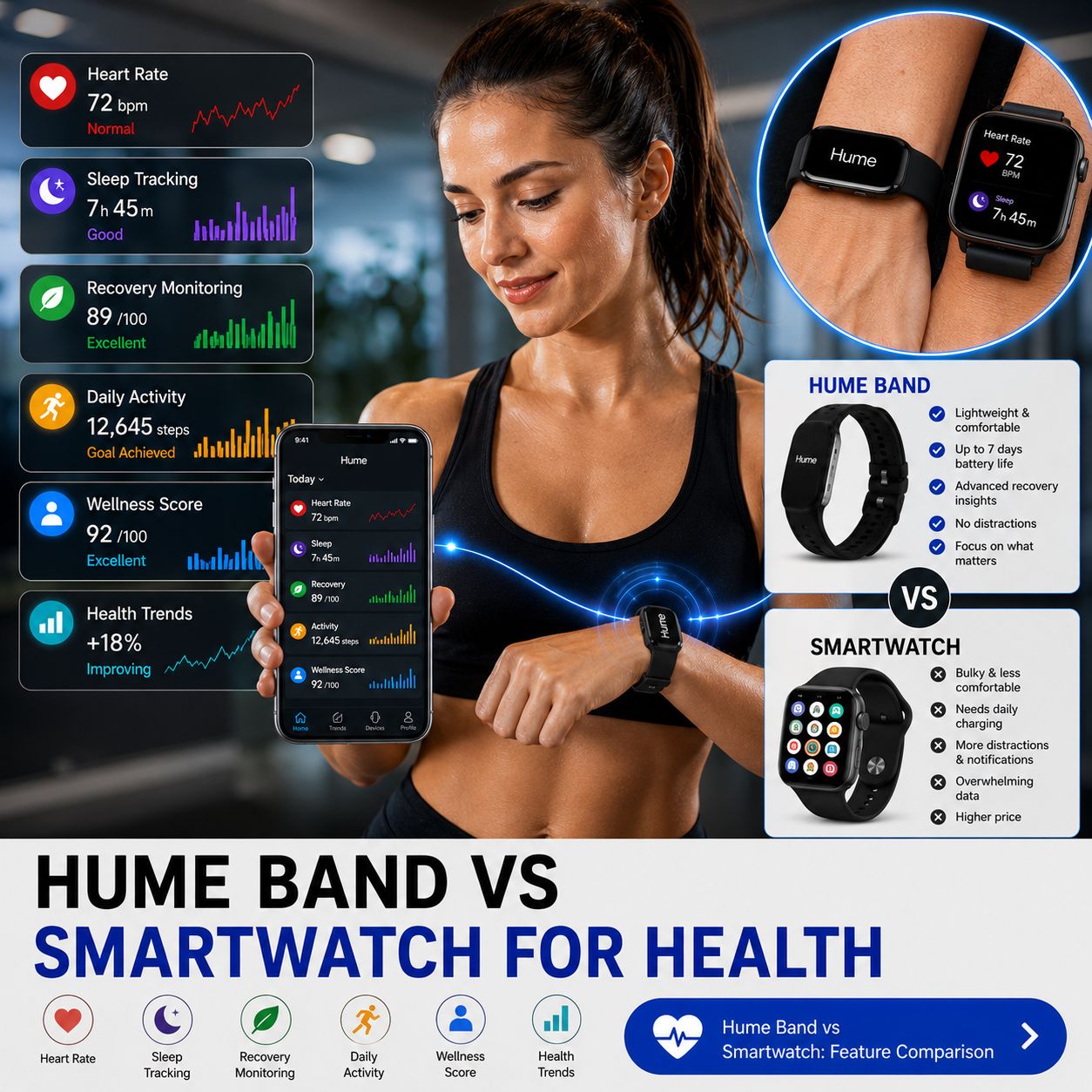
Hume Band vs. Smartwatch: Quick Comparison
| Feature | Hume Band 2.0 | Modern Smartwatch |
|---|---|---|
| Screen | No | Yes |
| Notifications | No | Yes |
| Calls | No | Many models |
| Apps | No | Yes |
| GPS | Not its focus | Common |
| Heart rate | Yes | Yes |
| HRV | Yes | Many models |
| Sleep tracking | Yes | Yes |
| Sleep stages | Yes | Many models |
| Recovery insights | Strong focus | Available on many models |
| Longevity metrics | Strong focus | Usually less central |
| ECG | No | Available on some models |
| Workout display | No | Yes |
| Battery | Up to 14 days claimed | Varies by model |
| Subscription | Not required for core use | Varies |
| Distraction | Very low | Higher |
| Best for | Wellness trends | All-around use |
Final Verdict
A smartwatch provides considerably more functionality and can be an excellent choice for people who want health tracking alongside communication, GPS, apps, workouts, and everyday convenience.
But if your goal is different, if you want to quietly monitor your health, sleep, recovery, HRV, activity, and longer-term wellness trends without another screen constantly competing for your attention, the Hume Band makes a strong case.
A wearable that sits on a charger because it is inconvenient isn’t particularly useful. Likewise, a smartwatch packed with features may be unnecessary if all you want is sleep and recovery tracking.
Hume Band’s appeal comes from doing less on your wrist while providing more context in its app. For health-conscious users interested in long-term trends, recovery, sleep, and minimizing digital distractions, it may be worth considering.
For athletes, smartwatch enthusiasts, and people who need GPS, communication, apps, or real-time workout information, a smartwatch remains the more versatile option.
.
.
.