How Accurate is Hume Health Body Pod for Weight Loss? – Read!
How Accurate is the Hume Health Body Pod for Weight Loss? 🔥Accuracy, Body Fat Tracking & Weight Loss Progress Explained!
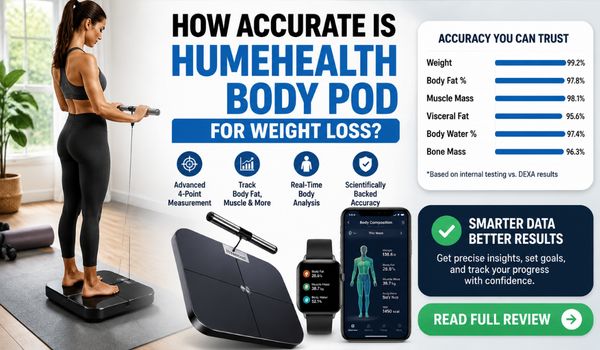

If you are trying to lose weight, the number on a bathroom scale tells only part of the story.
A person can lose body fat while maintaining muscle, gain muscle while losing inches, or experience temporary weight changes because of hydration.
That is why devices that estimate body composition have become increasingly popular. The Hume Health Body Pod is one of the more advanced consumer devices in this category.
It uses hand and foot electrodes and multi-frequency bioelectrical impedance analysis, or BIA, to estimate body fat, fat-free mass, skeletal muscle, visceral fat, body water, and other measurements.
Hume says the device can provide more than 45 metrics in about 60 seconds.
What Is the Hume Health Body Pod?
The Hume Health Body Pod is an at-home body-composition analyzer designed to provide more information than a conventional bathroom scale.
Traditional scales primarily measure body weight. The Body Pod uses an eight-point electrode system, with sensors for the hands and feet, to send very small electrical currents through the body.
Hume says its multi-frequency system evaluates how those currents move through different tissues and uses the resulting electrical impedance measurements to estimate body composition.
The device measures the body in segments, including the left arm, right arm, torso, left leg, and right leg.
This is important because a person’s body composition is not necessarily distributed evenly. Two people can have the same body weight and very different amounts of muscle and fat.
How Does the Hume Body Pod Measure Body Fat?
The Body Pod uses bioelectrical impedance analysis, commonly abbreviated as BIA.
BIA works by measuring the resistance or impedance encountered when a low electrical current passes through the body.
Tissues containing more water and electrolytes generally conduct electrical current differently from tissues containing less water.
The device combines impedance measurements with information such as body weight and other characteristics to estimate body composition.
The Hume Pod uses multiple frequencies and hand-to-foot measurement rather than relying solely on the electrical pathway through the legs. Hume says its eight electrodes allow the device to analyze different body segments.
This design is potentially more informative than a basic feet-only scale because the electrical pathway covers more of the body.
What Does “98% Accurate” Actually Mean?
This is one of the most important points to understand.
Hume markets the Body Pod with a claim of approximately 98% DEXA accuracy and says its accuracy has been third-party verified.
That wording can sound as though the device will give a body-fat percentage almost identical to DEXA every time. That is not necessarily what a high correlation or accuracy percentage means.
Correlation measures how closely two measurements move together. Imagine that a DEXA scan shows that one person has 20% body fat and another has 30%.
If the Hume Pod consistently ranks the second person as having more body fat than the first, the two methods can show a very high correlation even if the exact percentages are not identical.
For consumers, mean absolute error, bias, and limits of agreement can be more informative than a single correlation figure.
The 2026 independent study illustrates this distinction well. The Hume Pod showed very strong correlations with DEXA, but the average body-fat percentage was not identical to the DEXA measurement.
The Hume Pod’s body-fat estimate averaged 27.1% compared with 28.9% for DEXA in the study. The mean absolute error was approximately 3.0 percentage points.
So, a better interpretation is this:
The Hume Pod appears capable of producing reasonably strong body-composition estimates, but “98% accuracy” should not be interpreted as a promise that an individual’s body-fat percentage will always be within 2% of a DEXA result.

Is the Hume Pod Accurate Enough for Weight Loss?
For weight-loss tracking, the answer is more favorable.
If your goal is to determine whether your body composition is changing over several weeks or months, you do not necessarily need a laboratory measurement every morning.
Suppose your starting body-fat estimate is 35%. After eight weeks, the Body Pod consistently reports measurements around 32%, while your weight, waist measurement, exercise performance, and other indicators are also moving in the expected direction.
The exact number might not be identical to a DEXA result. But the direction of change may still be useful.
This is where consumer body-composition devices can provide practical value.
Weight loss is rarely perfectly linear. A person’s scale weight can increase temporarily after a salty meal, a high-carbohydrate day, intense exercise, or changes in hydration. Meanwhile, fat loss can continue underneath those short-term fluctuations.
A device that tracks body-fat and lean-mass trends can therefore provide additional context.
However, the key is consistency.
If you measure under completely different conditions every time, the device may be responding partly to changes in hydration rather than genuine changes in body fat.
How to Get More Consistent Hume Pod Measurements?
If you decide to use the Hume Pod for weight-loss tracking, consistency is more important than chasing a perfect number.
A practical approach is to measure under similar conditions each time.
For example:
- Measure at approximately the same time of day.
- Use the device before eating when possible.
- Avoid comparing a post-workout measurement with a resting measurement.
- Keep hydration conditions reasonably consistent.
- Follow the manufacturer’s instructions for positioning and electrode contact.
- Track trends over weeks rather than reacting to one reading.
This approach reduces some of the noise that can occur with BIA measurements.
It is also helpful to look at several measurements together. Instead of asking, “Why did my body fat change today?” ask, “What has happened to my average body-fat estimate over the last four weeks?”
That is a much more meaningful question for weight-loss management.
Hume Body Pod vs. DEXA
DEXA, or dual-energy X-ray absorptiometry, is commonly used as a reference method for body-composition assessment. It can provide measurements of fat mass, lean mass, and regional body composition and is widely used in research and clinical settings.
The Hume Pod offers something DEXA cannot: convenience.
A DEXA scan requires access to a facility, an appointment, and usually a fee. The Hume Pod can be used at home repeatedly.
The trade-off is precision.
The 2026 independent study found strong agreement between the Hume Pod and DEXA, but it also found statistically significant differences in several measurements.
Body-fat percentage differed by an average of roughly 1.8 percentage points between the two methods in that sample, and the mean absolute error was approximately 3.0 percentage points.
That means the Body Pod can be useful for monitoring progress, but someone who needs highly precise body composition information for medical research, diagnosis, or specialized clinical purposes should not assume the Hume Pod is equivalent to a laboratory scan.
The two technologies serve different purposes.
Hume Pod is better suited to frequent home monitoring.
What About Muscle Mass During Weight Loss?
- Tracks More Than Weight: The Hume Pod estimates body fat, skeletal muscle, and fat-free mass, providing a broader view of body composition changes during weight loss.
- Supports Muscle Monitoring: Tracking estimated muscle mass can help determine whether your weight-loss progress reflects mostly fat loss or also significant lean-tissue changes.
- Segmental Measurements: The Body Pod provides measurements for areas such as the arms, legs, and torso, helping you track change across different body regions.
- Focus on Trends: Individual readings can fluctuate, so comparing measurements over several weeks is generally more useful than focusing on one day’s result.
- Hydration Can Affect Results: Changes in hydration, food intake, and exercise can influence BIA measurements, leading to temporary changes in estimated muscle or fat levels.
- Use Multiple Progress Signals: Combine Body Pod trends with body weight, waist measurements, strength, activity, and nutrition to develop a more complete picture of weight-loss progress.
Is the Hume Body Pod Good for People Who Are Overweight?
It can be useful, but individual accuracy may vary.
The independent 2026 study included adults with an average BMI of approximately 24.6, with a relatively broad range.
That is valuable evidence, but it does not prove identical performance across all body types or all clinical populations.
This is an important limitation.
BIA algorithms estimate body composition based on relationships among electrical impedance, body water, body size, and other characteristics.
If an individual differs substantially from the populations represented in an algorithm’s development or validation data, accuracy can potentially change.
People with significant obesity, unusual body-water distribution, edema, certain medical conditions, or other factors affecting hydration should therefore be especially cautious about interpreting individual readings.
The Body Pod can still provide useful longitudinal information, but clinical concerns should be discussed with a healthcare professional rather than determined from a consumer device alone.
Does the Hume Pod Actually Help You Lose Weight?
The device itself does not cause weight loss.
This distinction is easy to overlook.
The Hume Pod measures and estimates body composition. It does not create an energy deficit, prescribe medication, increase physical activity, or automatically change eating behavior.
Its potential value is feedback.
For some people, seeing body composition trends can make a weight-management program easier to understand. Instead of focusing solely on scale weight, they can monitor body fat, estimated muscle mass, and other trends.
Hume’s current product pages position the Body Pod as a tool for tracking fat loss, muscle gain, visceral fat, and other metrics.
But the device should be considered one source of information among several.
A sustainable weight-management program should also consider nutrition, physical activity, sleep, waist circumference, strength, overall health, and, when appropriate, guidance from qualified healthcare professionals.
What Are the Main Strengths of the Hume Body Pod?
Several characteristics make the Body Pod more interesting than a basic bathroom scale.
Hand-and-foot measurement
The eight-point electrode system measures through the hands and feet rather than relying solely on the feet. Hume says this enables segmental assessment.
Multiple frequencies
The device uses multi-frequency electrical measurements. This allows the system to gather more information about electrical properties related to body water and tissues.
Frequent home measurements
Unlike DEXA, the device can be used repeatedly at home, allowing users to monitor trends without scheduling appointments.
Multiple body-composition metrics
The device provides estimates beyond body weight, including body fat, skeletal muscle, visceral fat, and other measurements.
Strong recent independent evidence
The 2026 preprint is particularly encouraging because it compared the Hume Pod against both a four-compartment model and DEXA and found strong agreement.
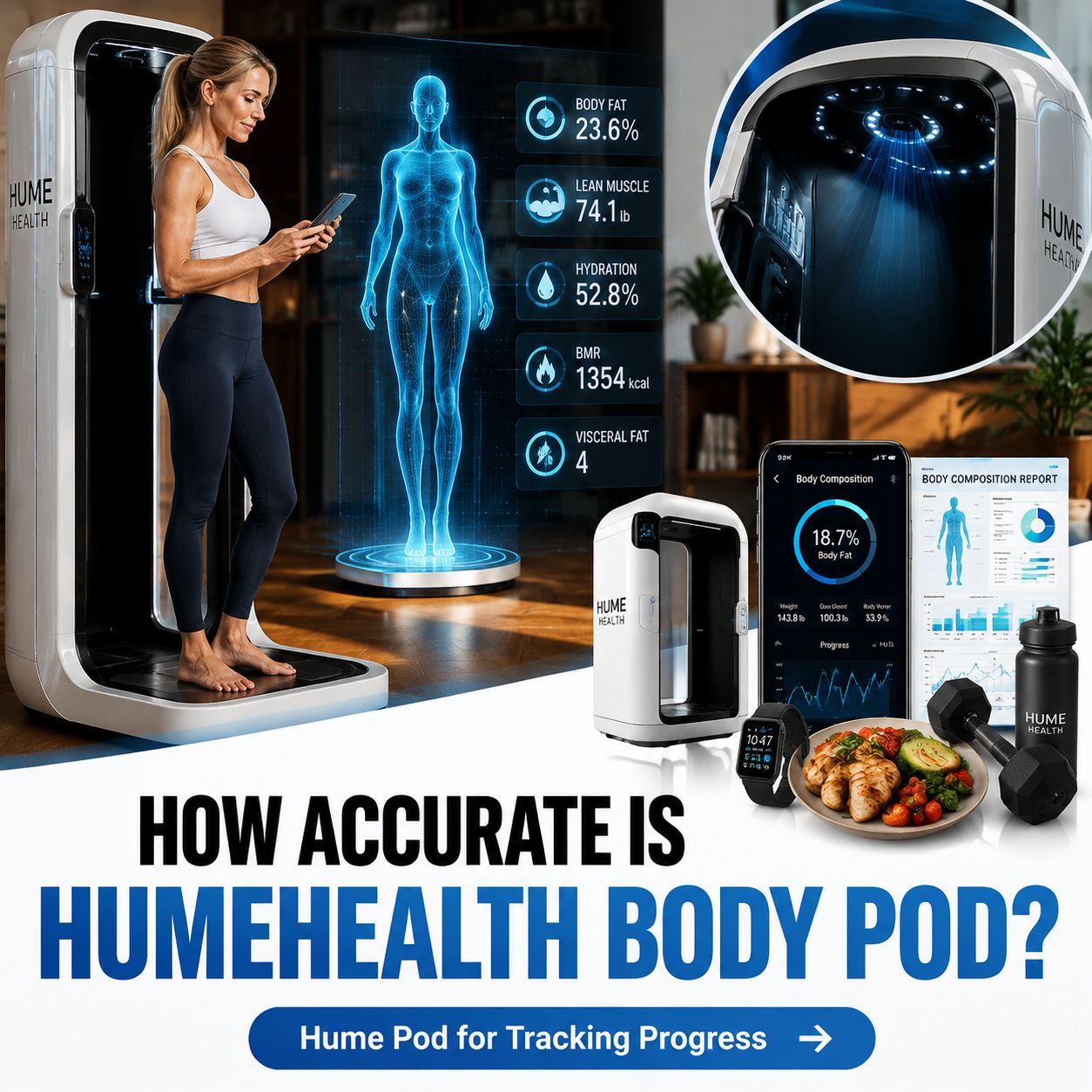
How Should You Use the Hume Pod During Weight Loss?
The best approach is to use it as a trend-monitoring tool.
Start by establishing a baseline. Take several measurements under consistent conditions rather than relying on a single reading.
Then select a small number of metrics that actually matter to your goal.
For a fat-loss program, those might include:
- Body weight
- Body-fat percentage
- Fat mass
- Skeletal muscle mass
- Waist circumference
- Strength or exercise performance
You do not need to obsess over every metric.
If your weight is decreasing, waist circumference is decreasing, body-fat estimates are trending downward, and strength is relatively stable, those combined signals can be more informative than any single number.
Conversely, if the scale is not moving but waist circumference and body-fat estimates are improving while strength is increasing, you may be experiencing body recomposition.
That is one reason body-composition tracking can be valuable.
A Practical Example
Imagine a person begins a weight-loss program at 200 pounds.
At the beginning, the Hume Pod estimates:
- Weight: 200 lb
- Body fat: 35%
- Fat mass: approximately 70 lb
- Lean mass: approximately 130 lb
After six weeks, the scale shows 194 pounds.
The Body Pod estimates:
- Weight: 194 lb
- Body fat: 32.5%
- Fat mass: approximately 63 lb
- Lean mass: approximately 131 lb
Those numbers would suggest a potentially favorable pattern: lower body weight, lower estimated fat mass, and relatively stable estimated lean mass.
But the important point is not that the Body Pod has necessarily measured exactly 63 pounds of fat.
The more useful conclusion is that multiple indicators are moving in a consistent direction.
That is how a consumer BIA device should ideally be used.
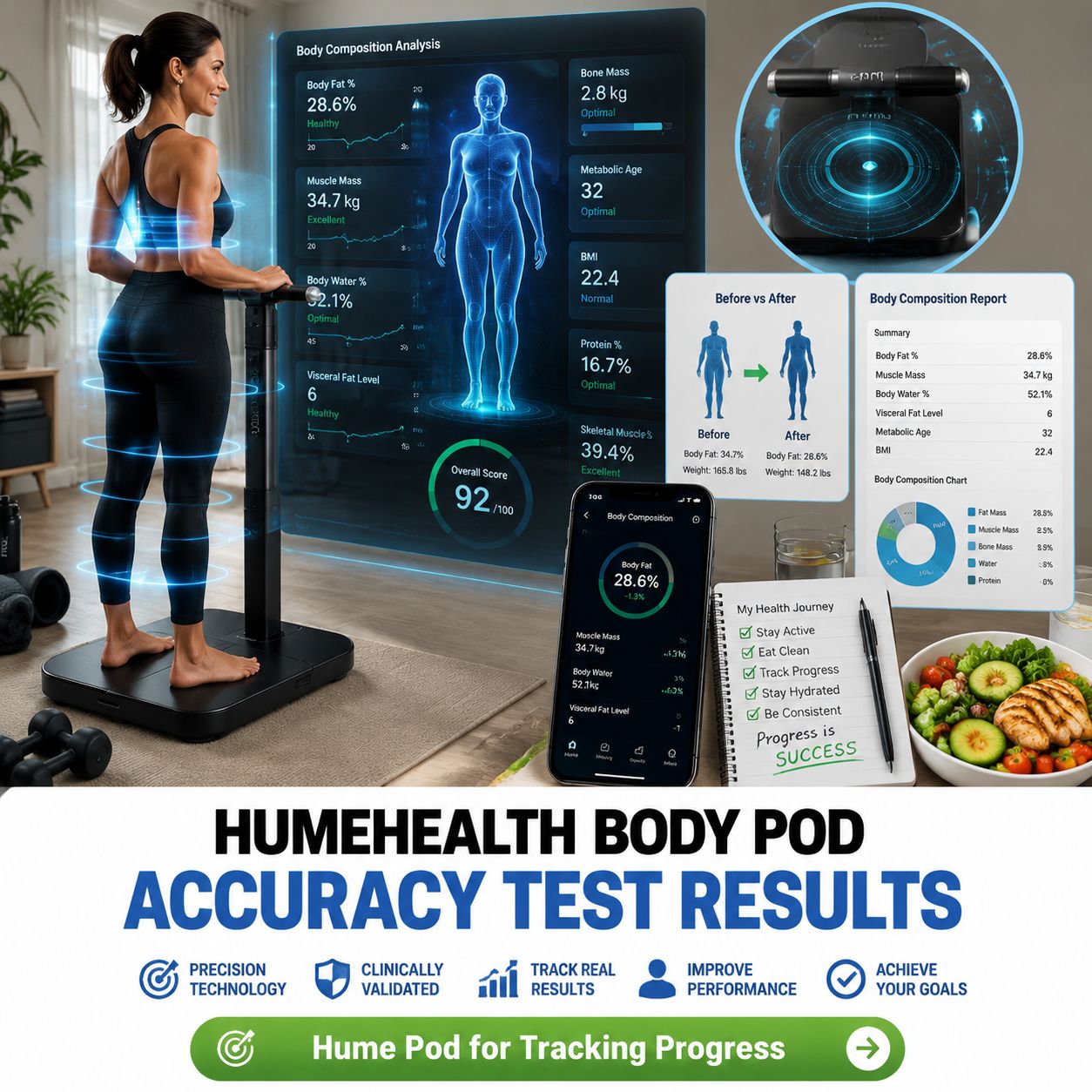
Bottom Line
The Hume Health Body Pod can be a useful tool for tracking body-composition trends during a weight-loss journey.
Its multi-frequency BIA technology provides estimates of body fat, fat mass, lean mass, skeletal muscle, and other metrics, offering more information than body weight alone.
Recent independent research has reported strong agreement with established body-composition methods, although individual readings can still vary.
Factors such as hydration, food intake, exercise, and measurement conditions may influence BIA results.
Therefore, the Body Pod should not be viewed as a replacement for DEXA or professional testing when highly precise measurements are required.
For everyday weight-loss tracking, its greatest value comes from monitoring consistent trends over time rather than focusing on a single reading.
Using it under similar conditions and combining its results with weight, waist measurements, nutrition, activity, and overall progress can provide a more complete picture of changes in body composition.
.
.
.