Is Hume Band Good for Health-Conscious Users? Key Benefits
Is Hume Band Good for Health-Conscious Users? – (🔥Smart Health Tracking!). Explore Hume Band features, health insights, benefits, and everyday use.
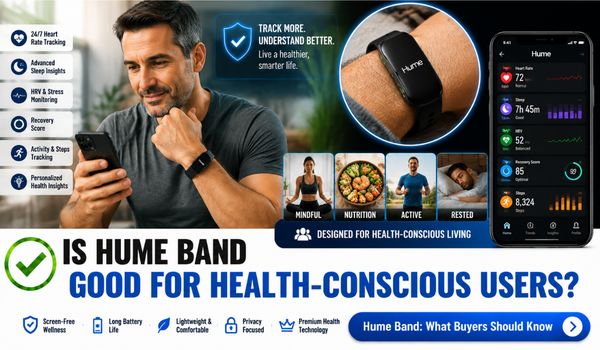
The Hume Band is designed specifically around this idea. Unlike a traditional smartwatch that combines health tracking with calls, notifications, apps, GPS, and entertainment, the Hume Band focuses primarily on health and wellness.
For many people, it can be a useful option, particularly if the goal is to monitor sleep, recovery, heart rate, HRV, activity, and longer-term wellness trends without wearing a smartwatch with a screen.
The current Hume Band 2.0 focuses on metrics such as heart rate, heart rate variability (HRV), resting heart rate, blood oxygen, skin temperature, sleep stages, activity, recovery, and blood pressure trends. Hume also promotes longer-term metrics such as Pace of Aging and Metabolic Momentum.
What Is the Hume Band?
The Hume Band is a screen-free wearable health tracker that works with the Hume Health smartphone app.
Instead of displaying information directly on your wrist, the Band continuously collects data and sends it to the app, where you can review measurements, scores, trends, and wellness insights.
The current Hume Band 2.0 is positioned as a wearable focused on longevity and overall wellness rather than simply counting steps or functioning as a smartwatch.
Hume lists features such as continuous heart rate tracking, overnight HRV, sleep-stage tracking, SpO2, skin temperature trends, activity, recovery, and blood pressure trend insights.
This makes the Band particularly interesting for people who don’t necessarily want another screen on their wrist.
The philosophy is relatively simple:
Wear the Band → collect health data → review your trends → make better-informed lifestyle decisions.
The purpose of tracking isn’t simply to collect hundreds of numbers. The information becomes useful when it helps you understand your habits and make reasonable changes.
Why Might Health-Conscious Users Want a Wearable?
Health-conscious people often pay attention to several areas simultaneously.
You may already monitor:
- Sleep duration
- Exercise
- Daily steps
- Heart rate
- Nutrition
- Recovery
- Stress
- Rest days
- Energy levels
- Weight
- Workout performance
The problem is that these factors can be difficult to connect. You might know that you slept poorly, for example, but you may not realize that your resting heart rate also changed and that your recovery was lower the following day.
A wearable can bring some of these signals together. That doesn’t mean the device understands everything happening inside your body.
Instead, it provides another source of information that can help you identify patterns. For a health-conscious user, that can be valuable.
Sleep Tracking Is One of Its Most Useful Features
Sleep is a major component of overall wellness, and it is also something that many people struggle to evaluate accurately.
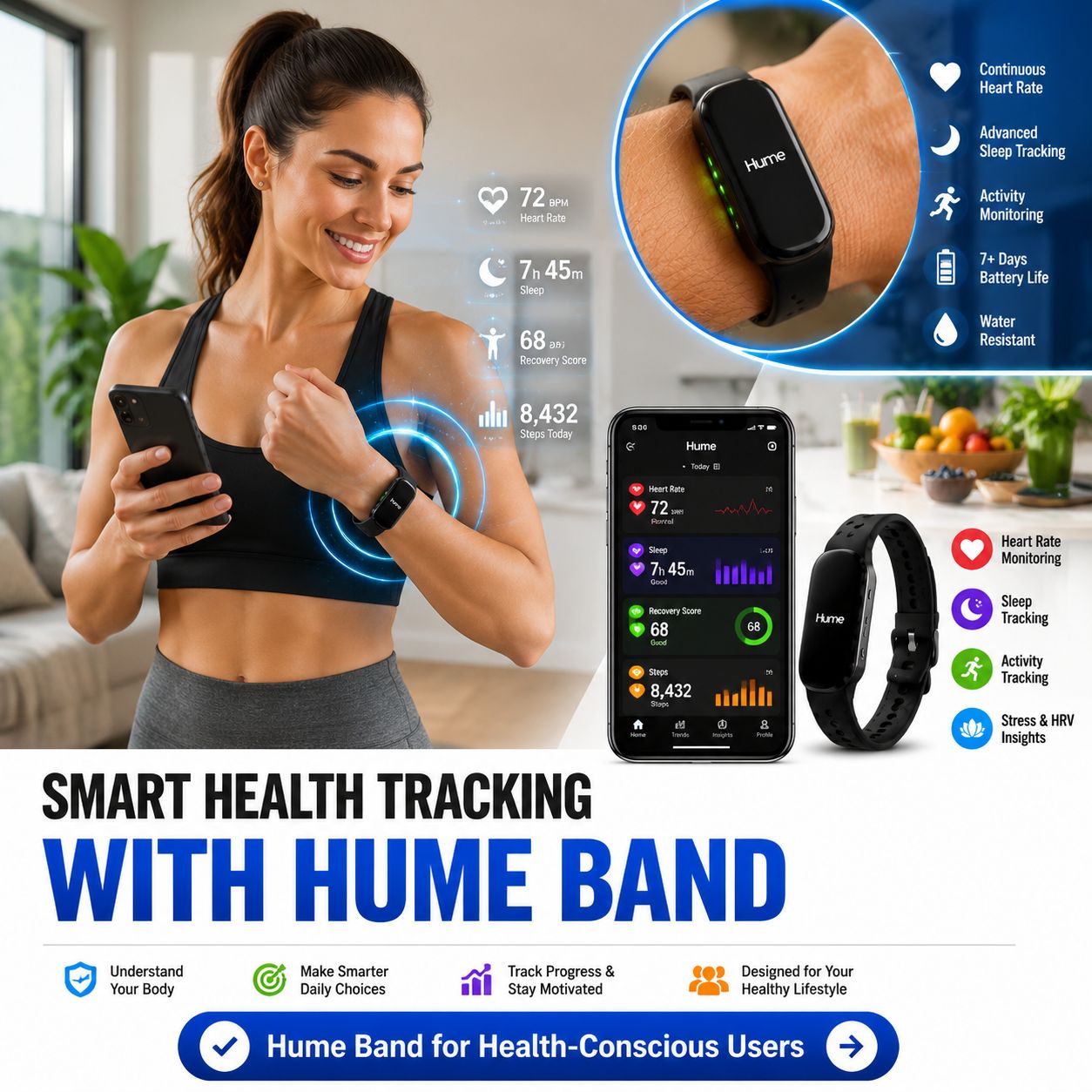
Hume says the Band tracks sleep stages, including light, deep, REM, and awake periods, along with HRV and resting heart rate during sleep.
The Hume app can then present sleep information in a way that’s easier to review. For health-conscious users, this can help identify patterns such as:
- Consistently short sleep
- Irregular bedtime schedules
- Changes in recovery after poor sleep
- Differences between weekdays and weekends
- Relationships between sleep and activity
For example, imagine you normally sleep around six hours on weekdays but seven and a half hours on weekends.
Over several weeks, you may notice that your recovery scores tend to be better after longer nights. That information could encourage you to gradually improve your sleep schedule.
The important point is that trends are generally more useful than a single night’s score.
- A bad night’s sleep happens to everyone.
- A repeated pattern is much more interesting.
A necessary limitation
Wearable sleep tracking should not be treated as equivalent to a professional sleep study. The Hume Band is a consumer wellness device, and its measurements are estimates generated by sensors and algorithms.
If someone has persistent sleep problems or symptoms that concern them, professional medical evaluation is more appropriate than relying solely on a wearable.
Recovery Tracking Can Help With Daily Decisions
Health-conscious users don’t necessarily want to exercise harder every day. Recovery is an important part of maintaining a sustainable routine.
Hume uses information such as HRV, resting heart rate, and sleep to provide recovery-oriented insights. This can be useful because how you feel and how your body responds aren’t always identical.
For example:
- Monday: Good sleep, normal activity, strong recovery
- Tuesday: Hard workout, shorter sleep
- Wednesday: Lower recovery
- Thursday: Rest day and longer sleep
- Friday: Recovery begins returning toward normal
Looking at this kind of pattern may encourage someone to balance challenging workouts with appropriate recovery.
The Band doesn’t need to make the decision for you. Its value can come from giving you more information to consider.
HRV Monitoring for Long-Term Trends
Heart-rate variability, or HRV, is another metric that attracts attention from people interested in recovery and wellness.
Hume Band 2.0 includes overnight HRV tracking. However, HRV is not a simple “higher is always better” number. Individual baselines differ significantly.
For this reason, health-conscious users may get more value by observing their own trends instead of comparing their HRV directly with someone else’s. Suppose your typical HRV stays within a particular range for several weeks.
Then you experience several nights of poor sleep and notice that your HRV also moves away from your normal range.
That could be an interesting observation. It doesn’t prove that poor sleep caused the change, but it gives you something to investigate.
This is a useful mindset for wearable data: Use measurements to ask better questions rather than treating every number as a diagnosis.
Heart-Rate Tracking
The Hume Band provides continuous heart-rate tracking, according to Hume’s current product information.
For everyday wellness tracking, this can be useful for understanding resting heart rate and observing how heart rate changes with activity.
A health-conscious user might use it to observe:
- Resting heart-rate trends
- General activity response
- Changes during exercise
- Overnight heart rate
- Recovery patterns
Again, the most interesting information is often the trend.
If your normal resting heart rate remains relatively consistent and then changes for several days, you may want to consider what else changed in your routine.
Perhaps you:
- Slept less
- Increased training volume
- Traveled
- Changed your schedule
- Experienced unusual stress
- Changed your daily activity
A wearable cannot necessarily tell you why something changed. But it can help you notice that something changed.
Blood-Oxygen and Skin-Temperature Tracking
The Hume Band also tracks overnight blood oxygen and skin-temperature trends. These measurements can provide additional context when reviewing your overall wellness patterns.
For example, a user might notice that skin temperature differs from their usual baseline during certain periods.
However, these measurements should be interpreted carefully. A consumer wearable isn’t a replacement for clinical equipment.
Small variations in sensor measurements can happen because of factors such as:
- Device placement
- Skin contact
- Movement
- Environmental conditions
- Individual physiology
Therefore, health-conscious users should avoid becoming overly concerned about isolated changes.
The best approach is to watch for consistent patterns and discuss concerning symptoms or persistent changes with a qualified healthcare professional.
Activity and Movement Tracking
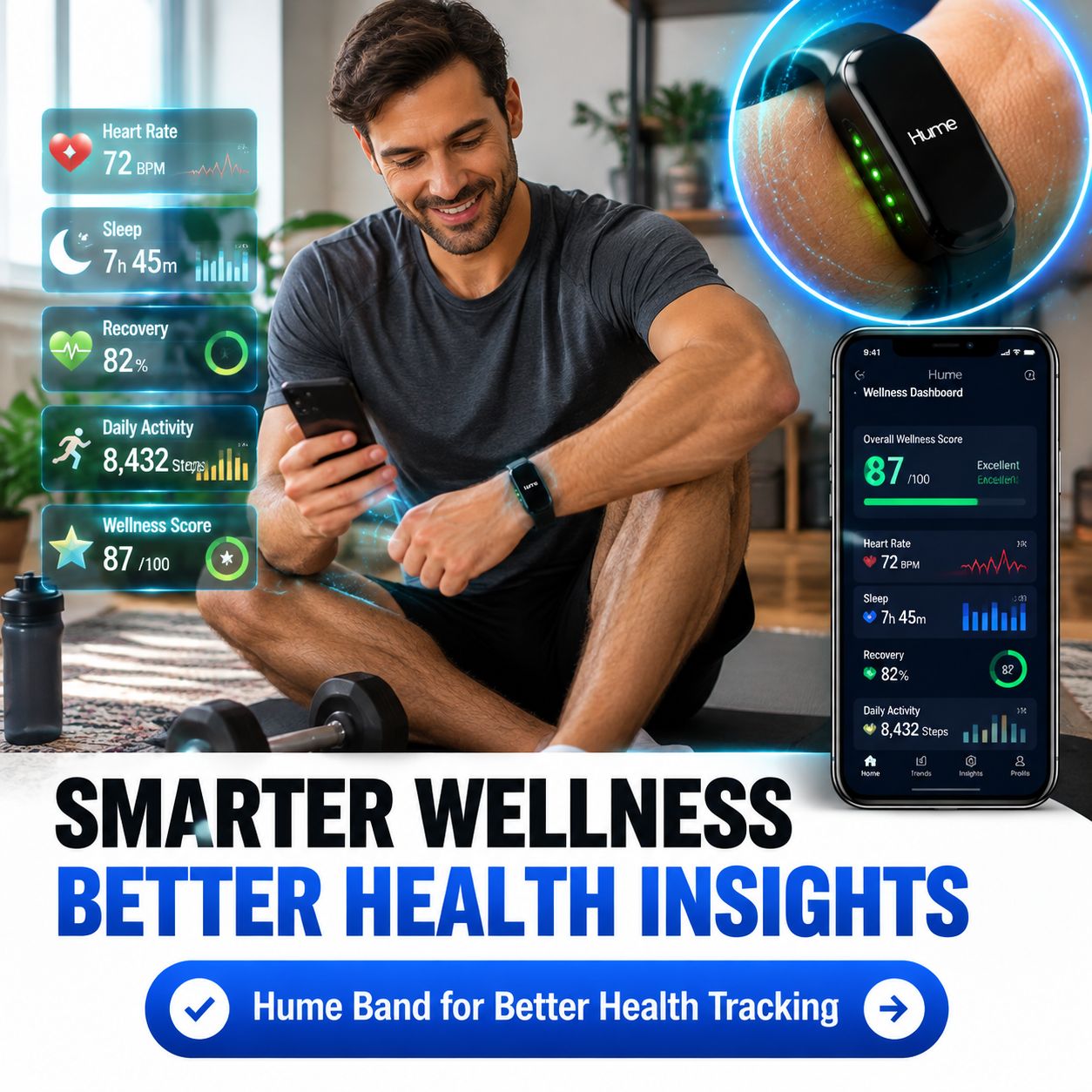
The Hume Band also tracks steps, distance, calories, activity, and strain-related information.
For someone who wants to stay active, this provides a simple way to monitor everyday movement. You don’t necessarily need to be a serious athlete to benefit.
A person might set a simple goal such as: Tracking daily activity can make progress more visible.
For example:
- Monday — 4,500 steps
- Tuesday — 6,200 steps
- Wednesday — 7,100 steps
- Thursday — 5,800 steps
- Friday — 8,000 steps
Seeing these numbers may encourage you to maintain a more active routine.
But steps shouldn’t become the only measure of health. Walking, strength training, mobility work, cardiovascular exercise, recovery, and sleep all play different roles.
The value of the Band comes from combining multiple signals rather than reducing health to one number.
A Screen-Free Design Can Be a Major Advantage
One feature that separates the Hume Band from many smartwatches is the lack of a screen. At first, that might sound like a disadvantage.
After all, a smartwatch can display:
- Time
- Messages
- Notifications
- Workout information
- Maps
- Music controls
- Calls
But some people don’t want those features. If you’re trying to reduce digital distractions, a screenless wearable can be appealing. You can wear the Band throughout the day without constantly checking your wrist.
Independent testing has also highlighted the screenless experience as one reason the Hume Band can appeal to people who want health tracking without the distractions of a smartwatch.
This may be particularly useful for people who already spend a lot of time looking at their phones. Instead of receiving more notifications, the Band quietly collects data in the background.
Battery Life Matters for Health Tracking
Battery life may sound like a technical specification, but it can directly affect the usefulness of a health tracker.
If you have to charge your wearable every day, you may remove it overnight. That can create gaps in sleep data.
Hume currently advertises up to 14 days of battery life for the Band 2.0. However, real-world battery performance can vary.
A June 2026 review by Wareable reported that its tester achieved approximately 7 days of continuous day-and-night use, rather than the advertised 14-day maximum.
Another August 2026 test reported the Band reaching 14% battery after 10 days of continuous wear.
This is a good example of why health-conscious buyers should distinguish between maximum advertised battery life and typical real-world experience.
Even if actual battery life is shorter than the maximum claimed, a multi-day battery can still make continuous tracking easier than a device that requires daily charging.
Hume Band and Long-Term Wellness
The Hume Band’s biggest distinction is its emphasis on longer-term wellness and longevity.
Hume promotes features such as Pace of Aging and Metabolic Momentum, which are designed to interpret health signals over time.
This may appeal to health-conscious users who aren’t only interested in today’s step count.
Instead, they may ask: “Are my habits helping me build a healthier long-term routine?”
For example, you could compare periods when you:
- Slept consistently
- Exercised regularly
- Reduced inactivity
- Improved recovery
- Changed your daily routine
The goal is to look for relationships between habits and trends. However, longevity scores should be viewed as wellness estimates, not precise predictions of how long someone will live.
Hume itself describes these signals as directional and wellness-oriented rather than medical diagnoses. That’s an important distinction.
Is Hume Band a Medical Device?
No. This is one of the most important points health-conscious users should understand.
The Hume Band is designed for wellness tracking and health insights. It should not be treated as a medical diagnostic device.
For example, Hume describes its blood-pressure information as trend insights rather than a cuff reading and says it does not replace a blood-pressure cuff or medical decision-making.
That means you shouldn’t use the Band to:
- Diagnose a medical condition
- Change medication
- Replace prescribed treatment
- Ignore concerning symptoms
- Make major medical decisions based solely on wearable data
Instead, use it as an additional source of wellness information.
If something concerns you, professional medical advice remains more important than a wearable score.
How Accurate Is the Hume Band?
Accuracy is one of the biggest questions for anyone considering a health tracker. Wearables use sensors and algorithms to estimate physiological information.
Their performance can vary depending on the metric, activity, fit, skin contact, movement, and other conditions.
Hume says Band 2.0 includes improved sensors and signal processing designed to improve accuracy.
However, independent testing has found limitations. Wareable’s June 2026 review reported inaccuracies in heart rate, sleep, and recovery measurements during testing.
Another recent test found that the Band was more convincing for general wellness tracking than for detailed workout performance, with heart rate lagging during higher-intensity exercise.
This is important for health-conscious users because expectations matter. If you want a general picture of your wellness trends, the Band may be useful.
Hume Band for Fitness Enthusiasts
The Hume Band can complement exercise, but it isn’t necessarily designed to replace a dedicated sports watch.
For general fitness, it can provide useful information about:
- Activity
- Recovery
- Sleep
- HRV
- Heart rate
- Strain
- Daily movement
But serious athletes may want additional features such as:
- Live pace
- Detailed workout zones
- GPS
- Advanced training metrics
- Live workout screens
- Structured workout support
Because the Hume Band is screenless, you won’t get live workout information directly on your wrist.
Recent independent testing similarly found that the device is better suited to wellness and longevity tracking than to detailed fitness performance.
Therefore, a recreational exerciser and a competitive athlete may reach very different conclusions about its usefulness.
Is Hume Band Comfortable Enough for Everyday Use?
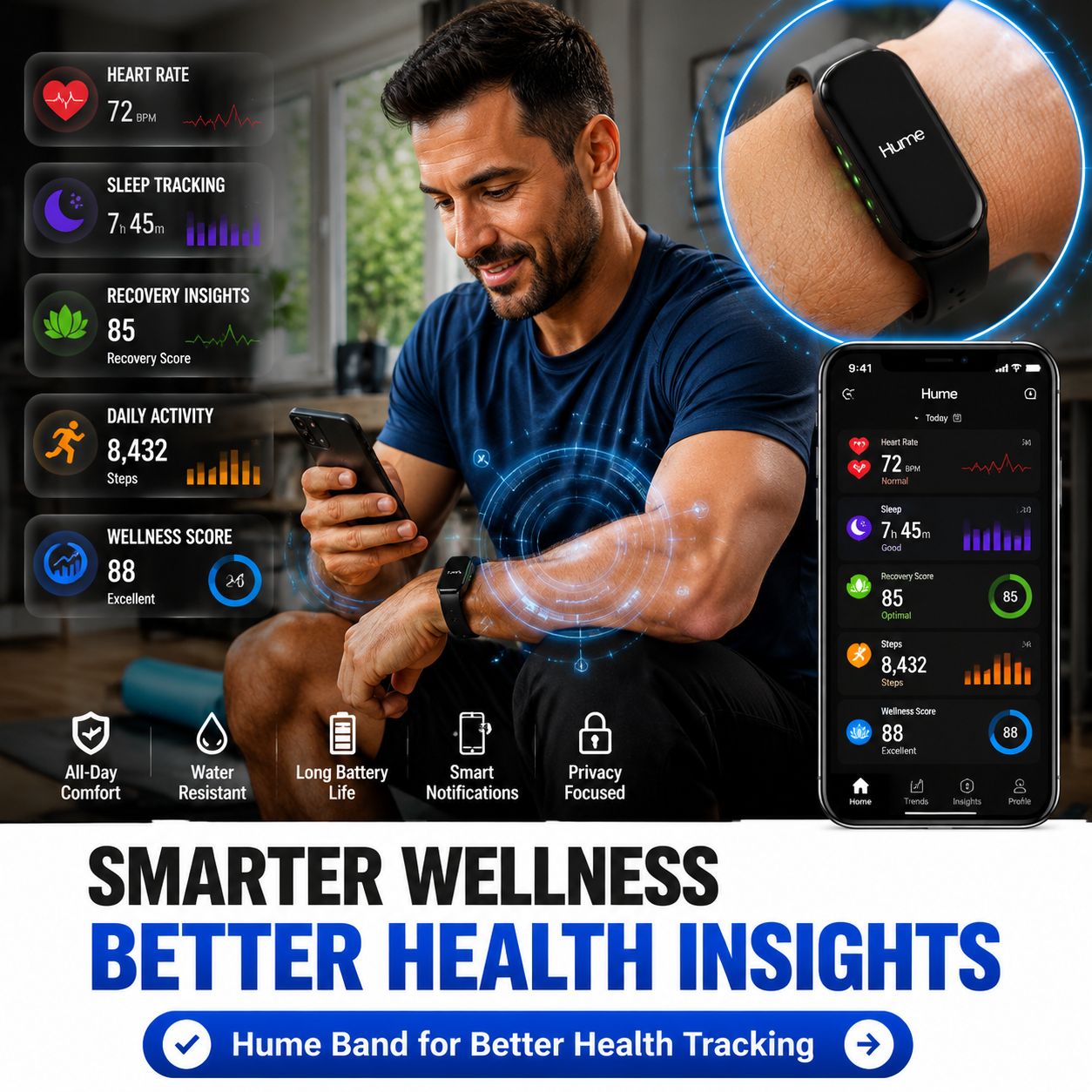
A health wearable only provides value if you actually wear it. This makes comfort extremely important.
The Hume Band 2.0 uses a redesigned strap, and Wearable’s testing described it as lightweight, soft, discreet, and comfortable enough for continuous wear and sleep tracking.
Comfort matters because health-conscious users may want to wear the device:
- During the day
- While sleeping
- During exercise
- While traveling
- During normal household activities
A device that is uncomfortable at night may result in inconsistent sleep data. Similarly, a band that irritates the skin during workouts can make people less likely to wear it consistently.
Fit also matters for sensor performance. The Band should be secure enough to maintain appropriate contact without being unnecessarily tight.
Does Hume Band Require a Subscription?
This is another factor that health-conscious users may appreciate.
Hume currently markets the Band 2.0 as a one-time purchase with core health data and insights available without a required subscription.
However, Hume also offers a premium option for deeper analysis, AI-driven insights, and additional coaching features. The current Hume product information lists Premium starting at $8.99 per month.
This means consumers should distinguish between: Core Band functionality and Optional premium services.
You can use the Band for its basic tracking experience without committing to a recurring subscription. For people who dislike monthly wearable fees, that can be an important advantage.
What Makes Hume Band Different From a Smartwatch?
The easiest way to understand the Hume Band is to compare its purpose with that of a smartwatch.
Hume Band focuses on:
- Health tracking
- Sleep
- Recovery
- HRV
- Long-term wellness
- Screen-free use
- Passive monitoring
A smartwatch typically focuses on:
- Notifications
- Calls
- Apps
- GPS
- Music
- Live workout information
- Smartphone integration
- Health tracking
Neither approach is automatically better. It depends on what you want.
If your main goal is to reduce digital distractions while still collecting health information, Hume’s screenless design may be appealing.
If you want a device that can replace some smartphone functions, a smartwatch may provide greater value.
Who Is the Hume Band Best Suited For?
The Hume Band may be a particularly good fit for several types of users.
Health-conscious beginners – If you’re just starting to pay more attention to sleep, recovery, and daily activity, the Band can serve as a central place to monitor multiple wellness signals.
People focused on longevity – The emphasis on longer-term trends and wellness may appeal to people who think beyond short-term fitness goals.
People who dislike smartwatch distractions – If you don’t want notifications on your wrist, the screenless design can be a significant benefit.
Sleep-focused users – The lightweight design and long advertised battery life make it suitable for continuous wear and overnight tracking.
People who dislike recurring subscriptions – The core experience does not require a mandatory subscription, which may make the ownership model more attractive.
How Can Health-Conscious Users Get the Most From Hume Band?
Simply wearing a health tracker doesn’t automatically make you healthier. The real benefit comes from how you use the information.
Step 5: Make small changes
If you notice that your sleep is consistently short, you don’t need to completely redesign your lifestyle overnight.
Try going to bed 20–30 minutes earlier. Then observe the trend. Small changes are often easier to maintain.
Hume Band’s Value for Health-Conscious Users
Value isn’t simply about price. A wearable can be inexpensive but provide little practical benefit.
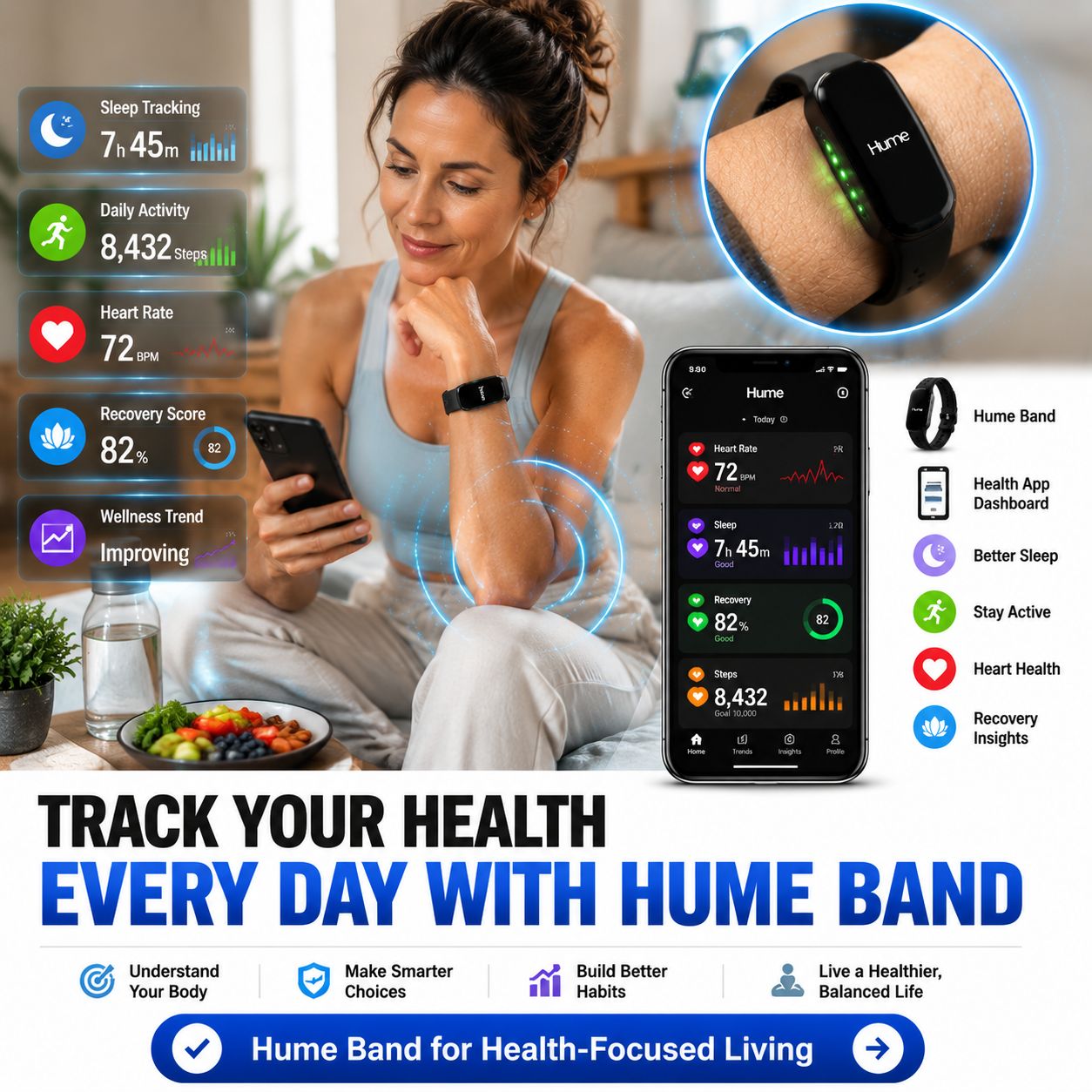
Another device may cost more but provide information you actually use. The Hume Band’s value comes from several factors:
- Continuous monitoring – It can collect information throughout the day and night.
- Health-focused design – Its primary purpose is wellness rather than smartphone functionality.
- Screen-free experience – It can reduce wrist-based digital distractions.
- Long battery potential – The manufacturer advertises up to 14 days of battery life, although independent testing has produced varying results.
- Core data without a mandatory subscription – Hume currently promotes the Band as a one-time purchase for its core tracking experience.
- Long-term trends – The platform emphasizes recovery, sleep, HRV, and broader longevity-related insights. For someone who actively uses these features, the Band can potentially offer substantial value.
Final Verdict
The Hume Band 2.0 is particularly appealing to users who want a wearable centered around sleep, recovery, HRV, heart rate, activity, and long-term wellness trends rather than a traditional smartwatch experience.
Hume’s current product information also emphasizes screen-free use, an advertised 14-day battery life, and core tracking without a required subscription.
Its biggest strength is its focus. The Band isn’t trying to be your phone on your wrist. Instead, it is designed to quietly collect health information while you go about your day.
That can be especially attractive for people who want to monitor their wellness without adding another source of notifications and distractions. At the same time, prospective buyers should have realistic expectations.
Independent testing has identified limitations involving accuracy, battery performance, and workout tracking. And although the Band provides health-related insights, it should not be considered a medical diagnostic device.
The best way to use it is as a wellness trend-tracking tool.
- Wear it consistently.
- Look for patterns.
- Connect those patterns with your habits.
- Make reasonable lifestyle changes.
And when something seems medically concerning, use professional healthcare advice rather than relying solely on the wearable.
.
.
.