Is Hume Band Good for Monitoring Wellness? Everything to Know
Is Hume Band Good for Monitoring Wellness? – (🔥Wellness Tracking Made Simple!). Explore its health, sleep, recovery, stress, and activity monitoring features.
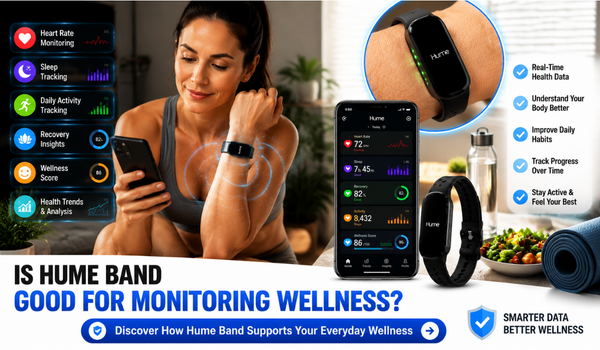
Wellness tracking has become a popular way to understand how everyday habits affect sleep, activity, recovery, stress, and overall health.
Instead of relying only on how we feel, wearable devices can provide useful information about patterns that may otherwise be difficult to notice.
One wearable that has attracted attention for its focus on long-term wellness is the Hume Band. Unlike a traditional smartwatch, the Hume Band is designed primarily around health and wellness tracking rather than notifications, calls, apps, and entertainment.
For many people, the answer is yes. Hume Band is designed to track several wellness-related signals, including heart rate, heart rate variability (HRV), sleep, blood oxygen, skin temperature, activity, strain, and recovery.
What Is the Hume Band?
The Hume Band is a screenless wearable health tracker designed to collect health and activity information throughout the day and night.
Instead of displaying information directly on your wrist, the band works with the Hume Health app. You wear the band; it collects data, and the app organizes that information into health metrics, scores, trends, and recommendations.
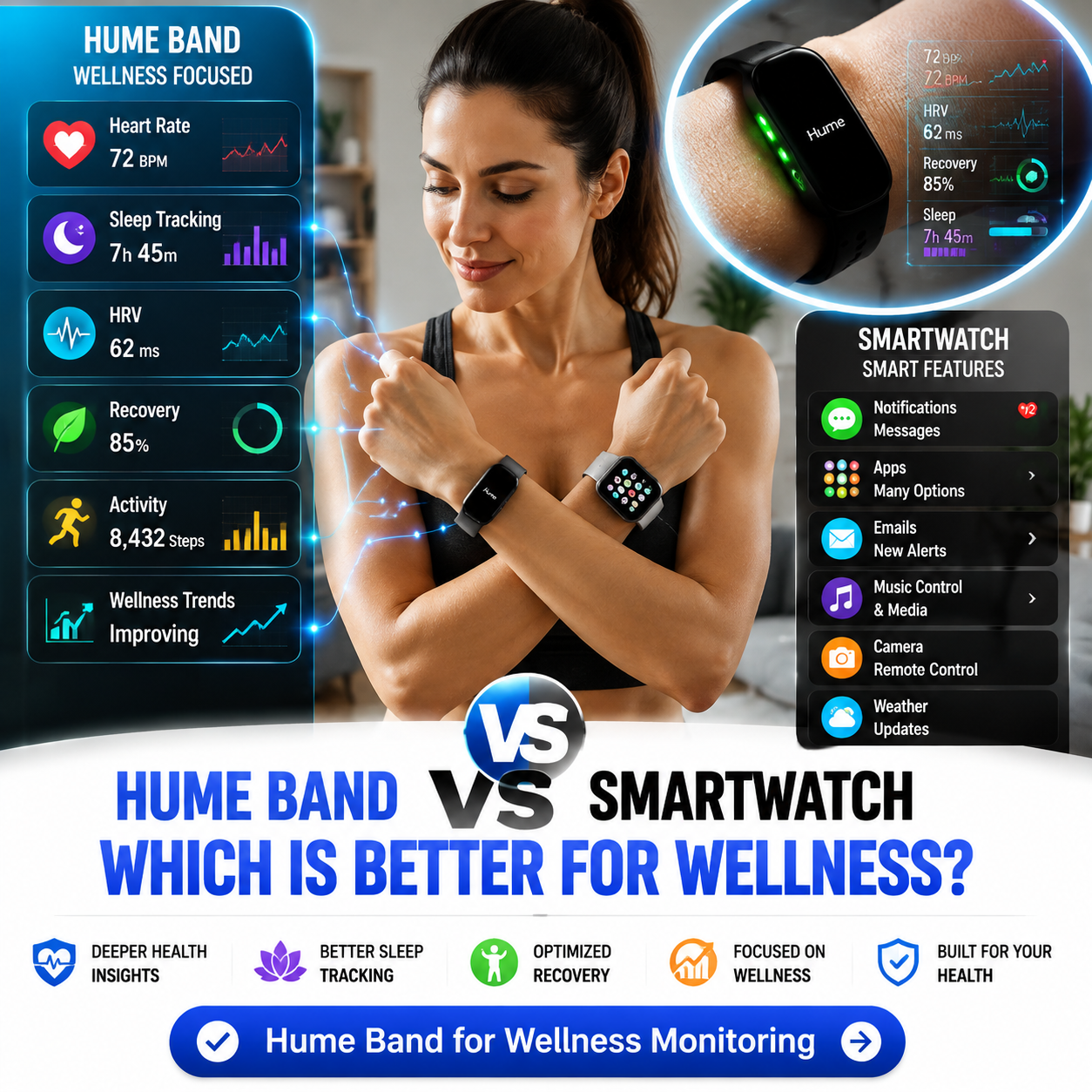
A smartwatch may focus on notifications, calls, messages, GPS, apps, music, workouts, and other smart features. Hume Band takes a more focused approach, placing greater emphasis on health, recovery, sleep, and long-term wellness.
Hume Band 2.0 is currently positioned by Hume as a screenless, subscription-free wearable with a claimed battery life of up to 14 days.
The company says it continuously monitors several signals, including heart rate, HRV, resting heart rate, blood oxygen, skin temperature, sleep stages, activity, strain, and recovery.
Is Hume Band Good for Monitoring Wellness?
Yes, Hume Band can be a useful wellness-monitoring device, particularly for people interested in long-term trends rather than individual readings.
A major advantage of wearable health technology is its ability to collect data consistently. Instead of remembering how well you slept last night or how energetic you felt three days ago, you can look at your historical data and compare patterns.
For example, you might notice that:
- Your resting heart rate increases after several nights of poor sleep.
- Your HRV tends to decrease during periods of high stress.
- Your recovery score improves when you maintain a consistent sleep schedule.
- Your activity increases when you walk more during the week.
- Your sleep quality changes after changing your evening routine.
- Your overall wellness trends improve when you combine regular exercise with better recovery.
These patterns can be more useful than obsessing over one individual number.
Independent reviews of the Hume Band have also highlighted its focus on long-term wellness and recovery rather than simply counting steps.
Wareable described it as a screenless tracker focused on long-term wellness trends, while Cybernews found it particularly useful for understanding sleep, stress, and recovery patterns.
What Wellness Metrics Does Hume Band Track?
One of the strongest aspects of Hume Band is the breadth of information it brings together.
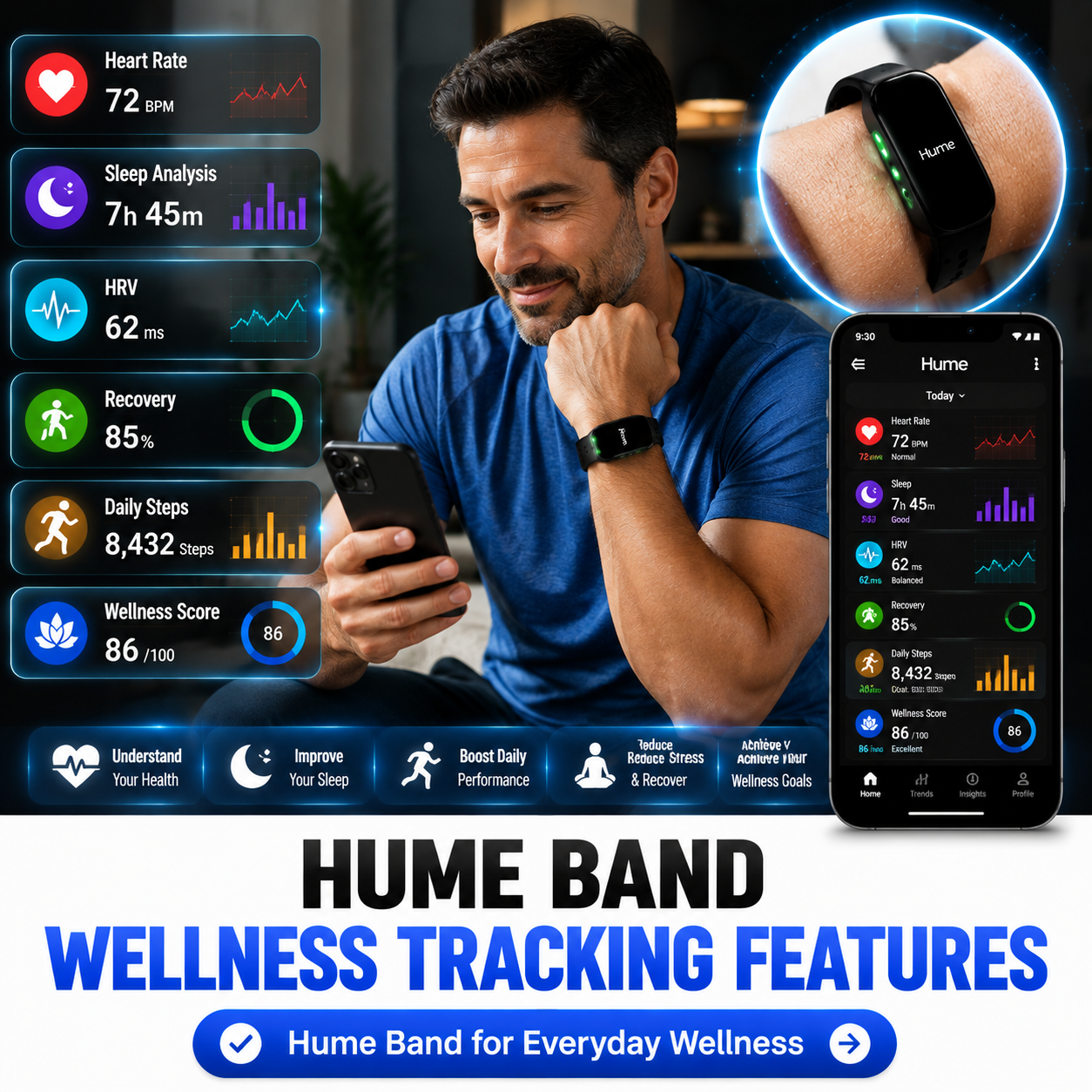
Depending on the Hume Band generation and software features available, the ecosystem can include metrics such as heart rate, HRV, resting heart rate, blood oxygen, skin temperature, sleep stages, activity, strain, recovery, and other wellness-related scores.
Hume Band 2.0 also adds blood-pressure trend insights and longevity-oriented measurements. Here are some of the most important metrics.
Heart Rate
Heart rate is one of the most basic but useful health signals available from a wearable.
Your heart rate naturally changes throughout the day. It may increase when you exercise, become stressed, climb stairs, or perform physical work. It generally decreases during rest and sleep.
Tracking heart rate over time can help you understand how your body responds to different activities. Hume says it’s Band 2.0 tracks heart rate continuously throughout the day and night.
However, users should remember that wrist-based optical sensors are not perfect. Movement, fit, skin contact, exercise intensity, and other factors can influence readings.
For everyday wellness, the overall trend can be more useful than treating every individual reading as exact.
Heart Rate Variability (HRV)
HRV is another important metric for wellness and recovery. Rather than simply measuring how many times your heart beats per minute, HRV looks at variations in the time between heartbeats.
HRV can be influenced by factors such as sleep, physical activity, stress, recovery, lifestyle, and other individual factors.
- Hume uses overnight HRV as part of its recovery-related insights.
- The key is not to compare your HRV number directly with someone else’s.
- Instead, establish your own baseline and watch how it changes over time.
For example, if your normal HRV is relatively stable and then drops for several days while you are sleeping poorly and feeling exhausted, that may be useful feedback that your body needs more recovery.
HRV should therefore be treated as a trend indicator, not a medical diagnosis.
Sleep Tracking
Sleep is one of the most important parts of overall wellness.
Poor sleep can affect energy, concentration, exercise performance, mood, and recovery. Unfortunately, it can be difficult to remember exactly how much you slept or how consistent your sleep schedule has been.
Hume Band is designed to be worn overnight and to track sleep-related information, including sleep duration and sleep stages such as light, deep, REM, and awake.
The Hume app can then use this information to provide a broader picture of your recovery. For example, you may discover that you regularly go to bed at different times, sleep fewer hours on workdays, or recover better after maintaining a consistent bedtime.
Blood Oxygen
Blood oxygen, commonly referred to as SpO2, is another metric offered by Hume Band.
The device can collect overnight blood oxygen data and incorporate it into the broader wellness picture. However, wearable SpO2 readings should be interpreted with caution.
A consumer wearable is not the same as a medical pulse oximeter, and variations in fit, movement, circulation, and sensor contact can affect measurements. Therefore, don’t use a wearable reading by itself to diagnose a health condition.
Skin Temperature
Skin temperature can change because of environmental conditions, sleep, exercise, stress, and other factors.
Hume Band tracks changes in skin temperature relative to your normal baseline. This can be useful for understanding personal trends.
For example, if your skin temperature repeatedly changes at the same time as changes in sleep or recovery, you may start to recognize patterns in your routine. Again, it should not be confused with a medical thermometer.
Activity and Movement
Wellness isn’t just about sleep and recovery. Regular movement is also important.
Hume Band tracks activity and movement, including steps and other activity-related information. Hume Band 2.0 also automatically tracks activity, distance, active-zone minutes, and calories.
For many users, these simple comparisons can be more motivating than trying to achieve a perfect fitness score every day.
Recovery Monitoring
One reason people consider the Hume Band over a basic fitness tracker is its focus on recovery.
Recovery is essentially about understanding how prepared your body may be for additional physical or mental stress.
Hume combines information such as sleep, HRV, and resting heart rate to produce recovery-oriented insights. The company says its morning recovery score is built using HRV, resting heart rate, and the previous night’s sleep.
The wearable may show a different recovery picture on those two days. That doesn’t mean the device knows exactly how you feel. Instead, it provides additional information that can help you make a more informed decision.
Hume Band and Stress Monitoring
Modern life can involve work pressure, poor sleep, long screen time, travel, financial concerns, exercise, and many other sources of stress.
While no consumer wearable can directly measure your emotional experience, physiological signals can provide clues about how your body is responding.
Hume uses biometric information to generate wellness and recovery insights related to stress. This can help users identify patterns.
For example: High-stress week → poorer sleep → lower recovery → reduced energy
Over several weeks, seeing this pattern may encourage you to adjust your schedule. The important point is that the band should complement your own awareness.
If you feel stressed but your wearable says your score is excellent, your personal experience still matters.
Hume Band for Everyday Wellness
Hume Band can be especially useful for everyday wellness because it is designed to be worn continuously.
You don’t have to manually enter every activity or remember your sleep schedule. The basic process is simple:
Wear the band → collect data → open the app → review trends → adjust your habits.
This makes it suitable for people who want passive tracking. The lack of a screen can also be an advantage.
There are no constant notifications or messages appearing on your wrist. Instead, you can check your information when you choose.
For someone who wants a wearable primarily for wellness rather than communication, that minimalist approach may be appealing.
Hume Band for Sleep and Recovery
If sleep is one of your biggest wellness goals, Hume Band may be worth considering.
Sleep tracking can help you understand:
- Total sleep duration
- Sleep consistency
- Sleep stages
- Overnight HRV
- Resting heart rate
- Recovery trends
Hume’s current Band 2.0 materials specifically emphasize sleep stages, HRV, resting heart rate, and morning recovery information.
Wearables estimate sleep using sensors that measure movement and heart rate. They don’t directly measure brain activity as a clinical sleep study does.
That means sleep-stage numbers should be viewed as estimates and trends rather than definitive measurements. Independent reviews have also noted that consumer wearables can differ in their estimates of sleep stages and awakenings.
Hume Band for Fitness and Exercise
Hume Band can also support general fitness, though its focus differs somewhat from that of a dedicated sports watch.
It can monitor activity, strain, heart rate, and recovery, helping users understand how exercise affects their body.
However, people who need advanced sports features may find a smartwatch or dedicated sports tracker more suitable.
For example, some reviewers have noted limitations around GPS and detailed workout tracking. Wareable’s testing found the Band’s activity tracking relatively basic compared with some competitors, and its automatic workout detection did not always identify every type of exercise.
Hume Band 2.0: What’s Different?
The Hume Band 2.0 represents a newer version of the device and adds several features beyond the original model.
According to Hume, Band 2.0 includes upgraded sensors and additional wellness insights, such as blood pressure trends, pace of aging, metabolic momentum, sleep, recovery, HRV, blood oxygen, skin temperature, strain, and activity.
Hume also states that Band 2.0 has a claimed battery life of up to 14 days. Independent coverage has also highlighted the longer claimed battery life and additional health-focused features as major differences from the original Hume Band.
That longer battery life can be particularly useful for wellness monitoring because frequent charging can interrupt overnight tracking.
What About Blood Pressure Tracking?
One of the newer features of Hume Band 2.0 is blood pressure trend information. This feature needs an important qualification.
Hume itself describes these as trend insights rather than a replacement for a blood-pressure cuff, and says they are not a diagnosis.
That’s an important distinction. If someone needs to know their actual blood pressure for medical reasons, they should use an appropriate medical blood-pressure monitor and follow professional medical advice.
The value of a wearable trend is potentially different: it may help a user notice that their estimated pattern is changing and encourage them to investigate further.
Is Hume Band Accurate?
Accuracy is one of the biggest questions people have before buying any health wearable. The honest answer is that accuracy depends on the metric, the activity, the individual, and how the device is worn.
Independent reviews have generally found Hume Band useful for broad wellness trends, while also pointing out limitations with certain measurements.
Cybernews reported that heart-rate tracking performs well at rest and during low-intensity activity, but accuracy may decrease during intense exercise or sudden movements. It also emphasized that HRV is more useful as a trend than as an absolute number.
Optical sensors can be affected by:
- Movement
- Wrist position
- Loose fit
- Exercise intensity
- Sweat
- Skin contact
- Temperature
- Other individual factors
Therefore, the best way to use Hume Band is to look for consistent patterns over days and weeks.
Should You Trust Hume Band’s Wellness Scores?
Wellness scores can be convenient because they turn multiple measurements into a single number. Instead of looking at five different metrics, you might see an overall recovery or wellness score.
That can make health information easier to understand. But there is a downside. A score is an interpretation of underlying data.
If your recovery score is 72 today and 78 tomorrow, that doesn’t necessarily mean your health has objectively improved by six points.
Think of scores as guidance, not absolute measurements. The raw information and longer-term trend may be more useful than a single daily score.
This is consistent with broader guidance on wearable data: metrics such as resting heart rate, HRV, activity, and sleep are most useful when interpreted over time rather than as isolated readings.
Hume Band vs. Smartwatch for Wellness
Whether Hume Band is right for you depends on what you want from a wearable.
Hume Band may be better if you want:
- A screenless wearable
- Continuous wellness monitoring
- Sleep tracking
- Recovery insights
- HRV trends
- Long-term health trends
- Minimal distractions
- A dedicated wellness-focused app
A smartwatch may be better if you want:
- GPS
- Calls and notifications
- Music controls
- Navigation
- A large selection of apps
- Detailed sports modes
- On-device information
- Broader smart features
Neither approach is automatically better. If your primary goal is wellness awareness, a focused health tracker can be appealing.
If you want a wearable that combines health monitoring with a mini smartphone on your wrist, a smartwatch may make more sense.
Advantages of Hume Band
Here are some of the biggest potential advantages.
Strong Focus on Wellness – Hume Band puts health, recovery, sleep, and long-term wellness at the center of its experience.
Screenless Design – The lack of a screen reduces distractions and makes the band feel less like another smartphone.
Multiple Health Signals – The device brings several health-related measurements into one ecosystem, including HRV, heart rate, sleep, SpO2, skin temperature, and activity.
Recovery Insights – Combining sleep and cardiovascular-related information can make recovery easier to understand.
Long-Term Trends – One of the biggest benefits of wearable tracking is the ability to compare your current habits with your own historical baseline.
No Traditional Smartwatch Distractions – For people who don’t want constant notifications, the screenless approach can be a genuine advantage.
Hume Band 2.0’s Longer Battery Claim – Hume says the newer Band 2.0 can operate for up to 14 days per charge, which can be useful for continuous tracking.
Potential Disadvantages
Not a Medical Device
Hume Band provides wellness insights, not medical diagnoses. Its readings, including blood-pressure trends, should not replace professional medical advice or measurements from a validated medical device.
Some Metrics Are Estimates
Metrics such as sleep stages, calories, recovery, and stress are estimates based on sensor data. They are best used for understanding personal trends rather than as exact medical measurements.
Limited Smartwatch Features
Hume Band focuses mainly on wellness tracking. If you want calls, messages, apps, GPS, or an on-wrist screen, a traditional smartwatch may offer more suitable features.
Exercise Tracking May Not Be Enough for Everyone
Hume Band can track general activity and exercise data, but athletes seeking advanced workout metrics, detailed sports modes, or GPS tracking may prefer a dedicated fitness or sports watch.
Wrist-Based Sensors Have Limitations
Wrist-based optical sensors can be affected by movement, exercise intensity, fit, and skin contact. During intense workouts, some measurements may therefore be less consistent or accurate.
How to Get Better Results From Hume Band?
If you decide to use Hume Band for wellness monitoring, consistency is important.
Wear It Consistently
Wearing the Hume Band regularly, especially overnight, helps collect more reliable data and build a personal wellness baseline for tracking sleep, recovery, activity, and health trends.
Wear It Correctly
Make sure the Hume Band fits comfortably and maintains proper contact with your skin. A secure fit can help the sensors collect more consistent wellness data throughout the day and night.
Don’t Focus on One Day
One unusual reading may not indicate a meaningful change. Review your Hume Band data across several days or weeks to identify consistent patterns and understand your wellness trends.
Combine Data With How You Feel
Your wearable should support your judgment, not replace it. If your device says your recovery is excellent but you feel exhausted, don’t ignore how your body feels.
Who Should Consider Hume Band?
Hume Band may be a good option for:
- Wellness-focused users: People who want a broad picture of their health habits.
- Sleep-conscious users: People interested in sleep duration and sleep trends.
- Fitness enthusiasts: People who want additional recovery information alongside exercise.
- People who dislike smartwatches: Anyone who wants a screenless wearable.
- Data-oriented users: People who enjoy tracking patterns and making lifestyle changes based on their own data.
- People interested in long-term wellness: Users who want to understand how their daily habits may influence recovery and overall health trends.
Who May Want Something Else?
Hume Band may not be the ideal choice if you primarily need:
- Professional medical monitoring
- Clinical-grade measurements
- Advanced GPS
- Detailed endurance-sports analytics
- Extensive smartwatch functionality
- On-wrist notifications
- Advanced navigation
In those cases, a medical device, chest strap, sports watch, or smartwatch may be more appropriate depending on your specific needs.
Is Hume Band Worth It for Wellness Monitoring?
Whether Hume Band is worth buying depends on what you expect from it. If you expect it to provide perfect medical measurements, it may disappoint you.
However, if you view it as a tool for understanding wellness trends, it becomes much more useful. The strongest argument for Hume Band is not that it can tell you everything about your health, but that it can help you connect the dots between your daily habits and your body’s responses.
For example, poor sleep may be followed by lower recovery and reduced activity, while consistent sleep may support better recovery and more regular exercise.
These relationships can be difficult to detect from a single day’s worth of data, but a wearable can make them more visible by tracking patterns over time.
Final Verdict
Hume Band is designed around continuous health and wellness tracking rather than traditional smartwatch features.
It can monitor and organize information such as heart rate, HRV, sleep, blood oxygen, skin temperature, activity, strain, and recovery, while Hume Band 2.0 adds additional longevity and blood-pressure trend insights.
Instead of asking whether today’s score is perfect, use the information to understand how your habits are changing your personal baseline. Those are the questions a wellness wearable can help you explore.
At the same time, Hume Band should not be treated as a medical diagnostic device.
Its readings and wellness scores are estimates, and certain measurements can be affected by movement, sensor fit, and other factors.
Independent testing supports using the data primarily for general wellness and trend awareness rather than clinical decision-making.
It can give you more information about your everyday habits, help you recognize patterns, and potentially motivate you to adopt healthier routines.
But the most valuable results come from combining the data with sensible habits, consistency, and professional medical advice whenever a genuine health concern arises.
.
.
.