Is Hume Band a Scam or Legit? Complete Guide (2026)
Is Hume Band a Scam or Legit? – (🔥Honest Review!). Explore Hume Band features, claims, customer feedback, and key facts before deciding if it’s worth buying.
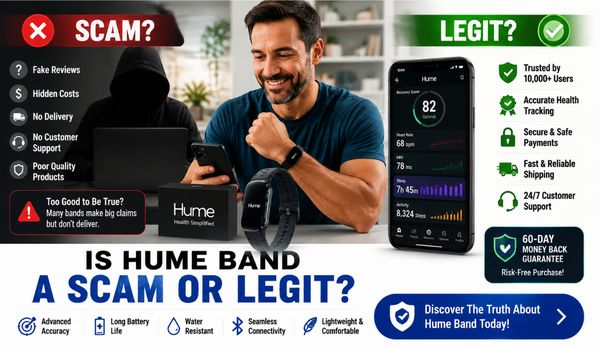
The Hume Band has attracted considerable attention because it focuses on health and wellness information rather than simply counting steps.
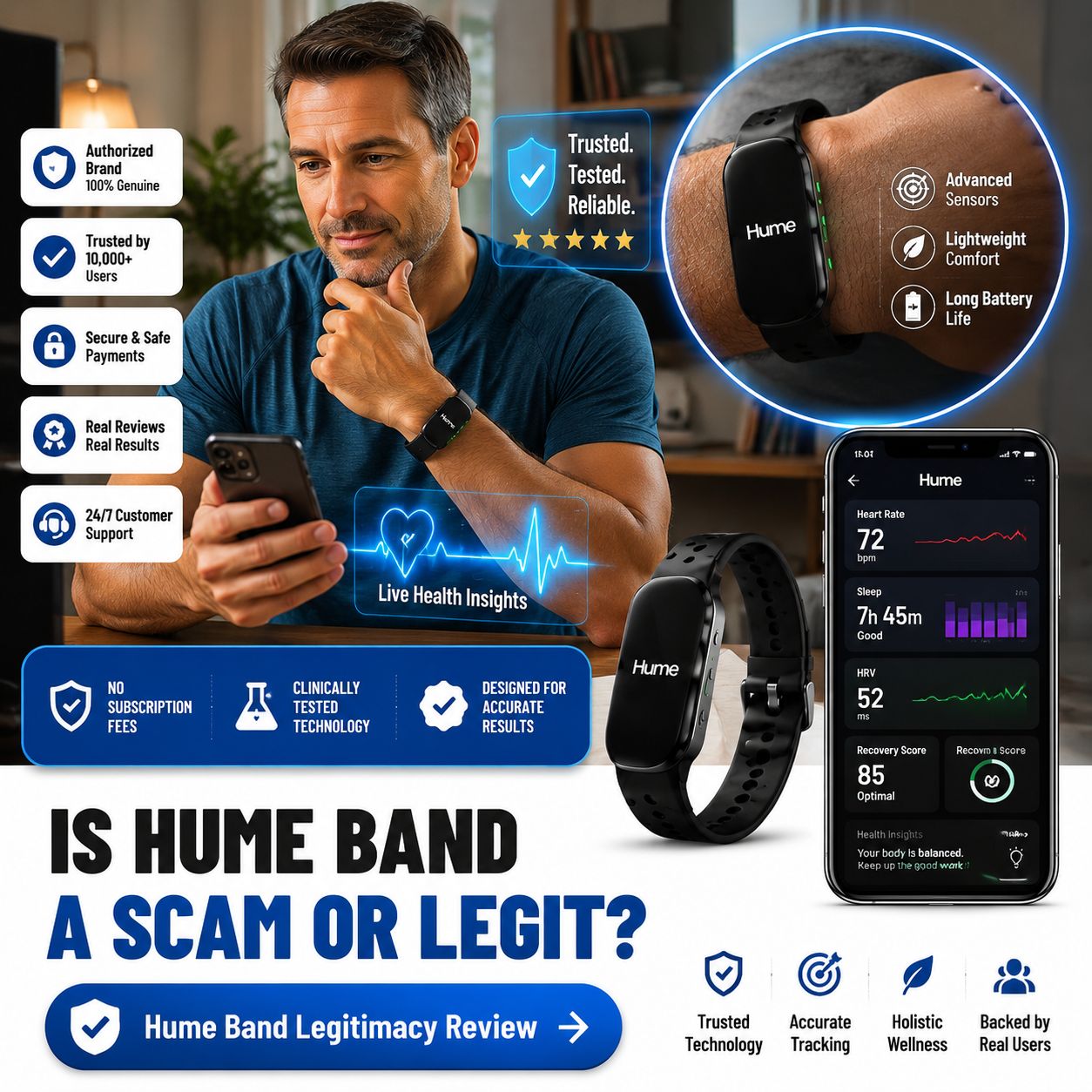
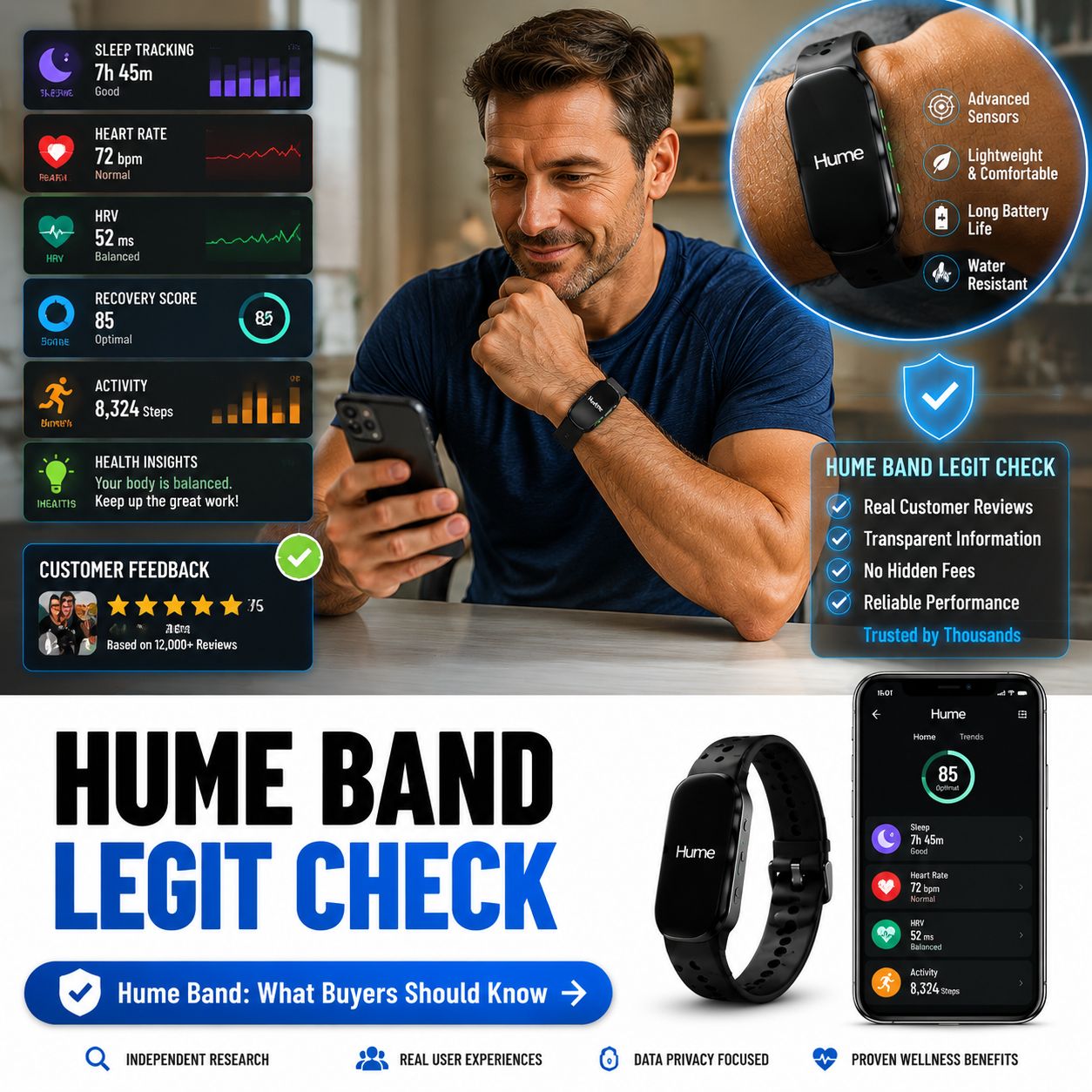
It is designed to collect data such as heart rate, heart rate variability (HRV), sleep, blood oxygen, skin temperature, activity, recovery, and other wellness trends through the Hume Health app.
A legitimate product can still disappoint some customers. Likewise, a product can receive negative reviews without being an outright scam.
The important question is whether the product exists, whether its claims are reasonable, what customers actually experience, how transparent the company is about pricing and features, and what you should realistically expect before buying.
In this article, we take a closer look at the Hume Band, its features, pricing model, customer feedback, potential concerns, and what buyers should consider before making a decision.
What Is the Hume Band?
The Hume Band is a screen-free wearable health and fitness tracker developed by Hume Health.
Instead of putting a display and notifications directly on your wrist, the band is designed to collect information in the background and present that information through the Hume Health smartphone app.
According to the company’s current product information, the newer Hume Band 2.0 can monitor several wellness-related signals, including heart rate, overnight HRV, resting heart rate, blood oxygen, skin temperature, sleep stages, activity, calories, and recovery-related information.
The company also promotes features such as Pace of Aging, Metabolic Momentum, and blood-pressure trend insights.
There is no large display demanding your attention throughout the day. You wear the band, let it collect data, then review your data in the app.
The company currently advertises the Hume Band 2.0 as a one-time purchase, with no subscription required for its core features. Its website also advertises a 45-day at-home trial and up to 14 days of battery life.
Is Hume Band a Scam or Legit?
Based on the available information, the Hume Band is a real health and fitness wearable sold by a real company; calling the product itself a “scam” would be an oversimplification.
The company has an established website, sells physical products, operates a companion health app, and has thousands of customer reviews across third-party platforms.
There are positive reviews from customers who praise the app, its insights, comfort, and lack of a required subscription.
At the same time, there are negative reviews citing accuracy concerns, technical problems, customer support issues, returns and refunds, and disagreements over advertised features.
For example, Trustpilot currently shows thousands of Hume Health reviews, with both positive and negative experiences represented.
Its review summary notes that some customers appreciate the data and the app, while others report concerns about tracking accuracy and customer service experiences.
The Better Business Bureau’s customer review pages show a much more negative set of experiences, including complaints about refunds, product performance, customer service, and expectations regarding advertised features.
Hume Band appears to be a legitimate wearable product, but potential buyers should carefully evaluate its claims, pricing, return terms, data accuracy, and customer-service reputation before purchasing.
Why Do People Think Hume Band Is a Scam?
Several factors can make people suspicious of a health wearable.
Health claims can sound very impressive
One reason consumers may become skeptical is the way advanced health products are marketed.
Terms such as “biological age,” “metabolic health,” “recovery,” “longevity,” and “blood-pressure trends” sound highly sophisticated.
However, a wearable should not be confused with a medical examination.
The Hume Band itself states that its wellness information is not intended to diagnose, treat, cure, or prevent medical conditions. Its blood-pressure feature is described as a trend insight rather than a replacement for a conventional blood-pressure cuff.
A wearable can potentially help you observe patterns in your lifestyle and activity, but it should not replace a doctor, laboratory testing, or medically validated equipment when medical measurements are required.
Some users report inaccurate measurements
Wearable devices do not always produce perfect measurements. Factors such as movement, skin contact, positioning, sleep conditions, exercise, device fit, and sensor limitations can affect readings.
Some Hume customers have complained about measurements they found inaccurate, including sleep, activity, and body-related metrics.
Trustpilot’s current review summary also mentions complaints about discrepancies in some tracking features.
This does not necessarily prove that every Hume Band is inaccurate. Instead, it demonstrates why consumers should avoid treating a single wearable score as absolute truth.
The best way to use a wearable is often to look at trends over time rather than to react strongly to a single unusual number.
What Does the Hume Band Actually Track?
The Hume Band is designed to collect a variety of health and activity signals. According to the current Hume Band 2.0 product information, these include:
- Heart rate
- Heart-rate variability
- Resting heart rate
- Blood oxygen (SpO2)
- Skin temperature
- Sleep stages
- Sleep score
- Recovery
- Activity and movement
- Steps and distance
- Calories
- Strain
- Blood-pressure trends
- Pace of Aging
- Metabolic Momentum
The company describes several of these as wellness estimates or directional trends rather than medical measurements. This is an important point for prospective buyers.
You should not purchase the Hume Band expecting it to function like a hospital monitor or diagnostic device.
Instead, think of it as a consumer wellness tracker that turns multiple biometric signals into understandable trends and insights.
Hume Band Customer Reviews: The Good and the Bad
Customer reviews are particularly interesting because they are not completely one-sided.
Positive experiences
Some customers say they enjoy the Hume Band because it provides a large amount of health information without requiring them to interact with a screen throughout the day.
Positive reviews commonly mention:
- Comfortable wearable design
- Helpful health insights
- Sleep tracking
- Recovery information
- The Hume Health app
- Long battery life
- No recurring subscription for core Band features
- Motivation to pay more attention to health habits
Trustpilot currently shows many positive reviews, including recent customers who report being happy with the Band and its health insights.
The official Hume Band page also features thousands of reviews and highlights the device’s screenless design, battery life, health insights, and no required subscription.
Negative experiences
There is also a significant amount of negative feedback. Some users report:
- Difficulty pairing the Band
- Tracking inaccuracies
- Problems with sleep or activity detection
- Battery concerns
- App-related frustrations
- Customer-support delays
- Difficult return or refund experiences
- Confusion about features and pricing
The Better Business Bureau review pages contain numerous complaints involving these areas. Trustpilot also contains negative reviews, including complaints about tracking performance and customer service.
These complaints should not automatically be interpreted as proof that the company is operating a scam. However, they are useful warning signs for anyone considering a purchase.
A smart consumer should consider both the positive and negative experiences.
What About the Hume Band Return Policy?
The Hume Band 2.0 website currently advertises a 45-day at-home trial and money-back guarantee.
The product page says that customers who are not satisfied within the trial period can return the product for a refund, subject to the company’s terms.
That can reduce the risk of trying the device. But this is an area where you should read the actual return requirements before ordering.
Pay attention to:
- The length of the return period
- Whether the product must be returned in a particular condition
- Return shipping requirements
- How is the refund processed
- Whether accessories must be returned
- How long refunds may take
- Whether different products have different policies
This is especially important because some customer complaints on third-party review sites involve returns and refunds.
The lesson is simple: save your order confirmation, receipt, tracking number, and correspondence with customer service.
If you ever need to return the product, having documentation can make the process easier.
Does Hume Band Really Measure Blood Pressure?
This is one of the areas where buyers need to be especially careful.
The Hume Band 2.0 provides blood pressure trend insights. But the company’s own product information makes clear that these are directional trends and not a replacement for a blood-pressure cuff.
That means you should not purchase the Band expecting it to provide the same type of measurement as a clinically validated blood-pressure monitor.
If you have been advised to monitor your blood pressure, use an appropriate medical device and follow your healthcare professional’s recommendations.
The Hume Band may be interesting as a wellness tool for observing patterns, but it should not be treated as a diagnostic instrument.
Is Hume Band a Medical Device?
No. The Hume Band is marketed as a general wellness wearable rather than a medical diagnostic device.
Its product page specifically describes its measurements and scores as wellness insights, estimates, and trends.
This matters because consumers sometimes assume that a wearable showing a number must be medically accurate. It is better to think of the device as an additional source of personal wellness information.
For example, if the Band indicates that your sleep has been consistently shorter than usual, you might use that information as a reason to examine your sleep schedule. That is very different from using the Band to diagnose a disease.
What About Hume’s “Pace of Aging” Feature?
The concept of biological or metabolic age can sound confusing. Your chronological age is simply the number of years you have been alive.
A wearable’s “biological age” or “Pace of Aging” score is an estimate generated from collected health-related data and models. It is not a literal measurement of your body’s age.
Hume describes Pace of Aging as a directional wellness trend rather than a medical diagnosis.
This means consumers should interpret such scores cautiously. If the score changes, that does not necessarily mean your actual biological age suddenly changed by the same number of years.
Instead, it may be better viewed as a motivational or trend-based metric designed to encourage attention to lifestyle patterns.

Is the Hume Health App Legit?
The Hume Band works with the Hume Health app, where much of the information is displayed.
The company says users can pair the Band with the app and review their measurements, trends, recovery information, sleep information, and other health insights. User reviews of the app are mixed, just like the Band’s reviews.
Some people enjoy the amount of information and the way the app presents trends. Others have complained about technical problems or customer-service experiences.
That is not unusual for connected wearable products. When a device depends heavily on an app, your experience depends on both the physical hardware and the software ecosystem.
Hume Band vs. Traditional Fitness Trackers
The Hume Band is not necessarily designed for everyone. If your primary goal is simply to count steps and receive smartphone notifications, a traditional smartwatch may be more appropriate.
If you want:
- A screen-free wearable
- Sleep tracking
- Recovery information
- HRV trends
- Wellness insights
- A focus on longevity-related metrics
- Less distraction from notifications
Then the Hume Band may be more interesting.
The current Hume Band 2.0 product page positions the device around continuous wellness tracking, recovery, sleep, longevity signals, and health trends rather than smartwatch functions.
In other words, the Hume Band is better understood as a health-focused wearable rather than a smartwatch replacement.
Who Might Like the Hume Band?
The Hume Band could be a reasonable option for someone who enjoys tracking health trends and wants a wearable that operates quietly in the background.
Want to monitor health trends – If you enjoy looking at patterns in sleep, activity, HRV, and recovery, having this information in one app may be useful.
Prefer a screen-free device – Some people do not want notifications constantly appearing on their wrist.
Dislike monthly subscriptions – The current Hume Band 2.0 page promotes a one-time purchase for core features, with no required subscription.
Want lifestyle feedback – A wearable can make it easier to connect everyday habits with changes in sleep, activity, and recovery.
Who Should Probably Skip It?
The Band may not be the best choice if you:
- Need medically validated measurements
- Expect every metric to be perfectly accurate
- Want smartwatch notifications
- Want built-in GPS
- Prefer a traditional watch display
- Do not enjoy reviewing health data
- Are uncomfortable with app-based ecosystems
- Expect customer service to resolve problems instantly
It is also not ideal for someone who interprets every wearable score as a medical fact.
Is Hume Band Worth the Money?
Whether the Hume Band is worth the money depends largely on how you plan to use it.
- The current Hume Band 2.0 is advertised at $249, with a 45-day at-home trial and no subscription for core features.
- For someone who regularly uses sleep, recovery, HRV, activity, and wellness trends, that could represent reasonable value.
- For someone who only wants to count steps, it may be unnecessary.
- The real value of a wearable is not the number of metrics it displays.
- The value comes from whether those metrics actually help you make better decisions.
For example, suppose you notice that:
- You sleep less after late-night meals.
- Your recovery score changes after hard workouts.
- Your activity decreases when your work schedule becomes busy.
- Your resting heart rate changes when your routine changes.
Those patterns might encourage you to make healthier choices. That is where a wearable can become useful.
Important Warning About Health Data
There is another issue that deserves attention: personal health information. Wearables collect sensitive information about your body, activity, sleep, and lifestyle.
Before buying any health wearable, it is worth reviewing the company’s privacy policy and understanding how your information is collected, stored, used, and shared.
Do not assume that because a device is marketed as a wellness product, privacy does not matter.
Before purchasing, look for information about:
- Account security
- Data collection
- Data sharing
- Third-party services
- Data deletion
- App permissions
- Privacy controls
This is good advice for any connected health device, not just the Hume Band.

How to Buy Hume Band More Safely?
If you decide that the Hume Band is worth trying, a few simple steps can reduce your risk.
- Check the current price – Prices and promotional discounts can change. Check the final price before payment.
- Read the current return terms – Do not rely solely on a review written months or years ago.
- Understand which features are included – Make sure you understand what is included in the Band purchase and whether any feature requires additional payment.
- Keep your receipt – Save your order confirmation and payment information.
- Test the Band during the trial period – If a 45-day trial is offered at the time you purchase, use the device consistently and evaluate whether the data is genuinely useful to you.
- Compare trends instead of isolated readings – One unusual reading does not necessarily tell you much.
- Do not use it for medical diagnosis – If you are concerned about a medical measurement, use appropriate medical equipment and speak with a qualified healthcare professional.
Final Verdict
The Hume Band is a legitimate consumer wearable product, but that does not mean every buyer will have a perfect experience.
The device offers a range of health and wellness tracking features, and the current Hume Band 2.0 is marketed with a screen-free design, up to 14 days of battery life, a 45-day trial, and no subscription for its core Band features.
At the same time, independent customer reviews reveal genuine concerns from some users about product accuracy, technical issues, customer service, returns, refunds, and feature expectations.
That means the smartest approach is neither blindly trusting every positive review nor automatically calling the product a scam because of negative reviews.
The Hume Band is best viewed as a wellness and health-tracking tool, not a medical diagnostic device. Its scores and trends can potentially help users understand their lifestyle patterns, but they should not replace professional medical advice or validated medical equipment.
If you value sleep and recovery tracking, enjoy reviewing health data, prefer a screen-free wearable, and dislike recurring subscriptions, the Hume Band may be worth considering.
If you need clinical-grade measurements, expect perfect accuracy, or have little interest in analyzing health trends, another product may be a better fit.
.
.
.