Is Hume Band a Good Value for Money? Key Benefits
Is Hume Band a Good Value for Money? – (🔥Worth the Price!). Explore Hume Band features, pricing, benefits, and long-term value to see if it’s worth buying.
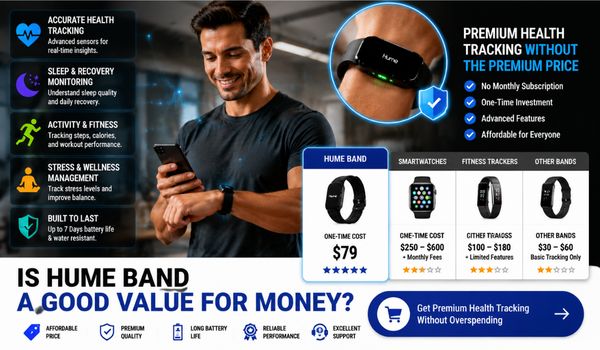
If you are considering buying a health wearable, one of the most important questions to ask is not simply, “What does it measure?” but “Is it actually worth the money?”
The Hume Band has attracted attention because it takes a different approach from traditional smartwatches and fitness trackers.
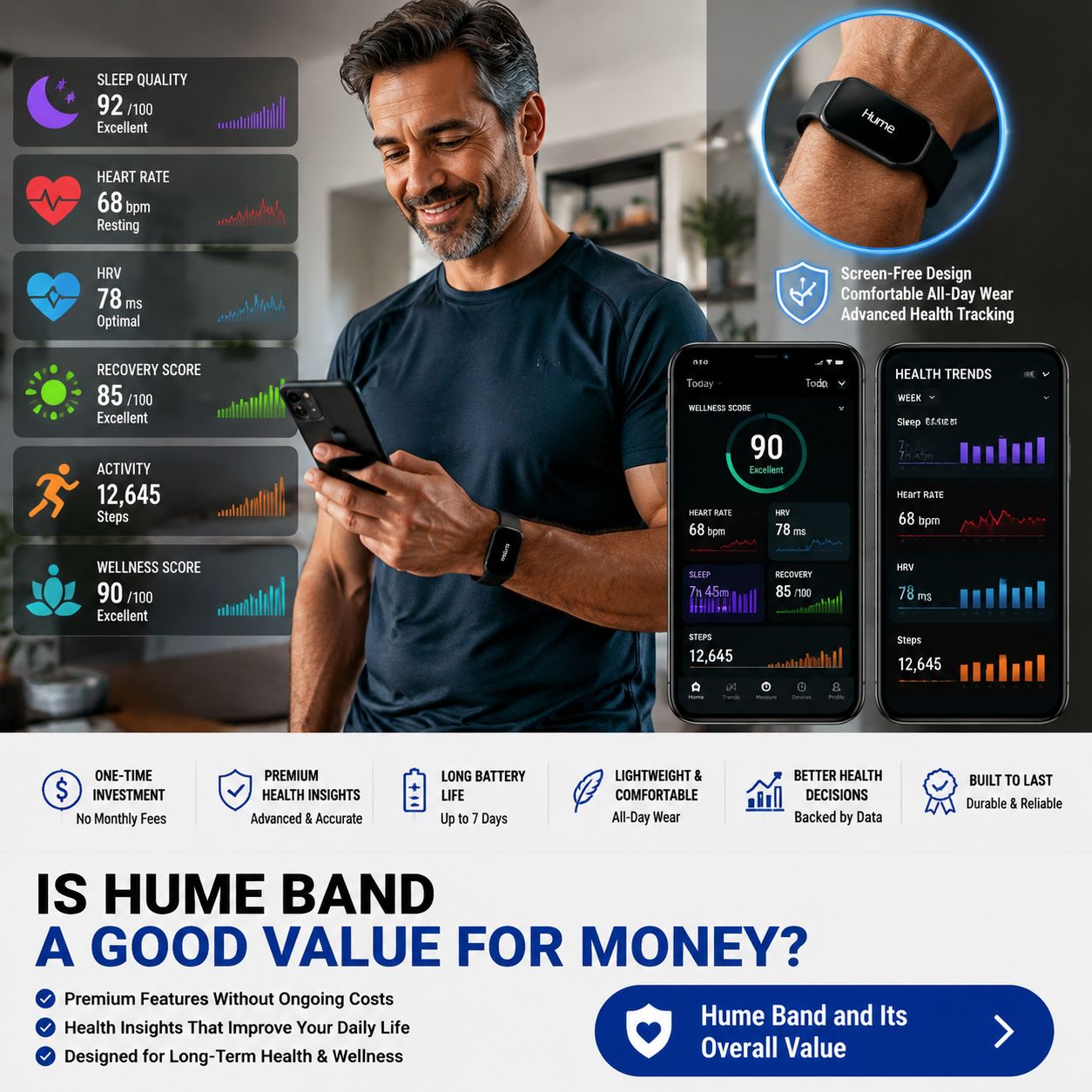
Instead of focusing primarily on notifications, apps, calls, or a screen on your wrist, it is designed for continuous health and wellness tracking, including sleep, recovery, heart rate-related metrics, HRV, activity, and longer-term health trends.
The answer depends on what you want from a wearable, how consistently you plan to use it, and whether you value long-term health insights more than smartwatch features.
What Is the Hume Band?
The Hume Band is a screen-free wearable health tracker designed to collect physiological information throughout the day and night.
Unlike a traditional smartwatch, there is no emphasis on constantly looking at a display. Instead, the Band works with the Hume Health app, where users can review their measurements, trends, scores, and other health information.
The Hume ecosystem is focused heavily on areas such as:
- Sleep
- Recovery
- Heart rate
- Heart rate variability (HRV)
- Activity
- Stress-related patterns
- Respiratory measurements
- Blood-oxygen-related measurements
- Body temperature
- Longer-term wellness trends
- Metabolic and longevity-related insights
Hume describes the Band as part of a broader health platform that combines multiple signals into a more understandable picture of health. That approach is important when considering value.
You are not simply paying for a device that counts steps. The intended value comes from wearing it consistently and using the app’s information to identify patterns in your lifestyle.
Hume Band – What Do You Get for the Money?
A good-value wearable should offer more than an attractive price. The real question is whether the features justify the purchase.
Continuous Health Tracking
One of the biggest reasons someone might consider the Hume Band is continuous monitoring.
Instead of taking occasional manual measurements, a wearable can collect data throughout the day and night. This can help users identify patterns that may otherwise be difficult to notice.
For example, you might discover that:
- Your recovery tends to be lower after short nights of sleep.
- Your resting heart rate changes after particularly demanding days.
- Your HRV trends differ depending on your sleep schedule.
- Your activity level changes your perceived energy.
- Late nights consistently affect the following morning.
The value isn’t necessarily in one individual measurement. The greater value comes from observing patterns over time.
Sleep Tracking
Sleep is one of the most useful areas for a wearable because it is difficult to remember exactly how well you slept.
The Hume Band is designed to track sleep-related information and provide insights through the Hume Health app.
Hume says the Band tracks sleep stages and combines this data with other physiological signals, such as HRV and resting heart rate.
This can make the device particularly appealing to people who want to understand their recovery rather than simply record how many hours they spent in bed.
But if you repeatedly wake up during the night or have a changing sleep schedule, the overall picture may be different. A wearable can help you compare these patterns over multiple nights.
Recovery Insights
Another major focus of the Hume Band is recovery.
Recovery is especially relevant for people who exercise regularly, have demanding schedules, or simply want to understand how their bodies respond to lifestyle changes.
The Band uses signals such as HRV, resting heart rate, and sleep-related information to generate recovery-oriented insights.
For example, you may notice:
- Day 1: Good sleep + strong recovery
- Day 2: Hard workout + reduced recovery
- Day 3: Better sleep + improved recovery
Over time, these patterns can help you understand how your routine affects your body. That doesn’t mean the device should dictate every decision you make. Instead, it can act as an additional source of information.
HRV Tracking
Heart rate variability, commonly called HRV, is another metric associated with recovery and stress-related physiological patterns. The Hume Band tracks HRV and uses it as part of its broader recovery framework.
For beginners, HRV can be confusing because a higher number is not automatically “better” in every situation.
What is often more useful is understanding your personal baseline and looking at changes over time.
For example:
- Monday: HRV near your normal range
- Tuesday: HRV slightly lower
- Wednesday: HRV significantly lower after poor sleep
- Thursday: HRV begins returning toward baseline
The trend may be more useful than obsessing over one day’s number.
This is an important part of getting good value from a wearable: use it to identify patterns rather than becoming dependent on individual scores.
Screen-Free Design
Another factor that contributes to the Band’s value is its screen-free design. A smartwatch can be useful, but it also introduces notifications, messages, calls, apps, and other distractions.
The Hume Band takes the opposite approach. You wear it, collect data, and review it in the app rather than constantly checking your wrist.
For people who want a health tracker without turning their wearable into another smartphone screen, this can be a major advantage.
On the other hand, if you want:
- GPS
- Calls
- Text notifications
- Music controls
- Apps
- A smartwatch display
Then the Hume Band may not offer the same value as a full-featured smartwatch.
Battery Life
Battery life can strongly influence the real-world value of a wearable. The Hume Band 2.0 is advertised with up to 14 days of battery life.
Long battery life is particularly useful for sleep tracking because frequent charging can create gaps in your data. However, advertised battery life and real-world battery life are not always identical.
One independent review of the Hume Band 2.0 reported approximately seven days of use during testing, despite the manufacturer’s claim of up to 14 days.
That doesn’t necessarily mean every user will get seven days or that the manufacturer’s figure is incorrect. Battery performance can depend on usage, firmware, sensors, connectivity, and other factors.
How Much Does the Hume Band Cost?
Price is one of the first things people consider when deciding whether a wearable is worthwhile.
As of 2026, Hume’s website lists the Hume Band 2.0 at approximately $249, with promotional pricing sometimes displayed against a higher list price.
The company also advertises a 45-day money-back guarantee and a one-year warranty with the Band.
However, prospective buyers should always check the current checkout price, warranty terms, return conditions, and any optional add-ons before purchasing because promotions and product terms can change.
The bigger question: What does ownership cost over time?
This is where Hume Band can become more interesting.
Some competing wearable ecosystems require an ongoing subscription for access to certain advanced features or insights.
Hume promotes its Band as a one-time purchase for its core experience, meaning the basic ownership model does not require paying a monthly membership simply to continue using the device.
For someone who plans to use a wearable for several years, avoiding recurring fees can make a significant difference.
For example, imagine a hypothetical wearable costing $249 upfront with no required subscription.
- After one year: $249 total
- After two years: $249 total
- After three years: $249 total
That makes the cost per year progressively lower as you continue using the device.
Of course, this calculation only makes sense if the Band remains useful to you and you actually continue wearing it.
No Required Subscription Can Improve Long-Term Value
Perhaps the strongest argument for the Hume Band from a value perspective is its subscription model.
Hume promotes the Band 2.0 as a one-time purchase with core health data and scores available without a mandatory recurring membership.
This matters because recurring subscriptions can become expensive. Consider a hypothetical wearable that costs $20 per month.
- That’s: n$240 per year
- Over three years: $720
Now compare that with a device purchased once for approximately $249. Even if another device has more features, the total cost of ownership can eventually become much higher.
That doesn’t automatically make Hume the better product.
But it can make Hume the more attractive financial choice for someone who wants to keep a wearable for several years.
Hume Band vs. Smartwatch: Which Offers Better Value?
This is where the answer becomes personal.
A smartwatch and Hume Band serve different purposes.
A smartwatch may be better if you want:
- Calls
- Notifications
- GPS
- Music
- Apps
- Exercise tracking
- A wrist display
- General smartphone integration
Hume Band may be better if you want:
- Screen-free health tracking
- Sleep tracking
- Recovery information
- HRV monitoring
- Long-term wellness trends
- A lightweight wearable
- Fewer distractions
- A no-required-subscription ownership model
Therefore, asking which is “better” isn’t always useful.
A better question is:
Which device provides the features you will actually use?
If you already own a smartwatch and are happy with its health tracking, purchasing another wearable may not provide enough additional value.
But if you want a dedicated, screen-free health tracker focused on long-term wellness and recovery, the Hume Band may make more sense.
Hume Band vs. Subscription-Based Trackers
Subscription cost is one of the most important factors when comparing wearable devices. Some popular health trackers use recurring memberships for advanced insights.
Hume’s current Band 2.0 positioning emphasizes a one-time purchase and no required subscription for its core experience.
Independent coverage has also highlighted this as a potential long-term advantage. Wareable, for example, noted that Hume Band 2.0 costs $249 and that the basic app is free, while deeper premium features may be offered separately.
- Consumers should distinguish between: No required subscription for core features
- No optional paid features whatsoever. These are not necessarily the same thing.
Before buying, check exactly which features are included in the current free experience and which features, if any, require a premium plan.
Is the Hume Band Accurate?
Accuracy is one of the most important questions when evaluating whether a health wearable is worth its price.
Wearables use sensors and algorithms to estimate physiological information. They are not automatically equivalent to clinical equipment.
Hume itself emphasizes that certain measurements, including its blood-pressure trend insights, are directional wellness trends rather than medical readings. The company explicitly states that the Band is not a medical device or a replacement for a blood-pressure cuff.
This distinction is extremely important. You should not purchase a consumer wearable expecting it to diagnose a medical condition. Instead, think of it as a wellness and trend-tracking tool.
There are also mixed user experiences online. For example, recent Trustpilot reviews include both positive comments about comfort and tracking and negative reports concerning device reliability, measurements, battery performance, and customer service.
As with any online review platform, individual experiences can vary, so it is better to consider multiple sources rather than relying on one review or rating.
The Value of Health Trends
One of the biggest mistakes people make with wearable technology is focusing too much on a single score.
Suppose your recovery score is lower today. Does that automatically mean something is wrong?
No. Maybe you:
- Slept less than usual.
- Had a stressful day.
- Trained harder than normal.
- Changed your sleep schedule.
- Traveled.
- Had a late meal.
- Simply experienced normal day-to-day variation.
One number rarely tells the entire story.
The real value of a wearable can come from observing what happens over weeks and months.
For example:
Week 1: Average sleep = 6 hours 20 minutes
Week 2: Average sleep = 7 hours
Week 3: Average sleep = 7 hours 30 minutes
You might then compare those changes with your energy, recovery, exercise performance, and other lifestyle factors.
This turns the Band from a simple gadget into a tool for self-awareness.
Who Is Most Likely to Find It Worth the Money?
The Hume Band may be particularly valuable for people who fit one or more of these categories.
- Health-conscious users – If you already pay attention to sleep, exercise, nutrition, recovery, and lifestyle habits, additional trend information may be useful.
- People who dislike smartwatch screens – If you don’t want notifications or a display on your wrist, the screen-free design can be appealing.
- People who want long-term tracking – A wearable becomes more useful when you use it consistently for months rather than checking it occasionally.
- Fitness enthusiasts – Recovery and sleep information can complement your training routine.
- People who dislike subscriptions – If avoiding monthly wearable memberships is important to you, Hume’s current ownership model can be financially attractive.
Who May Not Find It Worth the Money?
The Hume Band isn’t automatically the right choice for everyone. You may want to consider another type of wearable if you primarily want:
- A smartwatch
- GPS navigation
- Phone calls
- Text notifications
- A large wrist display
- Extensive sports features
- Advanced standalone workout functionality
Similarly, if you already have a health wearable that provides all the metrics you care about, spending another $200-plus may not provide enough additional benefit.
The best value isn’t necessarily the device with the most features. It is the device whose features solve your actual needs.
Is the Hume Band a Good Value for Long-Term Use?
This is arguably where the Band makes the strongest financial case. Suppose you purchase a Hume Band for approximately $249 and use it for three years. Ignoring taxes, accessories, or optional services:
$249 ÷ 3 years = $83 per year
That works out to roughly: $6.92 per month
If you continue using it for four years: $249 ÷ 4 = $62.25 per year
Or approximately: $5.19 per month
The longer you use the device, the lower your effective monthly cost becomes. But again, this only works if the device remains useful and functional. A $249 wearable that sits in a drawer is not a good value.
A $249 wearable that you wear every day and use to make meaningful lifestyle changes can potentially provide much greater value.
The 45-Day Return Period Reduces the Buying Risk
Another factor worth considering is the return period. Hume currently advertises a 45-day money-back guarantee for the Band 2.0.
A return window can be valuable because comfort and usability are highly personal. Before deciding whether the Band is right for you, you can evaluate:
- Is it comfortable during sleep?
- Does it fit securely?
- Do you actually check the app?
- Are the insights useful?
- Does the battery meet your expectations?
- Does the device fit into your routine?
- Are the measurements useful for your personal goals?
If the answer is consistently “no,” the device may not be worth keeping. Always review the current return conditions before purchasing.
How to Get the Most Value From Hume Band?
Buying the device is only the first step. To maximize its value, use it consistently.
- Wear it regularly – The more consistently you wear a health tracker, the more useful your long-term trends can become.
- Establish a baseline – Don’t immediately react to every score. Give yourself time to understand what your normal patterns look like.
- Compare trends – Look at several days or weeks rather than one isolated measurement.
What About the Hume App?
A wearable is only as useful as the software that interprets its information. The Hume Health app is an important part of the overall experience because the Band itself has no screen.
The company positions the app as a broader health platform that integrates data from sleep, activity, recovery, and other health-related signals.
For users, this means the value of the Hume Band isn’t simply the physical hardware. It is the combination of:
Band + sensors + app + historical data + interpretation
If the app helps you understand your information more easily, the device can feel more valuable. If you rarely open the app or don’t find the insights actionable, the value decreases.
Potential Drawbacks to Consider
No wearable is perfect. – Before buying Hume Band, consider some potential disadvantages.
It is not a smartwatch – If you want notifications, GPS, apps, or calls, this isn’t the primary reason to buy Hume.
Some insights are estimates – Wearable measurements should be interpreted as wellness information rather than clinical diagnoses.
Battery claims may differ from real-world experience – Independent testing has reported shorter battery life than the advertised maximum under certain conditions.
User experiences vary – Recent customer reviews show both positive and negative experiences, particularly around reliability, battery performance, accuracy, and customer support.
Optional premium features may exist – Although Hume does not require a subscription for core features, prospective buyers should check which features are included and whether optional premium services are currently offered.
These points don’t necessarily mean the Band is a bad purchase. – They simply show why buyers should evaluate the complete product rather than focusing only on the headline price.
Is Hume Band a Good Value for Money?
For the right user, yes, the Hume Band can be a good value for money.
Its strongest value proposition comes from combining health tracking with a screen-free design and a one-time purchase model for core features.
The current Hume Band 2.0 is advertised at around $249, includes a free core app experience, and comes with a 45-day money-back guarantee according to Hume’s current product information.
Its long-term value becomes especially compelling for people who plan to wear it consistently for several years and want to avoid mandatory recurring subscription costs.
If you want a smartwatch, you may get more from an Apple Watch, Garmin, or another full-featured wearable.
If you want medical-grade measurements, a consumer wellness tracker should not be treated as a replacement for clinical equipment.
And if you already own a wearable that provides the information you need, buying another device may not make financial sense.
Final Verdict
The answer ultimately depends on what you expect from a wearable. If your priority is notifications, apps, GPS, and smartwatch functionality, the Hume Band may not be the best choice.
But if your priority is sleep, recovery, HRV, health trends, continuous tracking, and a distraction-free wearable experience, it becomes a much more compelling option.
The biggest financial advantage is the current no-subscription-required model for the core Band experience. Over several years, avoiding recurring membership costs can significantly reduce the total cost of ownership.
At the same time, buyers should look beyond marketing claims and consider battery performance, software experience, measurement limitations, return terms, warranty coverage, and real customer feedback.
If you are unlikely to wear it regularly or you mainly want smartwatch features, your money may be better spent elsewhere.
Ultimately, the value of a wearable isn’t determined only by its price tag. It is determined by how useful its information becomes in your everyday life.
And for someone who wants a simple, screen-free way to understand sleep, recovery, and long-term health trends, the Hume Band may be exactly what makes the most sense.
.
.
.