Is Hume Band Good for Athletes? Performance Guide
Hume Band for Athletes – (🔥Fitness & Recovery Guide!). Explore how Hume Band tracks athletes’ recovery, sleep, activity, and wellness.
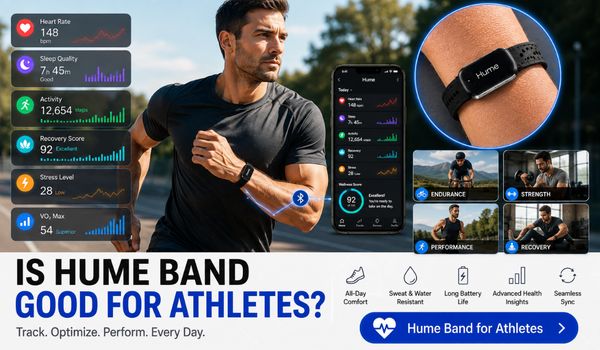
Athletes spend countless hours training, but performance is not determined by workouts alone. Sleep, recovery, stress, nutrition, and the body’s ability to adapt to training all play an important role.
This is why wearable health trackers have become increasingly popular among runners, strength athletes, cyclists, fitness enthusiasts, and people following demanding training schedules.
So, is Hume Band good for athletes?
The short answer is: it can be useful for athletes who want to monitor recovery and understand long-term patterns, but it should not be treated as a replacement for dedicated sports equipment or professional medical guidance.
The value of a wearable like the Hume Band is less about one individual number and more about identifying patterns.
If your sleep is consistently poor, your HRV is trending downward, your resting heart rate is elevated, or your recovery appears diminished after several hard training sessions, those signals may prompt you to reconsider how much additional stress you place on your body.
What Is the Hume Band?
The Hume Band is a screen-free wearable designed to continuously monitor various health and wellness signals.
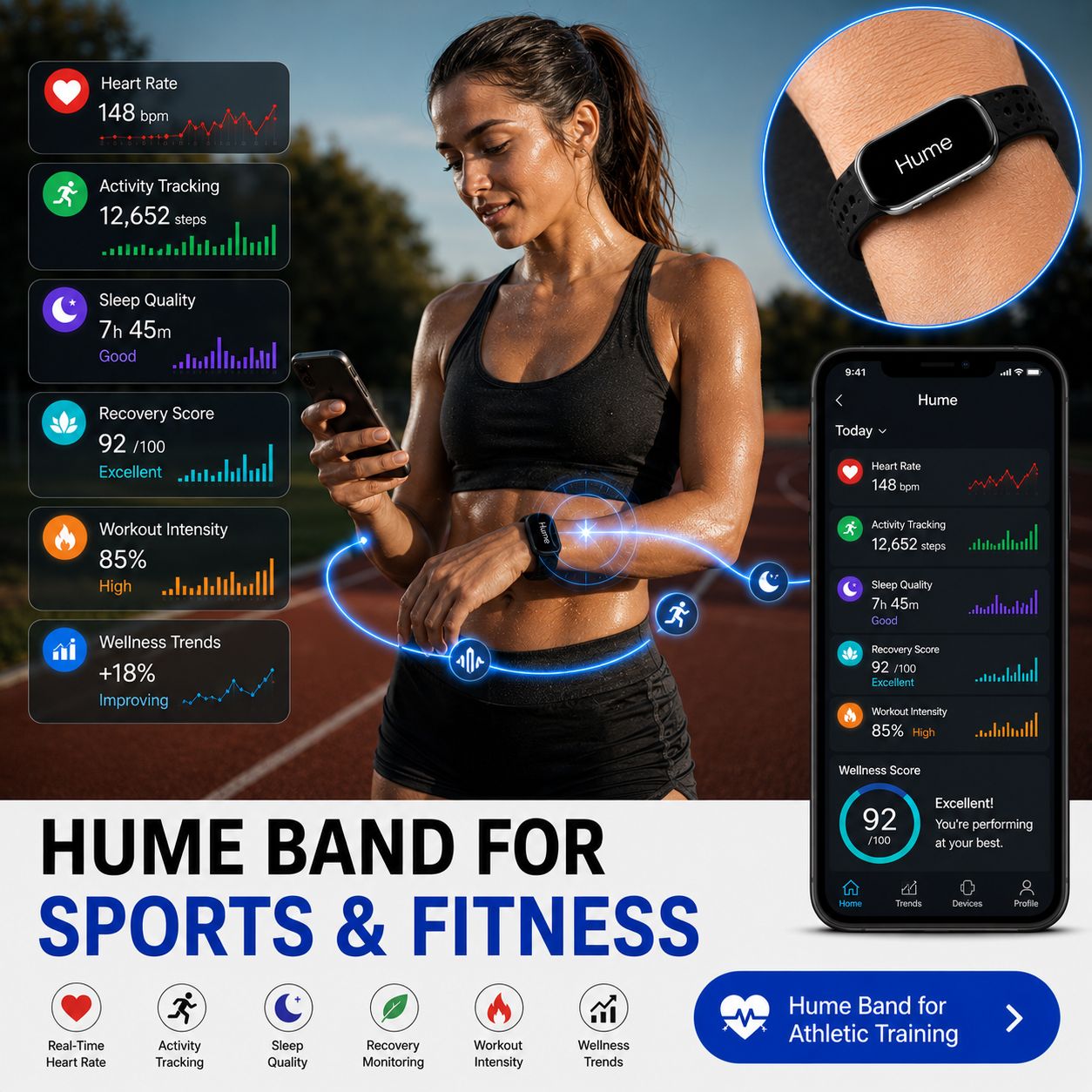
Hume says its current Band 2.0 tracks measurements including heart rate, overnight HRV, resting heart rate, blood oxygen saturation (SpO2), skin temperature, sleep stages, movement, activity, strain, and recovery.
Instead of requiring users to constantly look at a screen during training, the Band is designed to be worn throughout the day and night, with information reviewed via the Hume Health app.
This approach can be particularly interesting for athletes because recovery happens outside the gym, on the track, or on the field.
A hard workout creates training stress. The body then needs sufficient time to recover to adapt to that stress. If training continues to increase while recovery remains inadequate, fatigue can accumulate.
The Hume Band attempts to give users a broader picture of this balance by combining physiological information into recovery and strain insights.
Hume’s framework includes concepts such as strain, recovery, and metabolic capacity. The company describes these measurements as ways of understanding how much stress the body is experiencing and how prepared it may be for additional activity.
Why Recovery Matters for Athletes?
A runner wants to run farther or faster. A weightlifter wants to increase strength. A cyclist wants to improve endurance. A recreational athlete may simply want to complete workouts consistently.
But training is only one side of the equation. A simplified way to think about athletic improvement is:
Training stimulus + recovery = adaptation
Without enough recovery, additional training does not necessarily produce better results. Recovery includes several factors:
- Sleep
- Nutrition
- Hydration
- Rest days
- Stress management
- Appropriate training intensity
- Cardiovascular recovery
- Muscle recovery
- Overall workload
This is where wearable technology can become useful. Rather than simply asking, “Did I complete my workout?” athletes can begin asking:
“How is my body responding to my overall training load?” The Hume Band is designed around this broader perspective.
Is Hume Band Good for Athletes?
Runners may find recovery tracking particularly useful because running programs often involve repeated cycles of hard and easy sessions.
For example, a training week might include:
- Intervals
- Tempo running
- Easy mileage
- Hill training
- Long-distance running
- Rest or recovery
The challenge is balancing enough training stimulus with enough recovery. The Hume Band can provide information about sleep, HRV, heart rate, activity, strain, and recovery.
However, athletes should understand an important limitation. The Hume Band is not primarily designed to replace a dedicated running watch.
Independent testing of the original Hume Band found its sports-tracking capabilities to be relatively basic, with limited workout tracking and no built-in GPS.
Therefore, a serious runner who needs detailed GPS routes, pace data, elevation, advanced running dynamics, or highly specialized training metrics may prefer a dedicated sports watch.
The Hume Band can potentially complement such a device by focusing more on recovery and overall physiological trends.
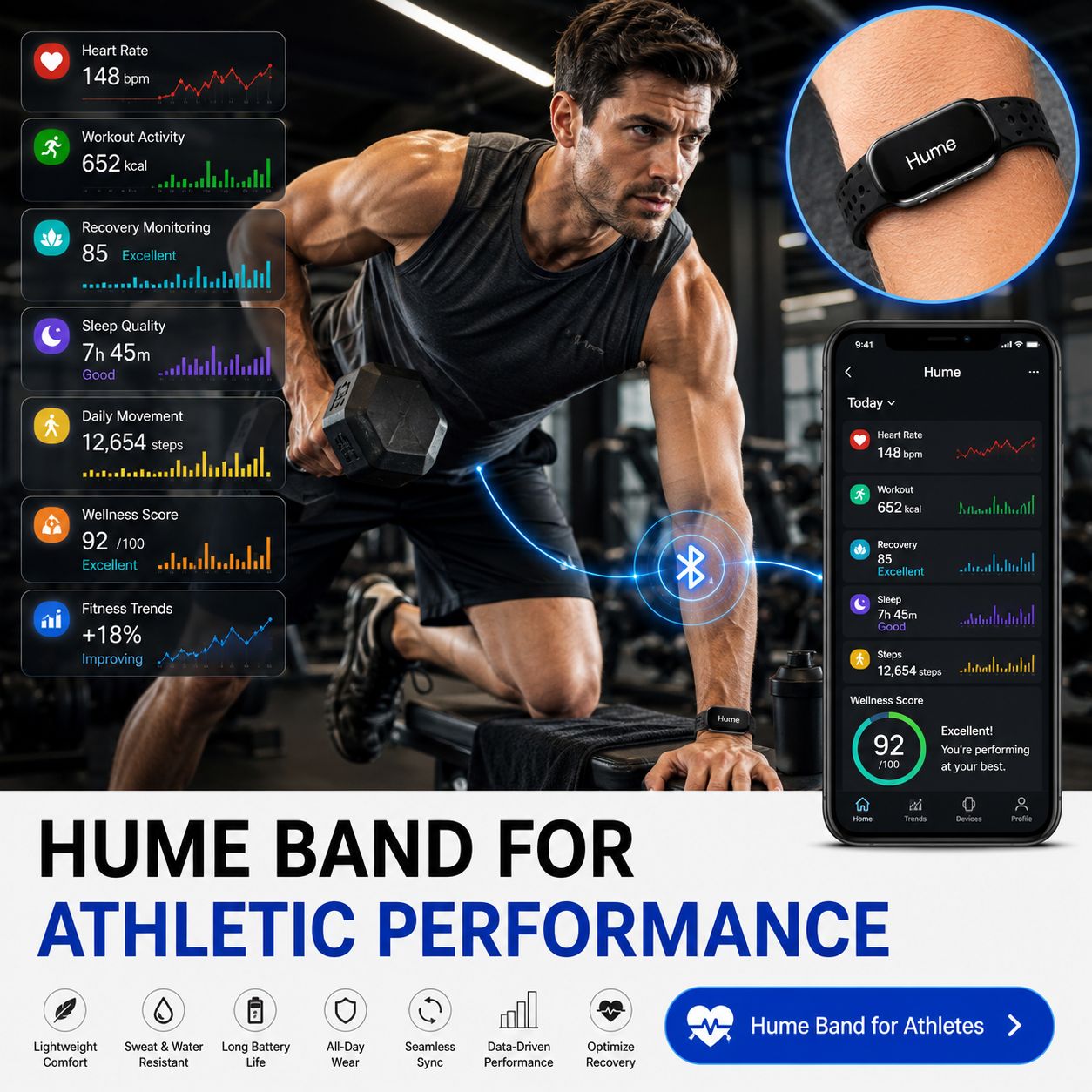
Hume Band and HRV for Athletes
One of the most interesting measurements for athletes is heart rate variability (HRV).
HRV describes variation in the time between consecutive heartbeats. It is different from simply measuring heart rate.
For example, two people may both have a resting heart rate of 60 beats per minute, but their beat-to-beat timing can still vary.
HRV is influenced by factors such as recovery, stress, sleep, training load, and other aspects of an individual’s physical state.
The Hume Band tracks overnight HRV and uses it as part of its recovery assessment. For athletes, the important point is not necessarily whether an HRV number is “good” or “bad.”
Instead, your personal trend may be more useful than comparing your number with somebody else’s. Suppose an athlete normally sees relatively stable overnight HRV measurements.
After several consecutive days of intense training, the athlete notices that HRV has dropped from their usual range while resting heart rate has increased and sleep quality has declined.
That combination may suggest that the athlete needs to pay closer attention to recovery. It doesn’t automatically mean they are overtrained, injured, or sick. But it can be a useful signal to investigate.
Sleep Tracking: One of the Biggest Benefits for Athletes
Sleep is one of the most important parts of athletic recovery.
During sleep, the body carries out numerous processes associated with physical and mental recovery. Athletes who consistently sacrifice sleep may find it harder to maintain training quality, concentration, mood, and overall performance.
The Hume Band tracks sleep duration and sleep stages, including light, deep, REM, and awake periods. For an athlete, this information can help answer practical questions.
Example
Imagine a recreational runner follows this schedule:
- Monday: Easy run
- Tuesday: Speed workout
- Wednesday: Easy recovery
- Thursday: Tempo run
- Friday: Rest
- Saturday: Long run
- Sunday: Rest
After several weeks, the runner notices that sleep quality consistently decreases following the Tuesday and Thursday high-intensity sessions.
Instead of immediately adding another hard workout, the athlete can examine whether recovery habits need adjustment.
Perhaps the problem is not the training itself.
It could be:
- Training too late at night
- Insufficient nutrition
- Too much caffeine
- Poor hydration
- Work-related stress
- An inconsistent sleep schedule
The wearable does not solve these problems by itself. However, it can help reveal patterns that might otherwise be overlooked.
Can Hume Band Help With Training Decisions?
Potentially, yes, but it should be viewed as a decision-support tool rather than an authority.
Hume describes its recovery information as a way to understand whether users should push harder or pull back based on their physiological trends. For athletes, this can be useful when combined with actual training information.
For example:
Scenario 1: Good recovery
- Your recent sleep has been consistent.
- Your HRV is near your normal baseline.
- Your resting heart rate is stable.
- Your perceived energy is good.
- Your previous workout was well tolerated.
- In that situation, an athlete may feel comfortable continuing with their planned training session.
Scenario 2: Recovery concerns
- Your sleep has been poor for several nights.
- Your HRV is noticeably below your usual pattern.
- Your resting heart rate is elevated.
- Your legs feel unusually tired.
- Your recent training load has been high.
That combination may be a reason to consider reducing intensity, taking an easier session, or prioritizing recovery.
The important distinction is that the wearable provides information, while the athlete still has to interpret that information in context.
Hume Band for Weightlifters and Strength Athletes
Strength athletes have different requirements from endurance athletes. A runner may care deeply about pace and distance. A weightlifter may care more about:
- Sets
- Repetitions
- Weight lifted
- Volume
- Exercise selection
- Rest periods
- Strength progression
- Recovery
The Hume Band can provide useful background information about overall strain and recovery, but it is not a replacement for detailed strength-training logs.
There is also an important limitation with wrist-based optical sensors during weightlifting.
Grip pressure, wrist movement, muscle contraction, and exercise technique can make heart-rate measurements more difficult for wrist-based devices.
Independent reviews have also noted limitations in peak heart rate tracking during heavy lifting and in automatic workout recognition.
Therefore, strength athletes should avoid treating every heart-rate measurement during a heavy set as perfectly precise.
For serious performance testing, a dedicated chest-strap heart rate monitor may be a better option.
One Major Advantage: Wearing It 24/7
One of the most important characteristics of a recovery-focused wearable is consistency.
If you only wear a device during workouts, it cannot provide much information about what happens between workouts.
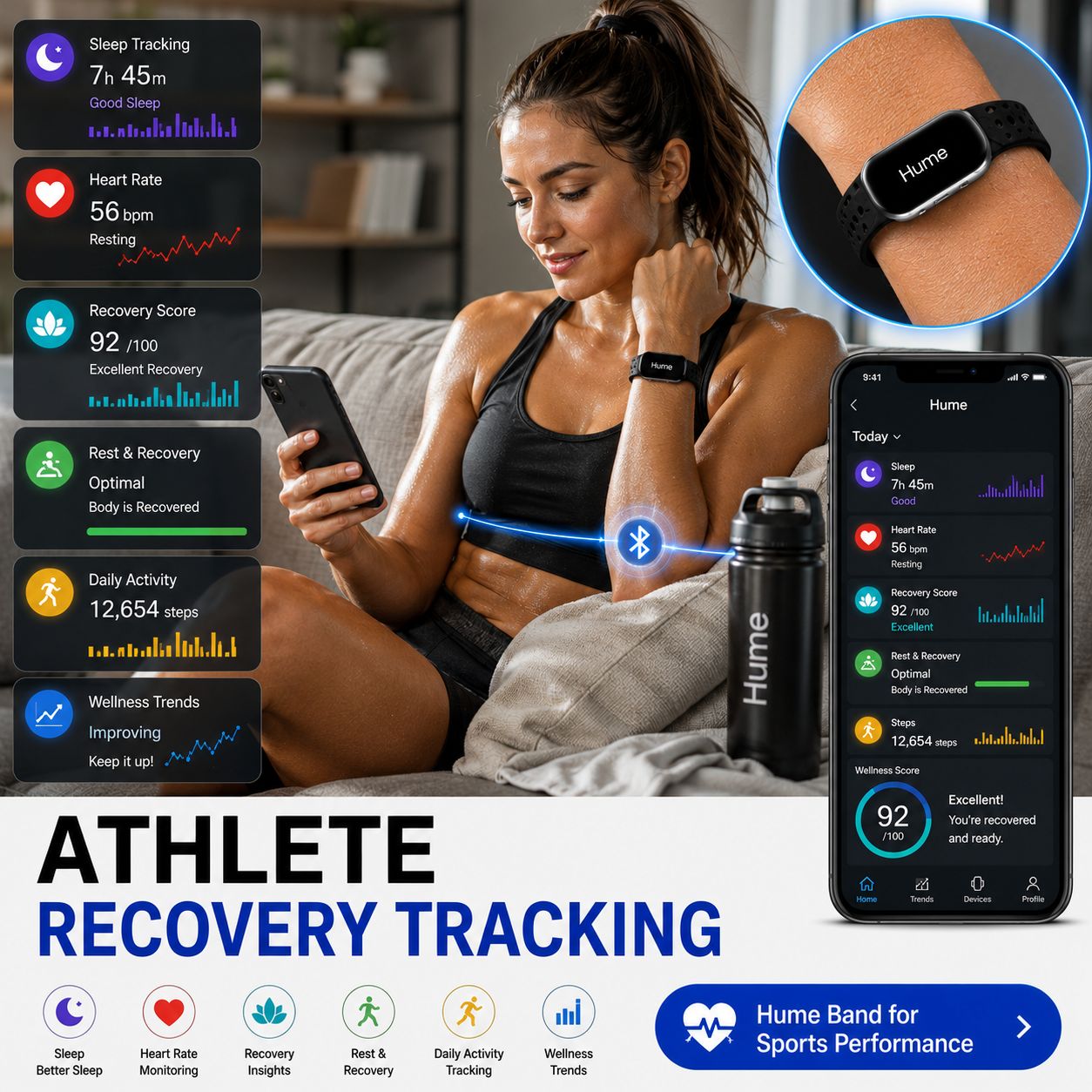
The current Hume Band 2.0 is designed for continuous wear and can provide up to 14 days of battery life. It is also designed to be worn during sleep and training.
For athletes, long battery life can be particularly convenient. A device that needs frequent charging can create gaps in overnight data.
Those gaps matter because recovery tracking depends heavily on consistent measurements. The more consistently an athlete wears a device, the more useful long-term patterns can become.
What Does Hume Band Measure?
According to Hume, the current Band tracks a broad range of signals.
These include:
| Metric | Why It May Matter to Athletes |
|---|---|
| Heart rate | Helps monitor cardiovascular response and trends |
| HRV | Useful for observing recovery and stress trends |
| Resting heart rate | Can provide a long-term fitness/recovery baseline |
| Sleep | Helps assess sleep duration and patterns |
| Sleep stages | Provides estimates of light, deep, and REM sleep |
| SpO2 | Provides overnight blood oxygen trends |
| Skin temperature | Helps identify deviations from personal baseline |
| Activity | Provides context for daily movement |
| Strain | Estimates overall physiological load |
| Recovery | Provides a directional view of readiness |
| Steps | Tracks everyday movement |
Hume states that these measurements are combined into broader health and recovery insights.
Is Hume Band Accurate Enough for Athletes?
This is one of the most important questions. No consumer wearable should automatically be treated as a medical-grade measurement device.
The accuracy of a wearable can vary depending on:
- Sensor placement
- Skin contact
- Movement
- Exercise type
- Individual physiology
- Workout intensity
- Device generation
- Measurement being evaluated
Recent independent testing of the Hume Band 2.0 found improvements in the sensor hardware but still reported some inaccuracies in heart rate, sleep, and recovery measurements.
This does not necessarily make the device useless. In fact, athletes often benefit more from consistent trends than from perfect individual readings.
Consider two possibilities.
Athlete A – Their Hume Band consistently reports an HRV trend around their personal baseline.
Athlete B – Their HRV changes substantially from their normal pattern after several hard training days.
Even if the exact HRV value is not perfectly accurate, Athlete B may still have a useful reason to look at sleep, stress, training load, hydration, nutrition, and recovery.
This is why wearable data should be interpreted as a source of information—not as an absolute diagnosis.
Hume Band vs. Chest Strap
A chest strap remains an important consideration for athletes who need highly responsive heart-rate data during demanding workouts.
Wrist-based optical sensors can struggle during certain activities, especially when the wrist moves rapidly or is under significant muscular tension.
For serious interval training, racing, or physiological testing, a chest strap is therefore a better choice for heart rate measurement.
The Hume Band’s strength is broader continuous monitoring rather than replacing specialized equipment.
Think of it this way:
- Chest strap: detailed workout heart-rate measurement.
- Hume Band: continuous health, sleep, recovery, and strain context.
How Athletes Can Use Hume Band More Effectively?
If you decide to use the Hume Band, avoid checking the app obsessively throughout the day.
Instead, create a simple routine.
Step 1: Wear it consistently
Wear the Band during normal daily activities and while sleeping.
Consistency gives the system more information about your personal baseline.
Step 2: Establish your baseline
Give yourself time to collect enough data.
Hume explains that personalized insights become more useful as the system collects more information about your individual patterns.
Don’t panic because of one unusual reading.
Step 3: Monitor trends
Look at several days or weeks rather than focusing on one morning.
Ask:
- Is my HRV generally stable?
- Is resting heart rate changing?
- Is my sleep consistent?
- Is my recovery declining?
- Is my strain increasing?
- Do these changes match how I actually feel?
Step 4: Compare data with your training log
This is particularly important for athletes.
Record your workouts alongside your wearable data.
For example:
Monday: Heavy strength session
Tuesday: HRV lower than normal
Wednesday: Easy recovery workout
Thursday: HRV returns toward baseline
Over time, patterns may become easier to recognize.
Step 5: Listen to your body
Wearable data should not override obvious physical warning signs.
If you feel unusually exhausted, dizzy, weak, ill, or injured, don’t ignore those symptoms simply because your wearable gives you a favorable score. Your symptoms and professional medical advice should take priority.
Common Mistakes Athletes Should Avoid
Mistake 1: Chasing a perfect score
A recovery score is not a grade you need to achieve every morning. Your body naturally changes. The goal is to understand your normal patterns.
Mistake 2: Comparing your HRV with another athlete
HRV varies considerably between individuals. Your personal baseline is generally more meaningful than someone else’s number.
Mistake 3: Training only according to the wearable
A wearable is an additional source of information. It should not completely control your training plan.
Mistake 4: Ignoring subjective fatigue
If your wearable says you’re ready but you feel exhausted, investigate the discrepancy rather than blindly following the score.
Mistake 5: Expecting medical diagnosis
The Hume Band is a wellness device, not a substitute for medical evaluation. Hume itself states that its wellness insights and blood-pressure trend information are not medical diagnoses and that its blood-pressure trends do not replace a cuff measurement.
What About Overtraining?
Athletes often search for wearable technology that can “detect overtraining.” This needs careful explanation.
No consumer wearable can simply look at one score and definitively diagnose overtraining syndrome.
Overtraining is a complex issue involving training load, recovery, performance, fatigue, psychological factors, sleep, nutrition, and other variables.
However, tracking several trends may help athletes recognize when something has changed.
For example:
- Training volume increases
- Sleep decreases
- Resting heart rate rises
- HRV changes from baseline
- Recovery scores decline
- Perceived fatigue increases
- Performance begins to decline
When several signals move in the same direction, it may be worth reconsidering the training plan and discussing persistent concerns with a qualified professional.
The wearable is best viewed as an early information system, not a diagnostic tool.
Is Hume Band Worth It for Serious Athletes?
A professional runner who needs advanced GPS, power, pace, cadence, race analytics, and highly specialized training data may need additional equipment.
A recreational athlete who wants to understand sleep, recovery, daily strain, and long-term health patterns may find a wearable like Hume much more useful.
A strength athlete may appreciate recovery insights but still want a dedicated heart-rate monitor and detailed training log.
A hybrid athlete may benefit from using the Band alongside a sports watch. Therefore, the Hume Band doesn’t have to be your only fitness device to be valuable.
Pros of Hume Band for Athletes
- Strong focus on recovery – Recovery is one of the areas where the Hume Band is most relevant to athletes.
- Sleep monitoring – Sleep data can help athletes recognize patterns between training and recovery.
- HRV tracking – Overnight HRV can provide useful information about personal recovery trends.
- Continuous monitoring – The device is designed to be worn throughout the day and night.
- Minimal distraction – The screen-free design can appeal to athletes who don’t want another screen constantly demanding attention.
- Long battery life – Hume currently states that Band 2.0 offers up to 14 days of battery life.
Broader health context – Instead of focusing exclusively on workouts, the platform combines activity, sleep, recovery, and physiological information.
Cons of Hume Band for Athletes
- Not a dedicated sports watch – Athletes requiring detailed GPS and sport-specific metrics may need another device.
- Wrist-based sensor limitations – Heart-rate accuracy can be affected during certain movements and exercises.
- Automatic workout detection may not be perfect – Independent reviews of the original Hume Band reported limitations in automatic workout recognition, particularly with some forms of exercise.
- Recovery scores are estimates – A score is an interpretation of physiological data—not a direct measurement of how recovered your muscles are.
- Individual readings should not be overinterpreted – One unusual number does not necessarily mean something is wrong.
Who Should Consider the Hume Band?
The Hume Band may be a good fit for:
- Recreational athletes
- Runners interested in recovery
- Strength-training enthusiasts
- Hybrid athletes
- Fitness enthusiasts
- People focused on sleep
- Athletes who want HRV trends
- People who prefer a screen-free wearable
- Users interested in long-term health patterns
It may be less suitable as a standalone device for athletes who primarily need:
- Advanced GPS
- Detailed pace analysis
- Cycling power
- Advanced running metrics
- Navigation
- Highly specialized sports analytics
Final Verdict
So, is Hume Band good for athletes? Yes, for the right purpose.
The Hume Band can be a useful tool for athletes who want to understand the relationship between training, sleep, recovery, stress, and overall physiological trends.
Its biggest potential advantage is not necessarily measuring every workout in extraordinary detail. Instead, it can help athletes look at what happens between workouts.
The Hume Band tracks signals such as HRV, resting heart rate, sleep, activity, strain, SpO2, and other physiological measurements and uses them to provide broader recovery and wellness insights.
The most effective approach is to use wearable data as one piece of the puzzle. And when you notice persistent or concerning symptoms, seek advice from a qualified healthcare professional rather than relying on a wearable score.
The goal isn’t to let a wearable decide how you train. The goal is to understand your body better so you can make smarter decisions about your training and recovery.
.
.
.