Is Hume Band Suitable for Everyday Use? Things to Consider
Hume Band Everyday Use – (🔥Daily Health Tracking!). Discover the comfort, features, and benefits of Hume Band, and whether it is suitable for everyday wear.
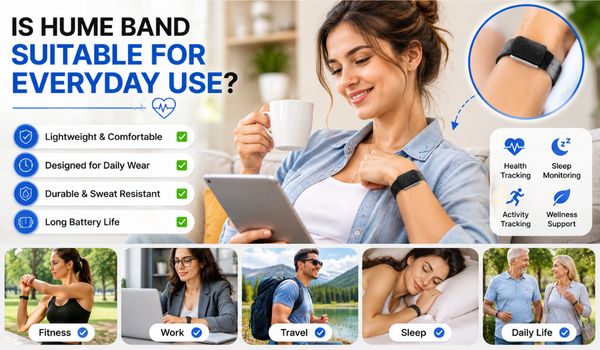
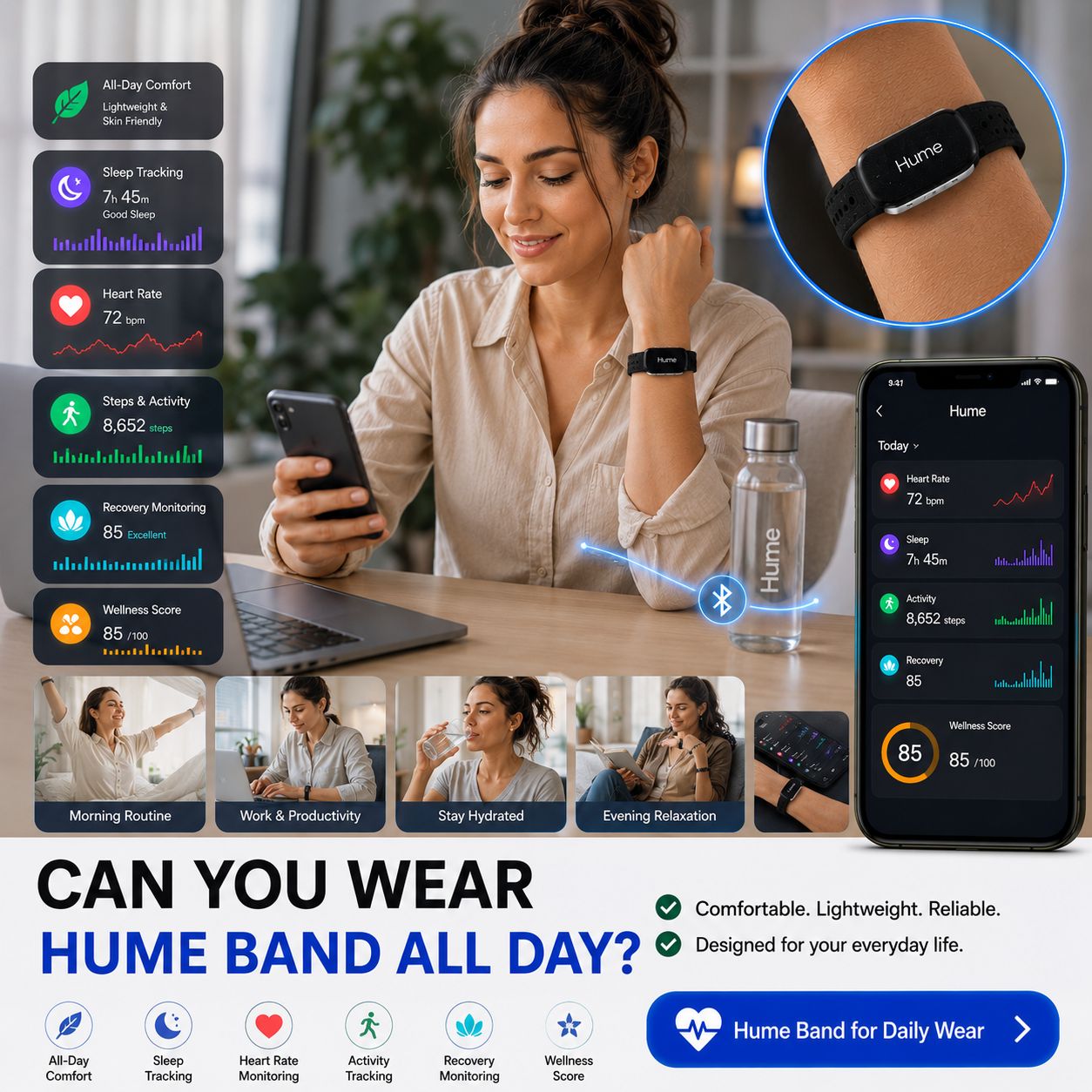
The Hume Band is designed with this idea in mind. Unlike a traditional smartwatch, it has no screen and is designed to stay on your wrist day and night.
Hume Band 2.0, the current version, focuses on wellness and longevity-related information, including sleep, recovery, heart rate, HRV, blood oxygen, skin temperature, activity, and blood-pressure trends. Hume states that the Band 2.0 can provide up to 14 days of battery life.
But does that actually make it suitable for everyday use?
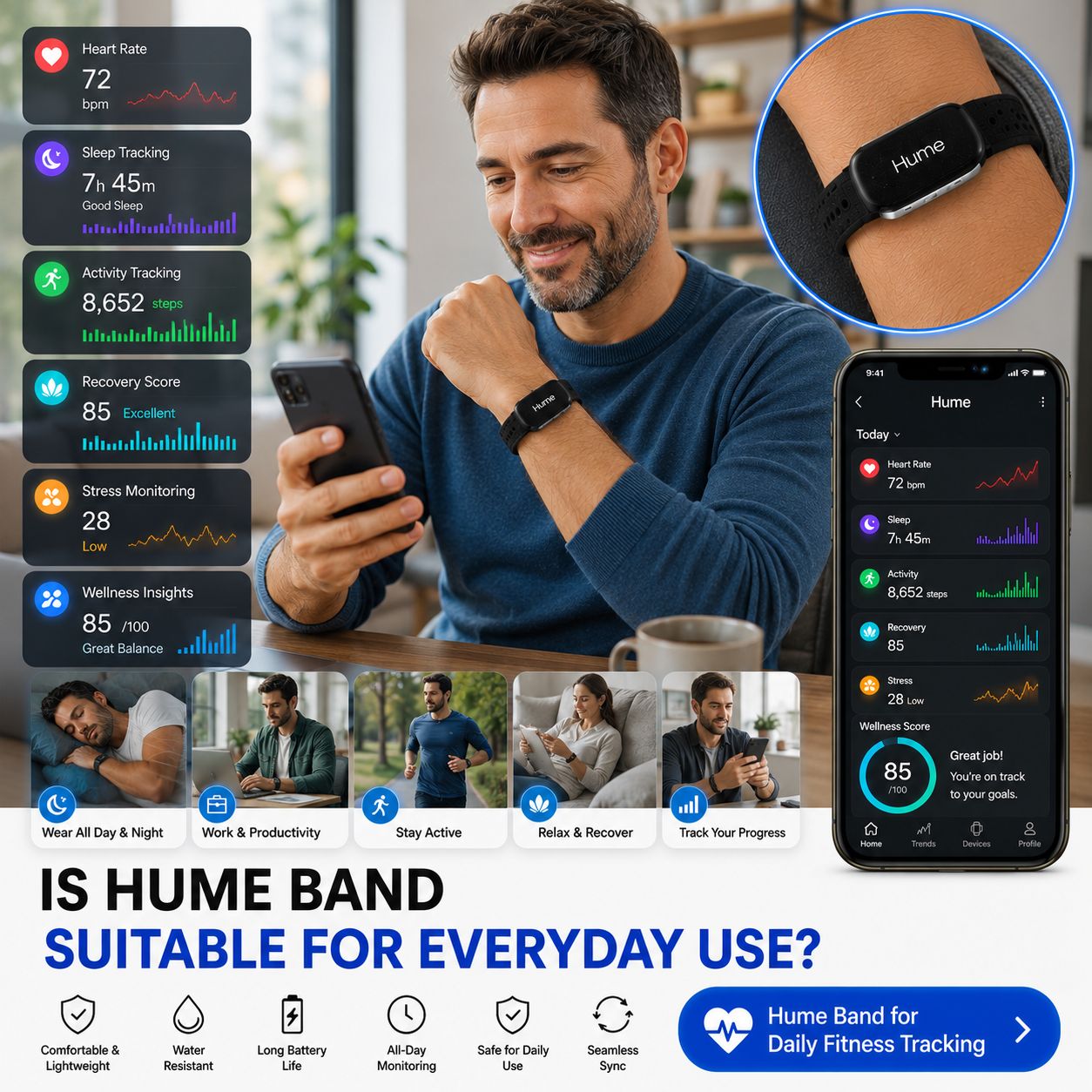
Yes, Hume Band 2.0 is designed for everyday and 24/7 wear, particularly for people who want passive health and wellness tracking without the distractions of a smartwatch.
Its lightweight, screen-free design, water resistance, and long claimed battery life make it practical for many daily activities.
However, there are some limitations to consider before deciding whether it is the right everyday wearable for you.
What Is the Hume Band?
The Hume Band is a screenless wearable health tracker designed to collect physiological information throughout the day.
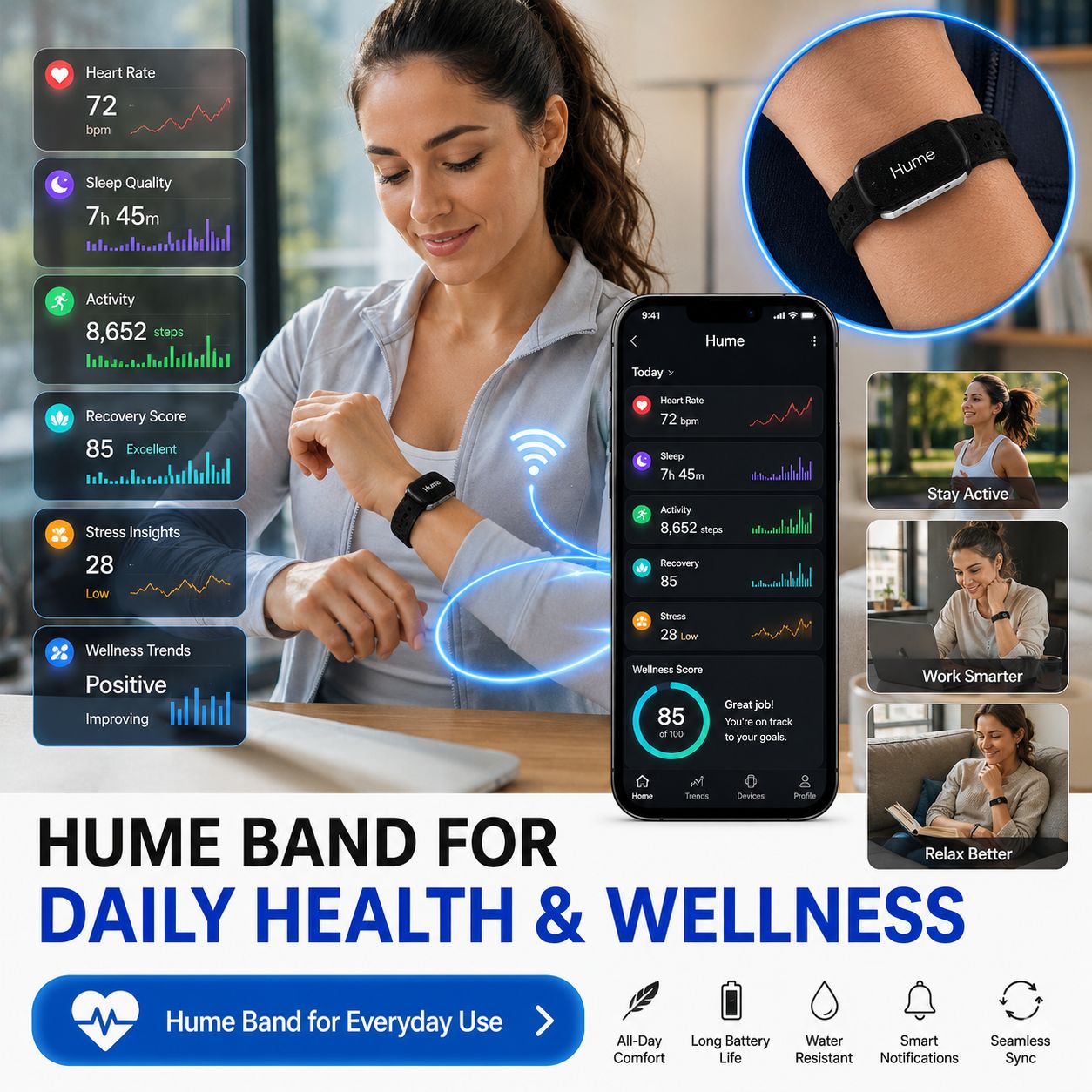
Instead of displaying information directly on your wrist, the Band sends its data to the Hume Health app, where you can view measurements, trends, scores, and insights.
Hume’s current Band 2.0 is positioned more as a wellness and longevity tracker than as a traditional fitness smartwatch.
The company highlights metrics and insights related to recovery, sleep, HRV, heart rate, blood oxygen, skin temperature, activity, strain, metabolic health, and pace of aging.
This screenless approach has an important advantage for everyday use: there are no constant notifications, messages, calls, or apps competing for your attention.
For someone who wants health information without having to check another screen throughout the day, this can be appealing.
Is Hume Band Suitable for Everyday Use?
For most people looking for a simple wellness tracker, Hume Band 2.0 is designed to be worn every day.
The manufacturer specifically describes it as a 24/7 wearable, and the Band 2.0 uses a soft UltraLux strap intended for continuous wear.
Independent testing has also found the updated Band lightweight and comfortable enough for extended wear and sleeping.
The main benefit of wearing it consistently is that health and wellness tracking becomes passive. You don’t have to remember to start a sleep session or manually record every period of activity.
Instead, the Band can collect information while you work, walk, exercise, relax, and sleep. That makes it especially useful for people who want to understand patterns over time rather than focusing on a single day’s number.
Comfort During Daily Wear
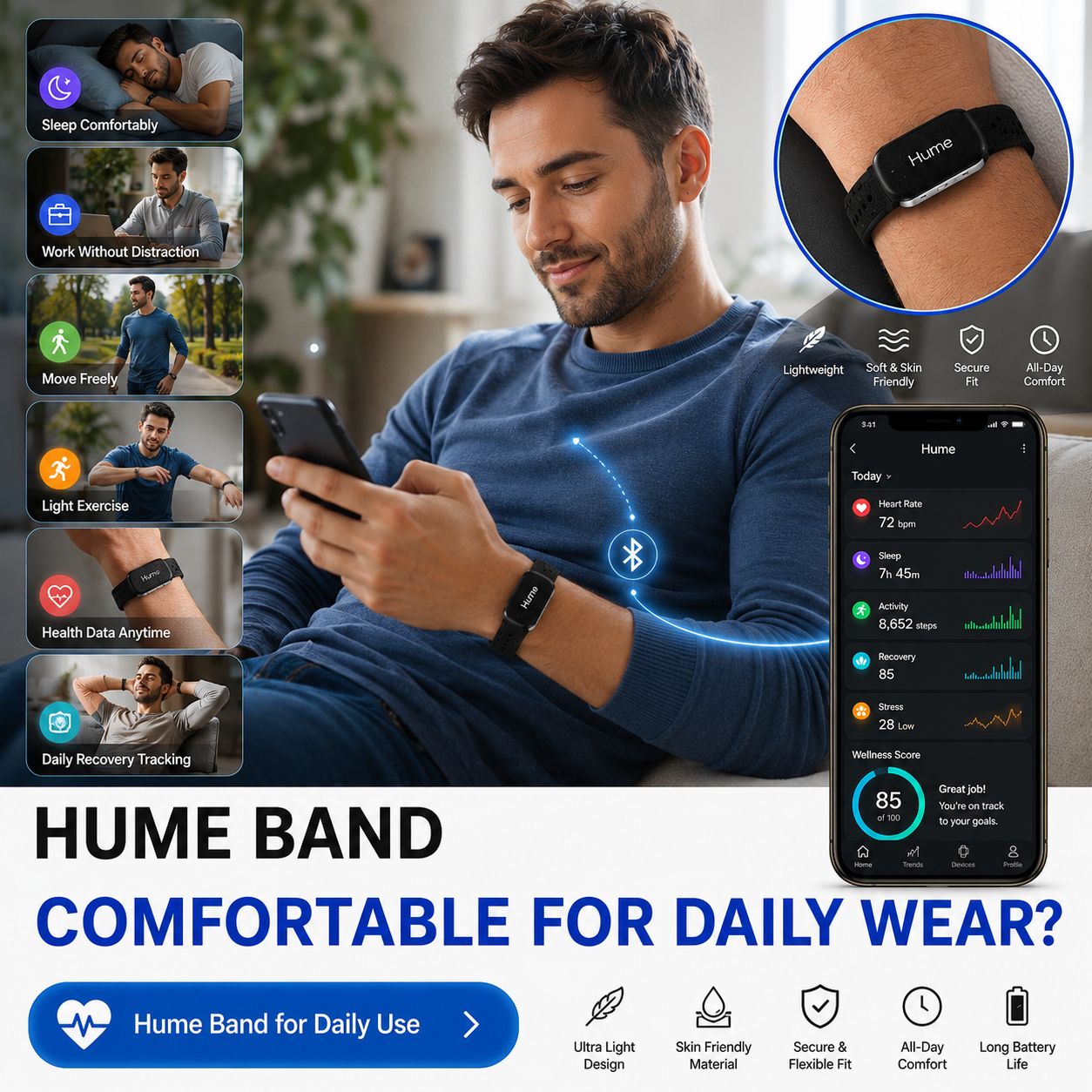
Comfort is one of the most important factors when choosing a wearable that you plan to use every day.
A device can have excellent features, but if it feels bulky, irritating, or distracting, you may eventually stop wearing it.
Hume Band 2.0 takes a minimalist approach. It does not have a display, large watch face, or bulky smartwatch-style body. Independent testing found the Band 2.0 lightweight and discreet, with a soft strap that made it easy to wear continuously.
Because there is no bright screen or constant notification system, the Band does not behave like a smartwatch at night. Reviewers have found the screenless design and lightweight construction suitable for sleeping.
Of course, comfort is personal. Some people prefer wearing nothing on their wrist while sleeping, while others quickly get used to a lightweight tracker.
Can You Sleep With the Hume Band?
Yes. Sleep tracking is one of the main reasons someone might choose to wear the Hume Band continuously.
Hume Band 2.0 tracks sleep-related information such as light, deep, and REM sleep, along with other signals used to provide a sleep and recovery picture.
Wearing the Band overnight can also help maintain continuity in your health data. If you remove your wearable every night, you may lose data that could be useful for analyzing longer-term patterns.
Independent testing of Hume Band 2.0 found it comfortable for sleeping, although reviewers also noted that health-tracking accuracy can vary and should not be treated as perfect.
The most useful way to approach sleep data is therefore to look for patterns.
For example, you might notice that your recovery tends to be lower after several nights of poor sleep. Or you may notice that changes in your routine correspond with changes in your sleep-related measurements.
The goal should be to understand trends rather than to become overly concerned about one night’s score.
Can You Wear Hume Band While Working?
The Hume Band can be a practical option for office workers, remote workers, students, and people who spend many hours at a desk.
Because it has no screen, it doesn’t interrupt your workflow with notifications. You can simply wear it and check the Hume Health app when you choose.
This is different from a smartwatch, where incoming notifications can encourage frequent checking.
For someone who wants a wearable mainly for wellness information, this minimalist design can actually be an advantage.
You can work, type, attend meetings, study, or perform household tasks without needing to interact with the Band itself.
The data becomes something you review periodically rather than something demanding your attention throughout the day.
Can You Exercise With the Hume Band?
Yes, Hume Band 2.0 is intended to remain on the wrist during exercise and can track activity and strain alongside other physiological signals.
Hume lists heart rate, HRV, activity, movement, strain, and recovery among the information supported by the Band.
However, there is an important distinction between wellness tracking and advanced sports tracking.
If you are a serious runner, cyclist, swimmer, or competitive athlete who needs detailed workout statistics, GPS, advanced training metrics, or a large real-time display, a dedicated sports watch may be more appropriate.
Independent testing of Band 2.0 has suggested that athletes may find its fitness features less comprehensive than those of more specialized fitness devices.
For normal walking, gym sessions, general exercise, and everyday movement, however, the Band can still be useful.
It is better viewed as a health and recovery tracker that happens to monitor activity rather than as a full replacement for a dedicated sports watch.
Is Hume Band Waterproof?
Hume Band 2.0 is rated IP68 for dust and water resistance. Hume says the sensor can withstand water at depths of up to approximately 1 meter for up to two hours.
That makes the Band convenient for normal everyday situations such as:
- Washing your hands
- Getting caught in light rain
- Sweating during exercise
- Taking a shower
- Everyday exposure to water
However, an IP68 rating should not automatically be interpreted as meaning that every type of water activity is suitable.
Independent testing has recommended caution with activities involving strong water movement, and the Band should not be treated like a specialist diving or high-performance swim device.
If you spend a lot of time swimming or participating in water sports, check the manufacturer’s current care and usage guidance before relying on the Band during those activities.
Hume Band Battery Life for Everyday Use
Battery life can make a major difference in whether a wearable is genuinely convenient.
Hume says Band 2.0 provides up to 14 days of battery life on a single charge. The company also states that charging typically takes around 20 to 80 minutes, depending on the battery level.
A longer battery life is particularly useful for people who want continuous sleep and recovery tracking.
With a short-battery wearable, you may have to remove it every few days, creating gaps in your data.
Independent testing has found the Band 2.0’s battery performance to be substantially improved over the original model, although actual battery life depends on usage and may not always reach the manufacturer’s maximum claim.
For everyday users, the practical advantage is simple: fewer charging interruptions.
What Health Information Can Hume Band Track?
One of the biggest reasons to wear the Band throughout the day is the range of health and wellness information it can collect.
Hume Band 2.0 supports several metrics, including:
- Heart rate
- Heart rate variability (HRV)
- Resting heart rate
- Blood oxygen (SpO2)
- Skin temperature
- Sleep stages
- Sleep score
- Recovery
- Activity and strain
- Steps and distance
- Calories
- Blood-pressure trends
- Pace of aging
- Metabolic Momentum
Hume describes these measurements as wellness signals and trends rather than medical diagnoses.
In particular, its blood-pressure feature is intended to show trends rather than replace measurements from a blood-pressure cuff.
A wearable can be useful for observing personal patterns, but it should not be used as a substitute for professional medical evaluation or clinically validated diagnostic equipment.
Why Continuous Tracking Can Be Useful?
Wearing a health tracker for only a few hours each day gives you a limited picture. For example, you might record your heart rate while exercising but have no information about what happens during sleep.
Continuous or extended wear can provide a broader view of how different parts of your routine relate to one another.
Sleep → Recovery → Activity → Stress → Daily habits
Over several weeks, patterns may become easier to recognize.
For example, someone might notice that their recovery tends to decline after several nights of reduced sleep. Another person may notice changes in their activity levels during particularly stressful periods.
The value is not necessarily in one isolated number. It is in identifying trends that may encourage healthier habits.
Hume’s own approach is centered on combining multiple physiological signals into broader wellness insights rather than simply presenting raw measurements.
Does Hume Band Need to Be Worn All Day?
You don’t necessarily have to wear it every minute of every day. However, if your goal is continuous health and wellness tracking, consistent wear makes the data more useful.
For example, wearing it during the day but removing it every night means you may miss sleep and overnight recovery information.
Similarly, wearing it only during workouts means you lose much of the information related to your normal daily baseline. The most useful routine for someone who wants long-term trends is likely to be:
Wear → Sync → Review → Look for patterns → Make reasonable lifestyle adjustments
You don’t need to constantly check the app.
In fact, the screenless design encourages a less distracting approach: wear the device and review the information when convenient.
Is Hume Band Good for People Who Don’t Like Smartwatches?
This may be one of the strongest reasons to consider Hume Band.
Smartwatches can be useful, but they also bring notifications, apps, calls, messages, music controls, and other features. Not everyone wants those things on their wrist.
Hume Band 2.0 has no screen and no notifications, making it more focused on passive health tracking. Hume describes the Band as a screenless wearable designed to stay out of the way while the app provides the information.
For someone who says, “I want health tracking, but I don’t want another screen,” this approach makes sense.
It is also useful for people who already have a smartphone but don’t want a smartwatch.
Hume Band vs. a Smartwatch for Everyday Use
Whether Hume Band is better than a smartwatch depends on what you want.
Choose Hume Band if you want:
- A lightweight wearable
- Continuous wellness tracking
- Sleep and recovery information
- A screen-free experience
- Minimal distractions
- Long battery life
- A device designed for 24/7 wear
A smartwatch may be better if you want:
- Notifications
- Calls and messages
- GPS
- Music controls
- A visible clock
- Detailed workout statistics
- Apps directly on your wrist
- More interactive features
In other words, Hume Band is not necessarily trying to replace every smartwatch function.
Its appeal is simplicity.
Potential Benefits of Everyday Hume Band Use
There are several potential advantages to making Hume Band part of your daily routine.
- Passive tracking – You don’t have to manually enter every measurement. The Band collects supported data while you go about your normal routine.
- Sleep monitoring – Because the Band is designed for continuous wear, it can collect overnight information that can contribute to your sleep and recovery trends.
- Recovery awareness – Recovery-related information can help you think about whether your body may need more rest rather than automatically pushing harder every day.
- Minimal distractions – The lack of a screen and notifications can make the Band less distracting than a smartwatch.
- Long battery life – The claimed 14-day battery life of Band 2.0 reduces the need for frequent charging.
- Water resistance – Its IP68 rating makes normal water exposure easier to manage.
- Long-term trends – Looking at weeks and months of information can be more useful than focusing on a single day’s score.
Potential Drawbacks of Everyday Use
No wearable is perfect, and Hume Band has some limitations.
Limited smartwatch functionality
The screenless design is an advantage for some people but a disadvantage for others.
If you want to quickly see the time, read a message, or check a notification, the Hume Band cannot provide that experience.
Not ideal for serious athletes
If advanced sports performance tracking is your priority, a specialized fitness watch may offer more detailed workout information. Independent reviews have noted that Hume Band 2.0 is more focused on longevity and wellness than advanced fitness performance.
Health measurements are not perfect
Wearable sensors can produce useful information, but they are not infallible.
Independent testing has identified inaccuracies in heart rate, sleep, and recovery measurements.
Therefore, it is better to use the information to understand general wellness trends rather than treat every measurement as medically definitive.
Fit and strap issues
A wearable needs to remain securely positioned to collect consistent data.
Some independent testing has reported occasional concerns with the clasp or fit during certain activities.
This is worth keeping in mind if you participate in vigorous exercise or water activities.
Is Hume Band Suitable for Older Adults?
Hume Band may be appealing to older adults who want a relatively simple wearable without the complexity of a smartwatch.
Its screenless design means there are fewer controls to learn, while the companion app can provide health and wellness information.
A wearable should not replace a doctor’s assessment, prescribed monitoring equipment, or clinically appropriate measurements.
For example, Hume itself emphasizes that its blood-pressure feature provides trend insights and does not replace a blood-pressure cuff.
If someone is monitoring a diagnosed medical condition, they should follow their healthcare professional’s recommendations rather than relying solely on wearable data.
Is a Hume Band Suitable for Everyday Use While Traveling?
A long battery life and screenless design can make a health tracker convenient while traveling.
Travel often changes sleep schedules, activity levels, meal timing, and daily routines. Keeping a wearable on can help maintain a continuous record of those changes.
The long battery life also means you may not need to pack a charger for frequent charging, although carrying one is still sensible for longer trips.
The Band’s water resistance can also be convenient during normal travel activities, although users should remain mindful of the limits of its IP68 rating.
How to Get the Most From Hume Band?
If you decide to use Hume Band every day, consistency is more important than constantly checking the app.
Step 1: Wear It Consistently
Wear the Hume Band during your daily activities and while sleeping to collect more consistent health, activity, recovery, and sleep data.
Step 2: Keep the Fit Comfortable
Adjust the Band so it stays securely on your wrist while remaining comfortable. A proper fit helps maintain reliable sensor contact throughout the day.
Step 3: Sync With the Hume Health App
Regularly sync your Band with the Hume Health app to review your health measurements, daily activity, recovery information, and longer-term trends.
Step 4: Look at Patterns
Avoid focusing on one score. Review your Hume Band data over several days or weeks to identify meaningful changes and recurring wellness patterns.
Step 5: Connect the Data With Your Habits
Compare your wellness data with sleep, exercise, activity, stress, and daily routines to understand how lifestyle changes may affect your overall trends.
Step 6: Use Common Sense
Treat Hume Band data as wellness information rather than a diagnosis. If something concerns you, consult a qualified healthcare professional.
Who Should Consider Hume Band for Daily Wear?
Hume Band 2.0 may be a good fit for people who:
- Want a simple health tracker
- Prefer a screenless wearable
- Want sleep and recovery information
- Care about long-term wellness trends
- Don’t want constant notifications
- Want a device designed for 24/7 wear
- Prefer fewer charging interruptions
- Already have a smartphone and don’t need another smartwatch
It may be less suitable for people who:
- Want a smartwatch experience
- Need built-in GPS
- Want advanced sports metrics
- Prefer a visible screen
- Need clinical-grade medical monitoring
- Expect every wearable measurement to be perfectly accurate
Final Verdict
Yes, Hume Band 2.0 is suitable for everyday use for people who want a simple, discreet wellness tracker that can be worn throughout the day and night.
Its biggest strengths are its lightweight screenless design, continuous health and wellness tracking, sleep support, water resistance, and claimed battery life of up to 14 days.
The Band is especially appealing if your priority is understanding long-term wellness trends rather than receiving notifications or managing apps from your wrist.
Hume Band is not a replacement for a smartwatch if you need advanced interactive features or detailed sports tracking.
It is also not a medical diagnostic device. Hume describes its health information as wellness insights and trends, and its blood-pressure feature should not replace measurements from a proper cuff.
Ultimately, the best reason to wear Hume Band every day is not to obsess over numbers. It is to build a consistent picture of your habits and how they may relate to sleep, recovery, activity, and overall wellness.
If you prefer a quiet wearable that works in the background instead of constantly demanding your attention, Hume Band 2.0 can be a practical everyday option.
.
.
.