Does the Hume Band Monitor Blood Pressure? A Simple Guide
Hume Band Monitor Blood Pressure 🔥 – Discover what it tracks, how it measures health metrics, and whether it can monitor blood pressure.
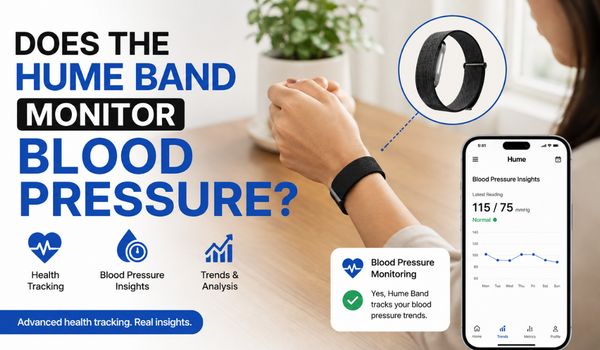
Hume describes the feature as a relative, PPG-based blood-pressure trend rather than a conventional blood-pressure measurement.
The company also clearly states that these insights are not a substitute for a blood pressure cuff and should not be used to diagnose or manage high blood pressure.
Blood pressure is one of the most important health measurements because high blood pressure can go unnoticed.
At the same time, wearable technology is advancing rapidly, and consumers understandably want the convenience of checking health information on a wrist-worn device.
What Is the Hume Band?
The Hume Band is a screenless wearable health tracker designed to be worn throughout the day and night.
Rather than focusing only on steps and exercise, the device tracks a range of physiological signals and presents them through the Hume Health app.
According to Hume, the current Band 2.0 tracks or provides insights related to heart rate, heart rate variability (HRV), blood oxygen (SpO2), skin temperature, sleep stages, activity, strain, recovery, and blood pressure trends, among other wellness metrics. The company says the Band can operate for up to 14 days on a charge.
The addition of blood-pressure insights is particularly interesting because traditional blood-pressure monitoring normally requires an inflatable cuff.
Instead of inflating a cuff around the arm and measuring pressure directly, it uses optical sensing technology to collect information about blood flow at the wrist.
Hume says the Band uses an optical PPG (photoplethysmography) signal. Its current sensor configuration includes five LEDs and four photodiodes.
This makes the technology convenient for continuous wear, but it also means users need to understand exactly what the resulting blood pressure readings represent.
Does the Hume Band Monitor Blood Pressure?
The Hume Band 2.0 currently provides blood pressure trend insights based on signals collected from the wrist.
Hume describes these as directional or relative patterns over time rather than a replacement for a cuff-based blood-pressure measurement.
| Hume Band | Traditional BP Monitor |
|---|---|
| Uses wrist-based optical signals | Usually uses an inflatable cuff |
| Designed for continuous wearable tracking | Usually measures at specific times |
| Provides blood-pressure trend insights | Provides a blood-pressure measurement |
| Useful for observing patterns | Used for clinical/home BP monitoring |
| Not a cuff replacement | Can be clinically validated |
| Not intended to diagnose hypertension | Can support diagnosis and management when properly used |
So, if someone asks, “Can the Hume Band tell me my blood pressure?”, the most accurate answer is:
It can provide blood pressure trend information, but you should not treat it as equivalent to a validated medical blood pressure cuff.
That difference is especially important if you have been diagnosed with hypertension, are taking blood-pressure medication, or need accurate readings for a medical decision.
How Does the Hume Band Estimate Blood-Pressure Trends?
To understand why the Hume Band’s feature is different from a standard blood-pressure monitor, it helps to understand PPG technology.
What Is PPG?
PPG stands for photoplethysmography.
It is an optical sensing technique used by many modern wearable devices. The basic concept is straightforward: LEDs emit light into the skin, and photodetectors measure changes in the amount of light reflected back to the sensor.
Hume explains that the Band’s optical sensor reads changes in blood flow and uses signal processing and models to turn those signals into various health insights.
A conventional cuff-based monitor temporarily restricts blood flow and uses pressure changes to estimate systolic and diastolic blood pressure.
A wearable without an inflatable cuff generally has to estimate blood pressure indirectly from physiological signals.
The American Heart Association explains that cuffless devices commonly use technologies such as PPG, pulse transit time, pulse arrival time, pulse-wave analysis, tonometry, and machine-learning approaches.
These devices often estimate changes relative to calibration rather than directly measuring blood pressure as a traditional cuff does.
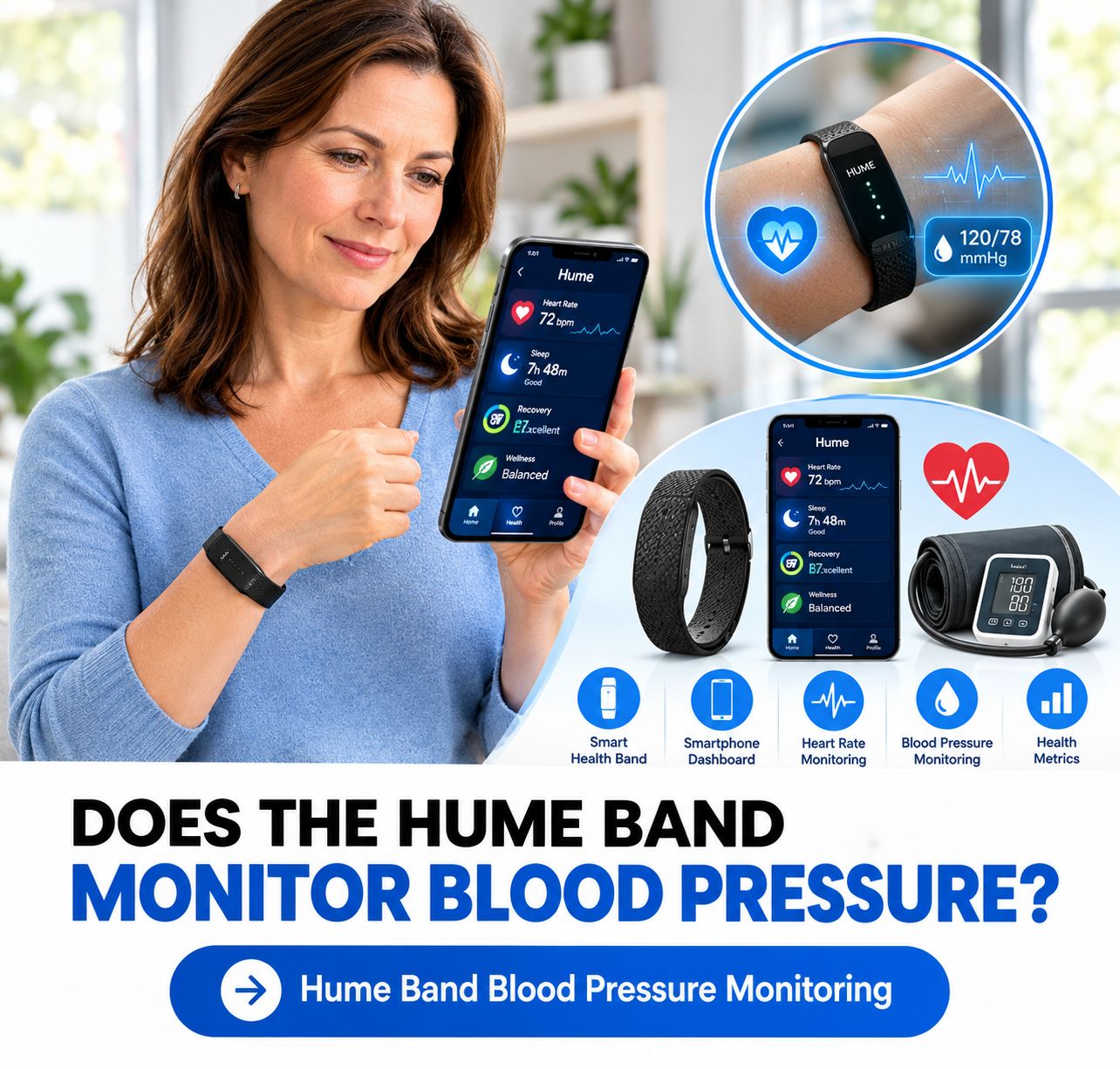
What Does “Blood-Pressure Trend” Mean?
Imagine that you use a traditional cuff to obtain one reading: 128/82 mmHg
That is a blood-pressure measurement at a particular moment. Now imagine a wearable that continuously collects physiological signals and looks for changes over days and weeks.
Instead of asking, Hume specifically describes its blood-pressure feature as a relative, PPG-based trend over time and emphasizes that it is directional rather than a cuff reading.
This can potentially make the feature useful for awareness and pattern recognition.
For example, a person may notice that their blood pressure trend changes during periods of poor sleep, increased stress, changes in activity, or other lifestyle changes.
However, a trend should not be confused with a diagnosis.
A wearable can help you notice when something appears to be changing, but determining whether someone has hypertension requires appropriate clinical assessment and accurate blood pressure measurements.
Why Is Blood-Pressure Monitoring Important?
Blood pressure measures the force of circulating blood against the walls of your arteries.
Diastolic blood pressure
The diastolic number is the pressure when the heart relaxes between beats. For example, a reading of 120/80 mmHg contains a systolic value of 120 and a diastolic value of 80.
Blood pressure naturally changes throughout the day. Physical activity, stress, sleep, caffeine, medications, illness, posture, and other factors can influence readings.
This is one reason repeated measurements can provide more useful information than a single reading.
The American Heart Association recommends home blood-pressure monitoring for people with high blood pressure and recommends an automatic, upper-arm cuff-style monitor that has been validated for accuracy.
Why Would Someone Want Blood-Pressure Trends From a Wearable?
Traditional blood-pressure monitoring requires sitting down, putting on a cuff, positioning the arm correctly, waiting for the measurement, and recording the result.
A wearable can remain on the wrist throughout the day. That creates the possibility of observing patterns that might otherwise be missed.
For example, a person may be interested in whether their health patterns change alongside:
- Sleep quality
- Physical activity
- Stress
- Recovery
- Resting heart rate
- HRV
- Blood oxygen
- Daily routines
- Changes in lifestyle
The Hume Band is designed around this broader picture rather than a single measurement. Hume says its blood-pressure insights can be viewed alongside other signals such as sleep, HRV, SpO2, activity, strain, and recovery.
Hume Band Blood Pressure vs. Traditional Monitoring
Let’s look at the two approaches in more practical terms.
Hume Band
The main advantage is convenience. You wear the Band and allow it to collect physiological data over time. The app can then present trend information.
This approach may be attractive to people who want a broader picture of their health and habits.
Traditional Upper-Arm Monitor
A validated upper-arm cuff is more appropriate when the objective is to obtain a clinically meaningful blood-pressure measurement at home.
The American Heart Association recommends automatic upper-arm cuff-style monitors and specifically says wrist and finger monitors are less reliable for routine home monitoring.
Therefore, these two technologies should not necessarily be viewed as competitors.
The Hume Band can provide wellness-oriented trend information. A validated cuff can provide the blood-pressure readings needed for medical monitoring.
Can You Use the Hume Band If You Have High Blood Pressure?
You may still use a Hume Band as a wellness and trend-tracking device, but you should not use its blood-pressure insights as a substitute for the monitoring plan provided by your healthcare professional.
If you have hypertension, your clinician may want you to record blood pressure readings at specific times and under specific conditions.
The American Heart Association advises people monitoring blood pressure at home to follow consistent measurement procedures, including resting quietly for at least five minutes.
Avoiding caffeine, smoking, and exercise for 30 minutes beforehand, sitting correctly, keeping the arm supported at heart level, and taking multiple readings when instructed.
The Hume Band can complement this routine by providing additional information about your overall health patterns.
Can the Hume Band Detect High Blood Pressure?
The Hume Band’s current materials describe blood-pressure trend insights, including examples of elevated patterns. But Hume also states that these insights are directional and are not intended as a diagnosis.
So it would be inaccurate to say: “The Hume Band diagnoses hypertension.”
A more accurate statement is: “The Hume Band can provide blood-pressure trend insights that may help users notice changes over time, but those insights should not be used to diagnose hypertension.”
If you repeatedly obtain elevated readings with a validated blood pressure cuff, that is a different matter and should be discussed with your healthcare professional.
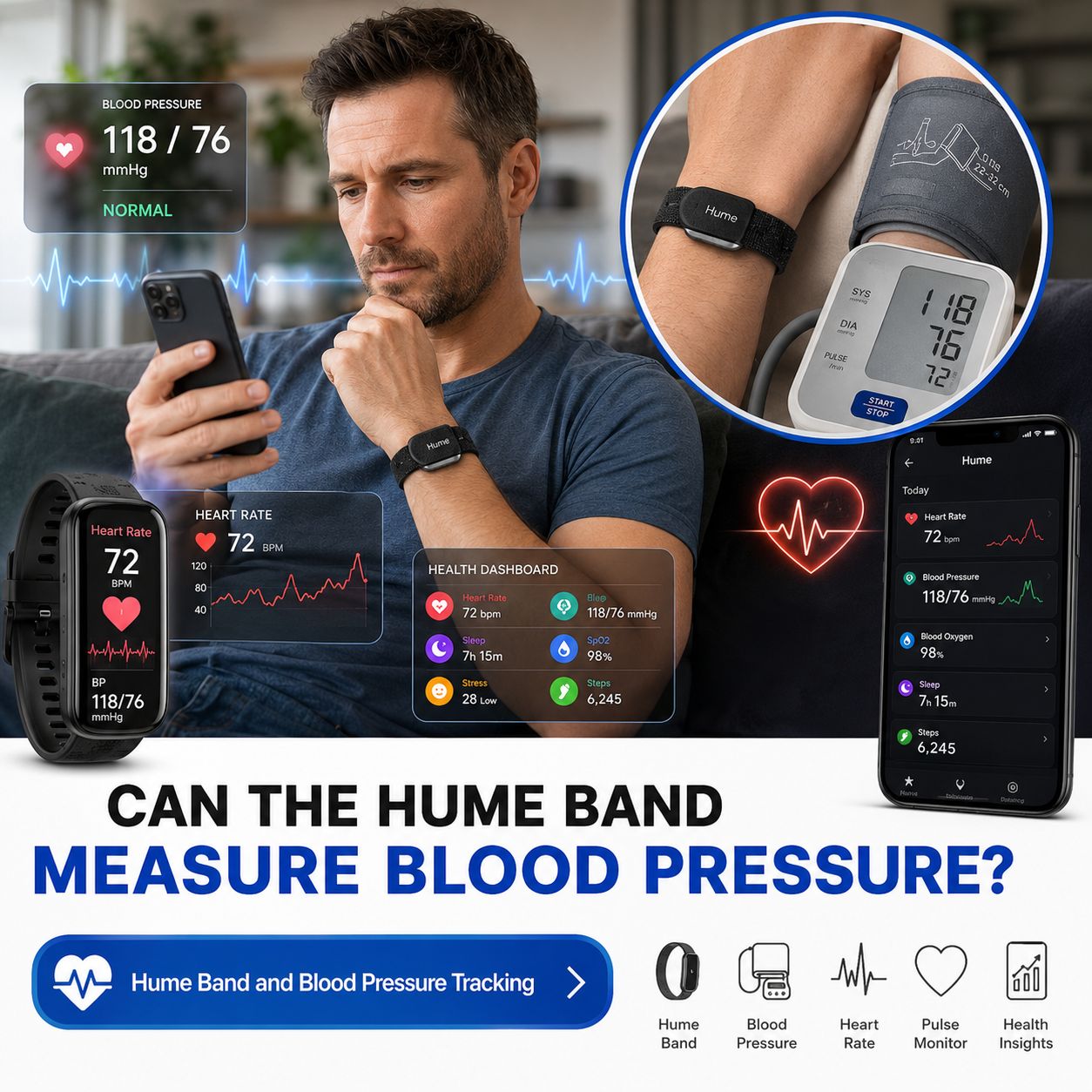
What Should You Do If Your Hume Band Shows an Elevated Trend?
First, don’t make a medical decision based solely on the wearable.
- Check your blood pressure with a validated monitor. Use an appropriate automatic upper-arm cuff and follow the manufacturer’s instructions.
- Make sure the cuff fits correctly. An incorrectly sized cuff can affect accuracy. The American Heart Association emphasizes choosing a cuff appropriate for your arm circumference.
- Rest before measuring. Avoid measuring immediately after exercise or other activities that can temporarily affect blood pressure.
- Take repeated readings. Your healthcare professional may recommend taking multiple readings and recording them.
- Look at the pattern; a single elevated result does not necessarily tell the whole story.
- Contact your healthcare professional when appropriate. If your readings remain elevated or you have concerns, discuss them with your doctor.
And if you ever experience symptoms or blood pressure readings that may indicate an emergency, seek appropriate urgent medical care rather than relying on a wearable.
How Reliable Are Wearable Blood-Pressure Devices Generally?
Cuffless blood-pressure technology is promising, but it is still an evolving field.
The technology can potentially provide measurements in situations where traditional cuffs are inconvenient.
Researchers are exploring whether wearables can eventually provide useful blood-pressure information during sleep, physical activity, and normal daily life.
The American Heart Association’s scientific statement notes that cuffless devices estimate blood pressure indirectly and that their performance can be affected by motion, sensor position, body posture, and other factors.
The statement also emphasizes the need for stronger evidence about real-world accuracy and clinical outcomes.
The FDA has also published draft guidance on the clinical performance testing and evaluation of cuffless, non-invasive blood-pressure-measuring devices.
The guidance reflects the growing regulatory interest in this technology and the need for appropriate clinical evaluation.
In other words, the technology is moving forward, but consumers should distinguish between innovation and clinical validation.
What Is PPG and Why Does It Matter?
Because the Hume Band’s blood-pressure insights are based on PPG-related signals, understanding PPG helps explain both the benefits and limitations.
- A PPG sensor uses light to detect changes in blood volume beneath the skin.
- The sensor contains light-emitting components and photodetectors.
- As blood volume changes with each heartbeat, the optical signal changes.
- Algorithms can analyze these patterns and extract information about cardiovascular physiology.
- This technology is already widely used for wearable measurements such as heart rate.
- The challenge is that blood pressure is influenced by many physiological variables.
Why Does the Hume Band Show Trends Instead of Simply Giving a BP Number?
The trend-based approach reflects the limitations of estimating blood pressure from wearable signals.
Suppose a wearable produces a number such as: 130/89
It might look exactly like a conventional blood-pressure measurement. But the number’s appearance does not automatically make it clinically equivalent to a cuff measurement.
Hume therefore emphasizes that its blood-pressure display represents a directional pattern, not a replacement for a cuff.
This is an important consumer-safety distinction. The practical value may come from noticing that a pattern changes over time rather than assuming that every displayed number is a definitive measurement.
Is a Traditional Blood-Pressure Monitor Still Necessary?
The American Heart Association recommends an automatic upper-arm cuff-style monitor that has been validated for accuracy.
The American Medical Association likewise recommends using validated devices for out-of-office blood-pressure measurement.
Its validation resources are designed to help consumers and clinicians identify devices that have undergone appropriate clinical accuracy assessment.
This means a sensible approach is: Hume Band + validated BP monitor
Rather than a BP monitor, use a Hume Band.
The first approach provides both wellness trends and clinically appropriate blood pressure measurements.
What Other Health Information Does the Hume Band Track?
Blood pressure is only one part of the Hume Band ecosystem.
According to Hume, the Band also tracks several other signals and wellness metrics, including:
- Heart rate
- Heart-rate variability
- Blood oxygen
- Skin temperature
- Sleep stages
- Sleep quality
- Activity
- Strain
- Recovery
- Blood-pressure trends
- Pace of Aging
- Metabolic-related insights
The company describes the Band as a longevity-oriented wearable rather than simply a traditional fitness tracker.
This broader approach can be useful for people interested in how their daily habits relate to changes in sleep, recovery, activity, and cardiovascular signals.
However, each metric should be interpreted in light of what the device actually measures and what has been clinically validated.
Is the Hume Band a Medical Device?
Hume’s current product information states that the Band is not a medical device and that its health metrics, including blood-pressure trends, are wellness insights and estimates rather than medical diagnoses.
That distinction should be kept in mind when evaluating the product. A wellness wearable can be useful for tracking patterns and encouraging healthy habits.
A medical device intended to measure blood pressure for clinical purposes has a different standard.
The FDA specifically warns consumers to be cautious about unauthorized wearable features that claim to measure or estimate blood pressure and recommends using an FDA-authorized device when accurate blood-pressure measurements are required.
Who Might Benefit From Hume’s Blood-Pressure Trend Feature?
The feature may be particularly interesting to people who want to:
- Observe long-term health patterns
- Track how lifestyle changes relate to wellness metrics
- Wear a health tracker continuously
- Monitor sleep and recovery alongside cardiovascular-related trends
- Reduce the need to manually track every wellness metric
- Have additional information to discuss with their healthcare provider
For example, someone may notice a change in their blood pressure trend at the same time they notice poorer sleep or increased stress.
That observation may encourage them to investigate further.
The important word is investigate.
The wearable can potentially raise a question. A validated blood pressure measurement and a professional medical evaluation can help answer it.
Who Should Not Rely on the Hume Band for Blood Pressure?
You should not rely solely on the Hume Band if you need blood-pressure readings for:
- Diagnosing hypertension
- Managing hypertension
- Adjusting medication
- Confirming whether the treatment is working
- Making urgent medical decisions
- Replacing a clinician-recommended home-monitoring routine
The 2025 hypertension guideline specifically advises against using cuffless BP devices for diagnosis or management of high blood pressure in adults.
If your healthcare provider has asked you to monitor your blood pressure, follow that plan
The Bottom Line
Yes, the Hume Band 2.0 provides blood-pressure trend insights. But it does not function as a conventional blood-pressure cuff, and Hume does not position these insights as a replacement for a validated blood-pressure monitor.
The distinction between monitoring a trend and measuring blood pressure for medical purposes is crucial.
The Hume Band uses optical PPG-based sensing and algorithms to identify patterns in cardiovascular-related signals.
This can make it convenient for observing changes over time while wearing the device during everyday activities and sleep.
If you need to know your actual blood pressure for diagnosis, treatment, or medication management, a validated upper-arm cuff remains the safer choice.
The best way to think about the Hume Band is as another source of health and wellness information, not a replacement for medical blood-pressure monitoring.
Used in that context, its blood-pressure trend feature may help users become more aware of changes in their health patterns and provide useful information to discuss with a healthcare professional.
And that is ultimately where wearable technology can be most valuable: not replacing medical care, but helping people pay closer attention to their health and recognize when a conversation with a healthcare professional may be worthwhile.
.
.
.